

C2 Word Formation Exercises
The main purpose of this post is to share some C2 Word Formation exercises. It’s worth reading my post on how to ace the C2 Use of English section of the Reading and Use of English paper as I offer advice about how to tackle word formation tasks there.
All about the C2 Proficiency Word Formation Task
Part 3 of the C2 Proficiency Reading and Use of English paper is a Word Formation, or word-building, task.
You will be presented with a text comprising eight numbered gaps. Each gap corresponds to a word. The stems of the missing words are provided beside the text and you have to change them to form the missing word.
Candidates should read the text and complete the EIGHT numbered gaps with a form of the word in capitals at the end of the line. This word at the end of the line is known as, among other terms, a stem word. There is an example at the beginning of the text.
This example reveals how the stem word effect should be changed to its adjectival form - effective:

The main focus of the Word Formation task is on vocabulary, especially the use of affixation (e.g. honesty to dishonesty or person to impersonal), internal changes (e.g. strong to strengthened and compounding (e.g. set to outset or rain to raindrop). It is possible to make any number of changes to the stem word (e.g. forming undoubtedly from the stem word doubt amounts to three changes).
You will be awarded ONE mark for each correct answer. Each word must be correctly spelt.
Sample C2 Word Formation exercises
I would now like to share four C2 Word Formation exercises.
Under each exercise you will find hints as to how to identify the correct word forms. The answers are under the tips.
Exercise 1:
This exercise comes from a Sample Test, published by Cambridge English in 2015.
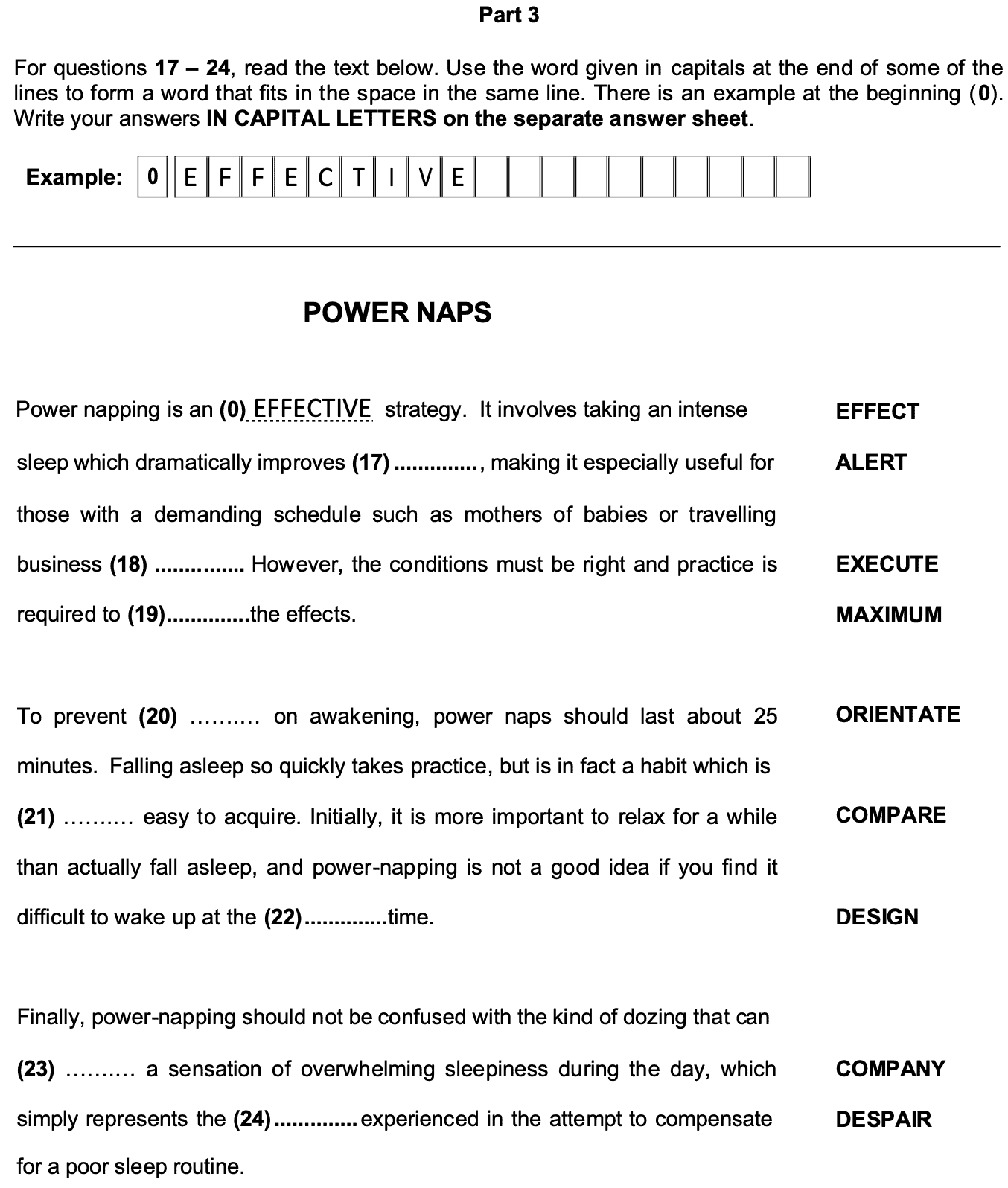
Source: Cambridge English Level 3 Certificate in ESOL International, Sample Test 1
Hints:
(17) The verb (improve) precedes nouns, e.g. improve efficiency, improve performance and improve my English.
(18) You should deduce that a compound noun representing a group of people is required. The group of people - mothers of babies - appears before the word or. Therefore, it is logical that we need another group of people after the word or.
(19) to + infinitive.
(20) The word ‘prevent’ suggests that a negative noun should follow. After all, one usually seeks to prevent negative occurrences/states.
(21) adverb + adjective combination
(22) adjective + noun combination
(23) can + base form of another verb. You need to add two letters before the word company - a common prefix before the letter ‘c’
(24) The article the suggests that a noun should follow
Answers:
(17) alertness
(18) executives
(19) maximise / maximize
(20) disorientation
(21) comparatively
(22) designated
(23) accompany
(24) desperation
Exercise 2:
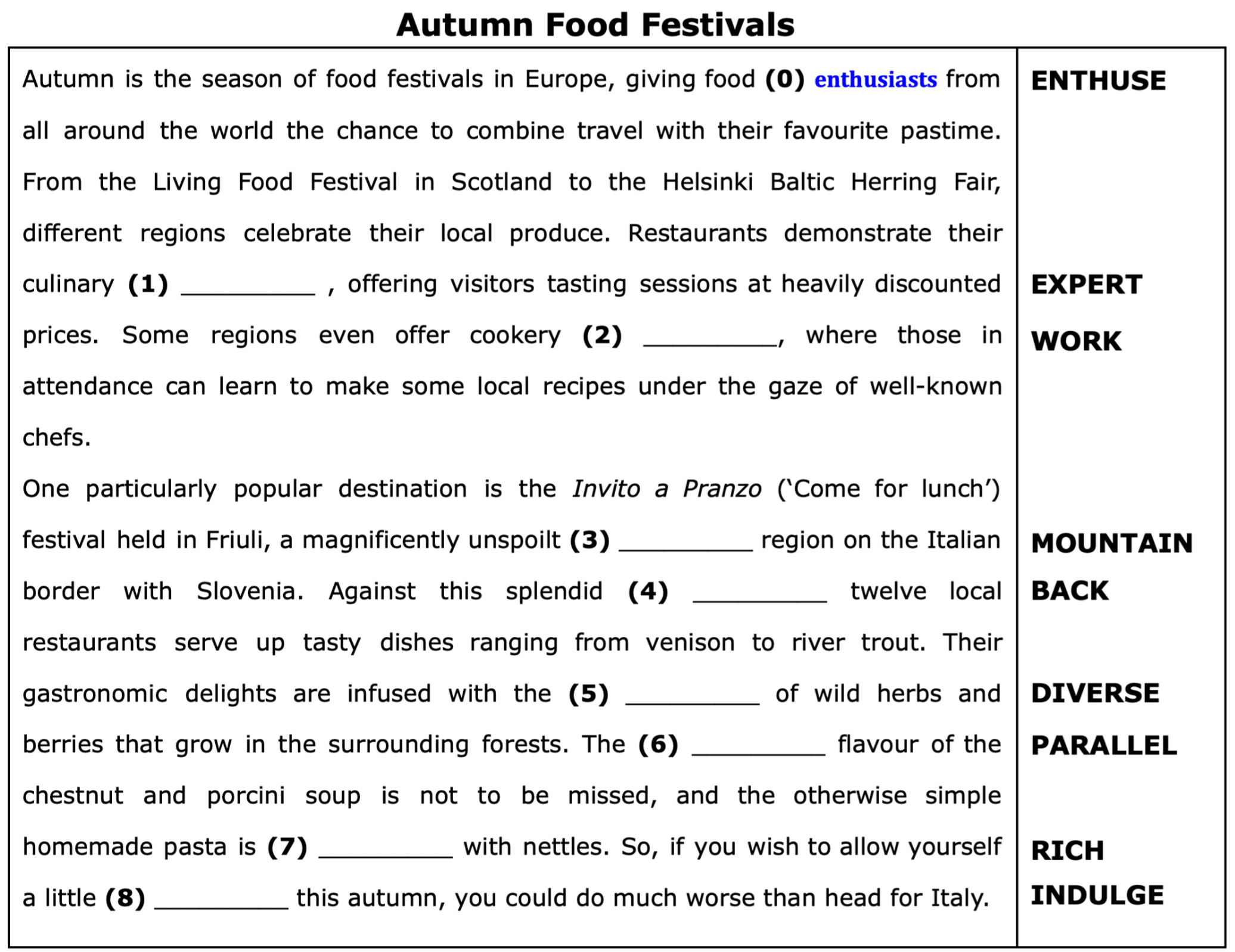
Source: Adapted from a text found in Expert Proficiency, p.99
Tips:
(1) adjective (culinary) + noun combination. Which suffix can be added to expert?
(2) Cookery is a noun which functions as an adjective. The main noun in the gap is in the form a compound noun.
(3) adverb + adjective + noun combination. What suffix can you add to mountain?
(4) A choice of two compound nouns. Add another word to back to make one word
(5) We need a noun between the ___ of. Drop the letter ‘e’. What is a common suffix after the letter ‘s’?
(6) adjective + noun combination, meaning ‘exceptional’ or ‘having no equal’ (there’s never been anything like it).
(7) A passive form of a verb is needed with the meaning of ‘improve the quality of by adding something else’.
(8) The quantifier ‘a little’ should be followed by a noun. The suffix of this abstract noun is a common one for verbs which end in the letter ‘e’.
Answers:
(1) expertise
(2) workshops
(3) mountainous
(4) backdrop/background
(5) diversity
(6) unparalleled
(7) enriched
(8) indulgence
Exercise 3:
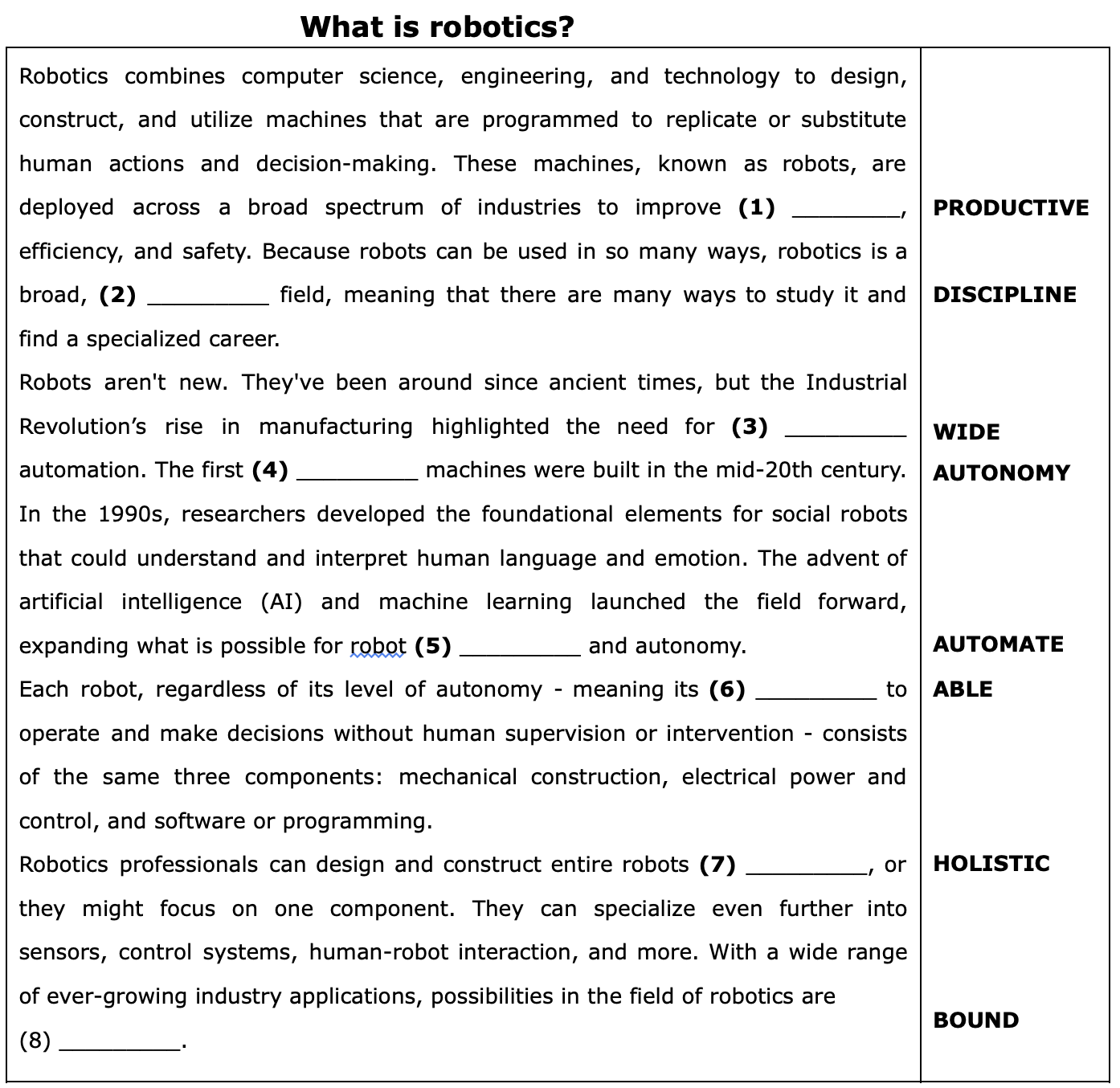
Tips:
(1) Looking at the form of the words efficiency and safety which follow the gap, it’s clear that another noun should be formed from productive. What is a common suffix for nouns whose adjectival form ends in -ive?
(2) We need an adjective meaning ‘relating to more than one branch of knowledge’.
(3) An adjective is required meaning ‘found or distributed over a large area or number of people’.
(4) A common three letter suffix can be added after the letter ‘m’ for the adjectival form of nouns ending with -my.
(5) A common three letter suffix can be added after the letter ‘t’ for the noun form of verbs ending with -te.
(6) Which suffix forms abstract nouns, often from adjectives ending in ‘-le’?
(7) The verb (construct) and object (robots) are already in place. This suggests that an adverb must be formed from the base word to describe how robotics professionals go about their business. Which suffix is used to form adverbs from adjectives ending “-ic”?
(8) An adjective meaning ‘unlimited’ or ‘infinitive’ is required.
Answers:
1. productivity
2. interdisciplinary
3. widespread
4. autonomous
5. automation
6. ability
7. holistically
8. boundless
Exercise 4:
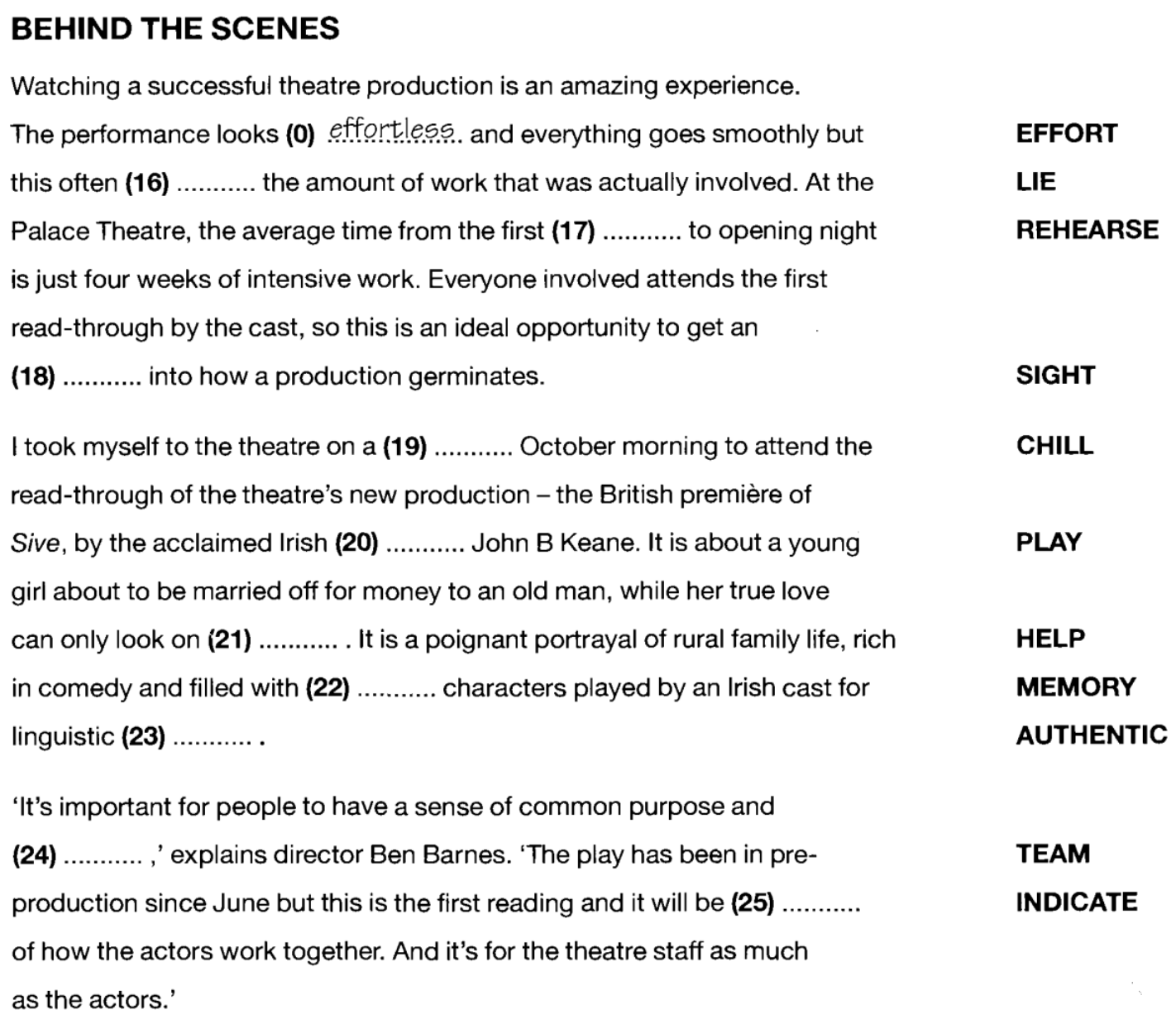
Tips:
(16) Verb meaning ‘to give a false impression of’.
(17) Noun required. Which suffix could follow the letter ‘s’?
(18) Which prefix can be added to sight to give a noun meaning ‘a clear, deep, and sometimes sudden understanding of a complicated problem’?
(19) An adjective is required.
(20) What do we call a person who writes plays?
(21) An adverb is required to modify the phrasal verb look on. You need to form an adjective from the word help before forming an adverb.
(22) Which suffix often follows the letter ‘r’ to form adjectives?
(23) We need a noun. Which suffix could follow authentic?
(24) It’s important to look at the word before ‘and’. Purpose is a noun. This suggests that another noun should follow ‘and’.
(25) Quite a few multisyllabic verbs ending with -ate have an adjectival form which ends with the same suffix after the letter ‘t’.
Answers:
(16) belies
(17) rehearsal
(18) insight
(19) chilly
(20) playwright
(21) helplessly
(22) memorable
(23) authenticity
(24) teamwork
(25) indicative
Gaining full marks on the C2 Word Formation Task
The purpose of sharing the C2 word formation exercises above is to give you a broad flavour of the kinds of word-building you would have to undertake during the exam proper. For example, we have instances of forming adjectives from stem words which are both verbs and nouns. There are also cases in the four exercises where you have to add another word to the stem word to form a compound noun.
During my journey to becoming an English proficiency teacher/C2 exam specialist, I completed dozens of word formation exercises. The best piece of advice I can give you is to read the whole text before attempting to fill in any gaps. Some answers may jump out at you and you’d be right to go with your initial hunch. However, careful reading beyond sentence level may be required for other answers.
If you would like to go through some more word-building exercises with me or are interested in enrolling on my four-month C2 Proficiency exam preparation course, hit the contact form below