
Why Learning with a British Native Speaker Online is Your Ultimate Language Shortcut
If you want to move past "surviving" in English and start truly thriving, finding a British native speaker online is the single best investment you can make.
Let’s face it: you can spend years memorising vocabulary lists and conjugating verbs on language apps, but the moment you step off the plane at Heathrow, reality strikes. Real English doesn’t sound like a textbook. It’s rapid due to connected speech, it’s full of idioms, and it’s deeply bound up with culture.
This post delves into why this learning model is a total game-changer for fluency.
The Power of Real-World Authenticity a British Native Speaker Tutor can offer you
When you study with an English language tutor from Great Britain, you aren't just learning words and collocations; you are learning how all that vocabulary is actually deployed in daily life. Let’s have a look at what a British native English teacher can offer you:
(a) Master intonation, word stress, sentence stress and multiple letter sequences notorious for their unpredictable pronunciation
British English has a distinct rhythm. A British English tutor can help you nail the subtle glottal stops, the soft 'r' sounds, and the rising and falling intonations that make you sound natural.
Here on English Coach Online, I’ve explored topics as diverse as English word stress rules, the varied pronunciation of words ending in -ough and the intonation of yes-no questions.
Non-native speaker teachers would have to be exceptionally proficient in English to be able to model the many intricacies of English stress and intonation patterns.
(b) Instruction on connected speech
Connected speech is at the very heart of my British English Pronunciation Course.
Essentially, connected speech describes the way spoken words morph, blend, and link together when we talk at a natural, fluid pace. The mouths of proficient speakers of English, especially native speakers, seek physical shortcuts to conserve energy. When the end of one word bumps into the beginning of the next, it causes the sounds to change entirely.
There are various kinds of connected speech. One of the most common is catenation. This is when the final consonant sound of one word seamlessly joins with the vowel sound at the beginning of the next word. For example, “turn off” rather sounds like “tur-noff”.
(c) The schwa sound
The most common vowel sound in English is known as schwa. Represented by the phonetic symbol /ə/, the schwa is a short, neutral and unstressed “uh” sound. It requires almost no effort to produce so it is therefore described as the “laziest” sound in the English language.
British English generally uses the schwa more heavily than American English. Any savvy British native speaker online would model how British English collapses unstressed syllables or function words (the, for, to) and articles (a, the) into schwas at a much higher rate. Swallowing all these short function words and articles helps to speed up speech. Overall, schwa is one of the main reasons why native speakers of English appear to be so ‘fluent’.
Check out BBC Learning English for more information and exercises.
(d) Context is key in the world of collocations
To my mind, the study of collocations is another crucial factor when it comes to attaining fluency in English.
According to Michael Lewis (2008, p.8):
Collocation is the readily observable phenomenon whereby certain words co-occur in natural text with greater than random frequency.
Lewis continues (ibid.):
Collocations range on a spectrum from fully fixed (a broken home, to catch a cold), through relatively fixed, to totally novel.
You should easily recognise which is the more common in each of these pairs:
(a) chase/miss the bus = miss the bus
(b) make/do a mistake = make a mistake
(c) slump dramatically/gracefully = slump dramatically
‘Good language teachers should take collocations seriously.’ That’s the title of an article by Micheal McCarthy, Professor of Applied Linguistics and author of countless books on grammar and vocabulary over the years.
According to McCarthy:
… research suggests that natural use of collocation is a distinguishing feature when native-speaker texts are compared with texts written by expert users or near-native speakers. So, we can say that acquiring collocations is an integral part of acquiring proficiency in the target language.
Your chosen British native speaker online will have an intuitive, subconscious knowledge of collocations. Related to this point, language is undeniably cultural. A native speaker can explain why certain collocations and phrases are used in specific contexts, potentially helping you to steer clear of awkward social blunders.
(e) Light-hearted, interactive exercises which explore British etiquette and its associated stereotypes
Since the turn of 2026, I’ve been designing interactive lessons on the collaborative design platform, Figma.
Several of my lesson plans, such as ‘Cultural Differences in Etiquette’, ‘Humour across Cultures’ and ‘That’s the way the British do it’ have touched upon aspects of British etiquette. It’s been a lot of fun discussing stereotypes surrounding British manners.
Anyway, here's a sample of some of the light-hearted, interactive exercises I have designed to help students decode and practice the subtle art of being British:
Stereotypes about British manners
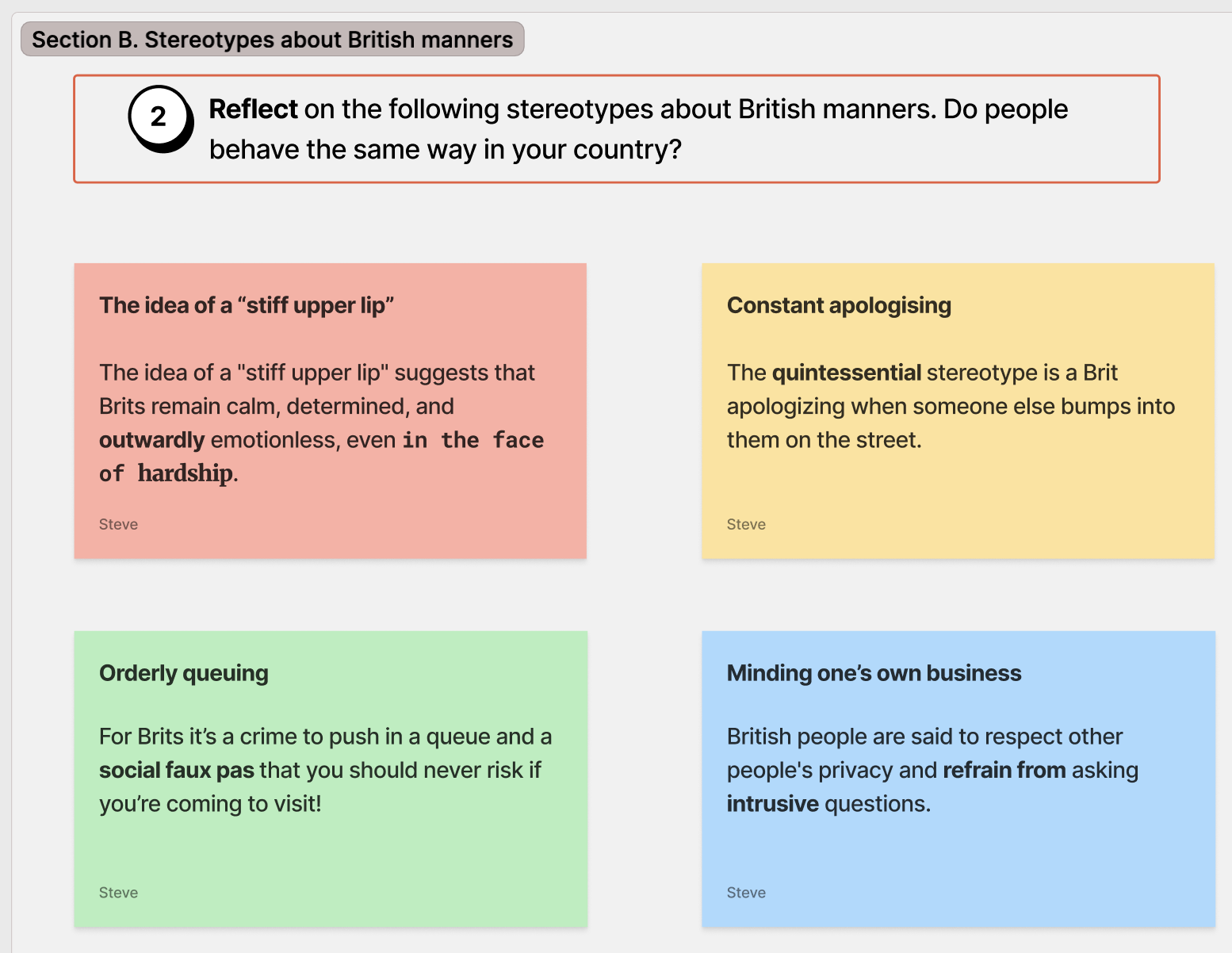
In this discussion-based exercise, students analyse common stereotypes about British manners and compare them to behavioral norms in their own cultures. Students also pick up some vocabulary and chunks, including intrusive, refrain from and in the face of.
The Complaining Game - Using peak British Politeness
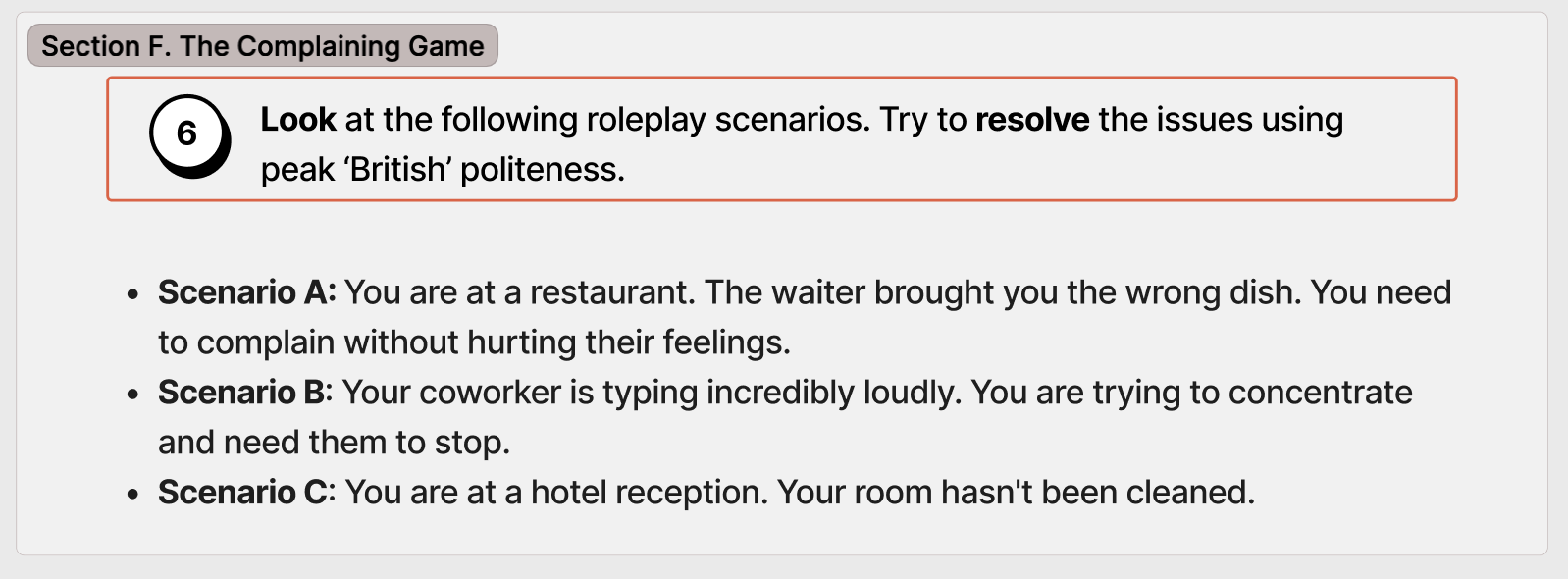
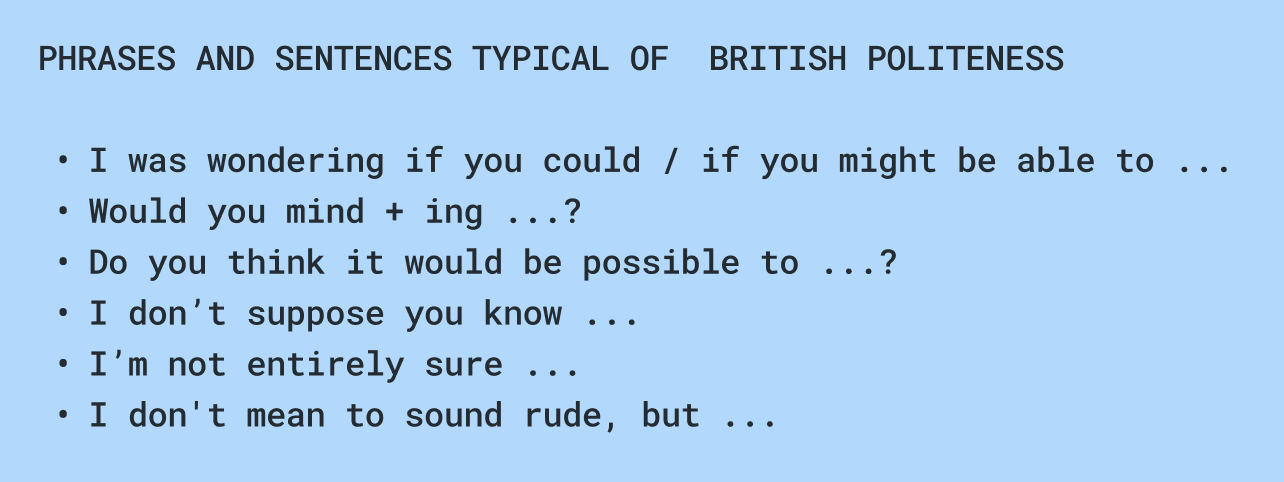
In the roleplay scenarios above, students have to try to resolve the issues using exaggerated ‘British’ politeness. They may make use some of the phrases and sentences below to express their minor grievances:
Trigger’s absurd statements comically delivered with a straight face
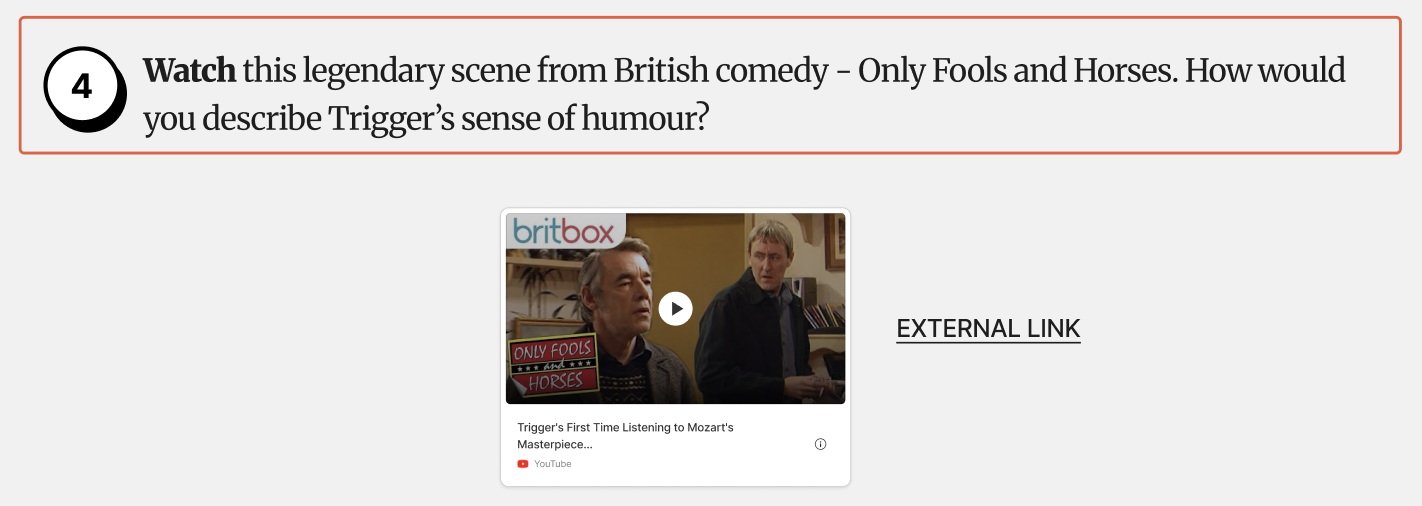
To add a bit of spice to my lesson ‘Humour across Cultures’, I included a scene from the British television sitcom, Only Fools and Horses.
One of the show’s main supporting characters, at least in the early years, was Trigger, played by Roger Lloyd-Pack.
In the scene below, Trigger delivers several absurd statements with a straight face, oblivious to the fact that he’s said something ridiculous:
Exchange 1:
Rodney: So um - what you doing here Trig?
Trigger: Well Del said he’d give me a lift to the pub.
Rodney: Oh right . . . But you live closer to the pub than us?
Trigger: I know.
Rodney: In fact, you have to walk past the pub to get to this flat.
Trigger: Yeah, but Del said he’d give me a lift.
Rodney: Right.
Exchange 2:
Trigger: You put a bit of music on Dave.
Rodney: Yes. Mozart’s Symphony number 38 in D Major. I find it helps me unwind, you know - eases my executive stress.
Trigger: Ain’t there no words to this Dave?
Rodney: No there’s no words Trig - no. It’s sort of instrumental.
Exchange 3:
Del: What’s this?
Trigger: It’s Mozart’s Symphony number 38 in D Major … It’s the karaoke version.
It may be the case that this scene is not that linguistically taxing. However, it is, nevertheless, culturally eye-opening as it illuminates just how absurd and confusing British humour can be.
Trigger was the master of delivering extremely absurd statements with a straight face. The beauty of the character was that he was completely unaware that he had said something ridiculous, such was the different wavelength he operated on compared with the rest of the characters.
What I have just described is a type of humour called deadpan humour, also known as dry humour.
Final Thoughts
As I wrote about in my post on choosing a good online English tutor, it’s vital that your British native speaker online has extensive knowledge of language learning strategies and what it actually entails to attain spoken competency in English.
The entire purpose of my English fluency course is to help students’ get rid of unnecessary mental clutter that grammar-based coursebooks and grammatical syllabus impose upon them.
I focus on helping my learners to overcome the intermediate plateau by encouraging them to have short but REGULAR classes with me. These classes tend to be conversation-oriented. In terms of language work, I encourage my students to create personalised sentences containing high-frequency collocations and lexical chunks they meet in the articles I ask them to read before each class. By ‘personalised sentences’, I mean true sentences about one’s current life circumstances, life experiences, hobbies and opinions on controversial matters. The idea is - with regular repetition and rereading of these personalised sentences, you can prepare for all future conversations in a second language as whole sentences, or at least parts of sentences, will be running around your mind just waiting to be said. All sentences can be added to a Word-Phrase Table.
Reference
Lewis, M. (2008). Implementing the Lexical Approach: Putting Theory into Practice, Andover, UK: Heinle
Offer
Enrol on the course of your choice (discount available if you enrol before 30 September 2026):