Open cloze C2 Proficiency task
This post on the open cloze C2 Proficiency task in the Reading and Use of English paper serves as a more detailed walkthrough than the information and advice I shared in my post which provides tips for acing all four parts of the Use of English section.
In this post, I go into the common parts of speech that are often tested in part 2 of the C2 Reading and Use of English paper. I also devote significant attention to the type of grammatical inversion patterns and negative adverbs tested in the open cloze task. Before sharing some practice C2 open cloze tasks, I outline the perfect three-step in-exam execution strategy worth adopting to prevent you from guessing blindly and maximise your chances of getting 8 marks out of 8.
C2 Proficiency Open cloze task - Everything you need to know
The C2 Reading and Use of English paper consists of seven parts. Parts 1-4 focus on Use of English, in other words vocabulary, grammar, collocations, and lexical chunks. Parts 5-7 focus on reading skills. Part 2 is the open cloze task.
The open cloze C2 Proficiency task comprises a modified cloze text of roughly 150-200 words with eight gaps. The gaps are numbered 9-16. There is also an example marked ‘0’ followed by the correct word.
Candidates have to fill each gap by using their knowledge of the structure of English and ability to comprehend the overall context of the text.
Never forget that a SINGLE WORD is required to fill each gap. Don’t be tempted to put a contraction (e.g. don’t or isn’t) or a phrase. You should write/type your answers IN CAPITAL LETTERS. Pay heed to spelling as you can lose marks for careless mistakes.
Don't panic if you come across a gap where you are certain two different single words could both grammatically fit (for example, sometimes which or that can be interchangeable). Cambridge English includes an "acceptable alternatives" list in their marking keys. Just pick the word you are most confident in and write it clearly on your answer sheet.
One mark is awarded for each correct answer.
How long should candidates spend on part 2 of the C2 Reading and Use of English paper?
I recommend that candidates spend no longer than FIVE minutes on part 2 of the C2 Reading and Use of English Paper.
Exceptional candidates should be able to complete this task in around four minutes.
An example of an open cloze C2 Proficiency task
Directions: Read the text below and think of the word which best fits each gap. Use only one word in each gap. There is an example at the beginning (0). Write your answers IN CAPITAL LETTERS on the separate answer sheet.
Example: (0) AS
The Evolution of the Book
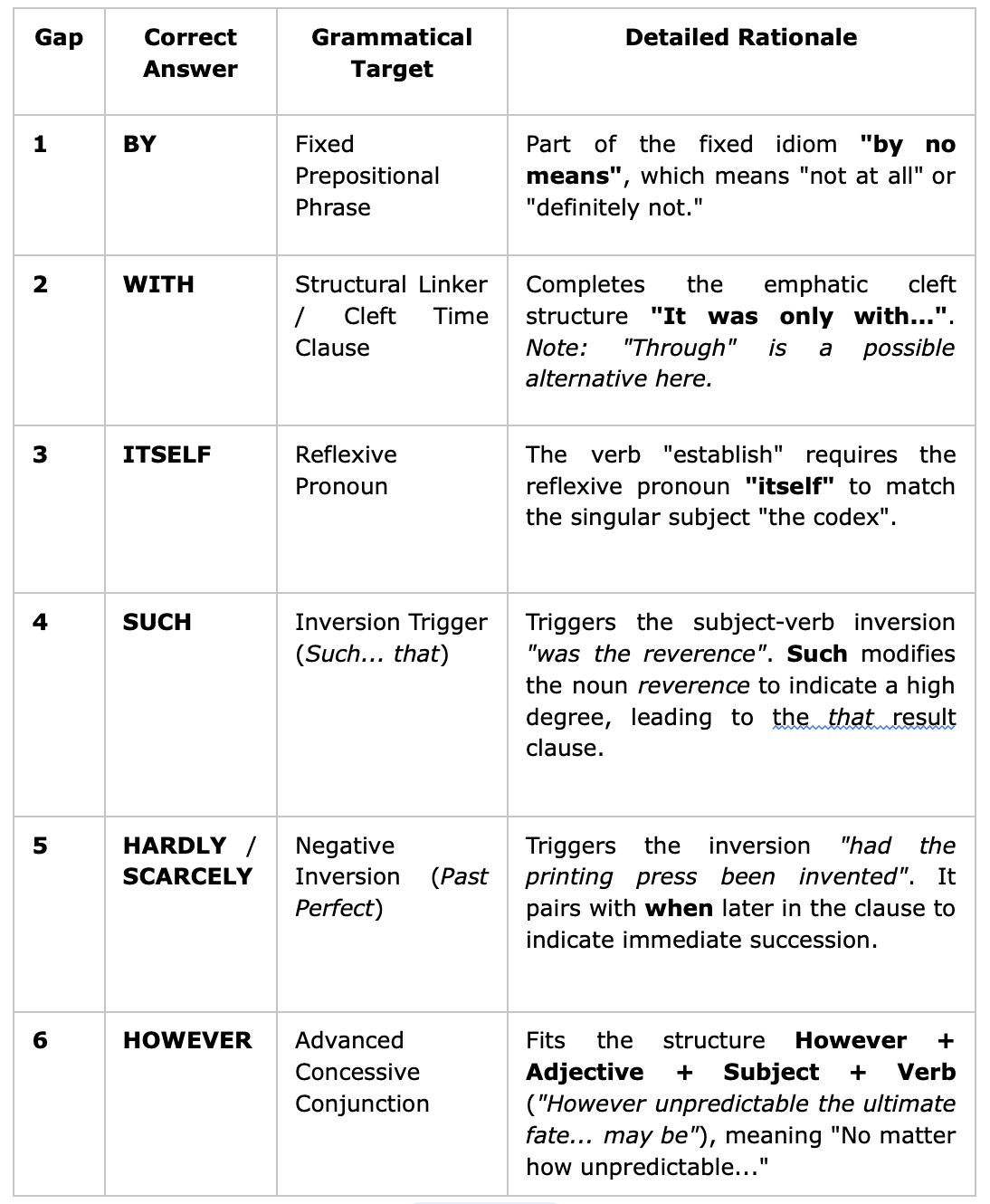
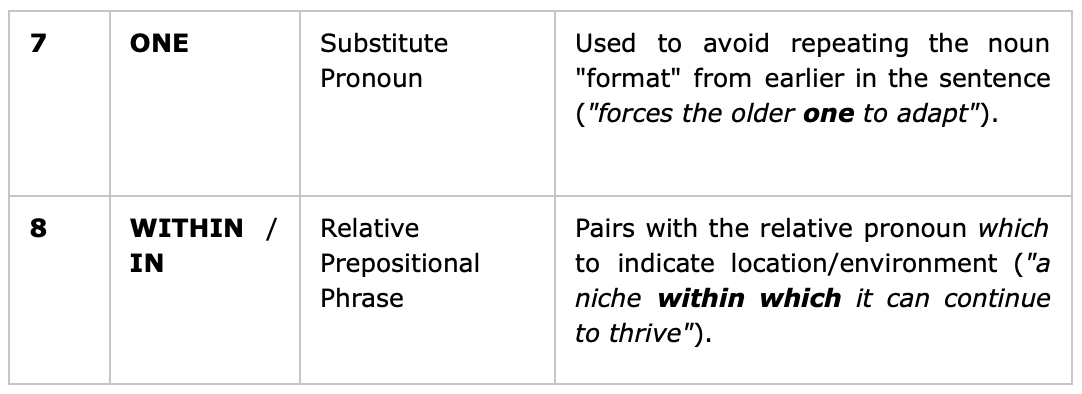
The history of the written word is a story of continuous technological adaptation. For centuries, the codex - the physical format of bound pages we recognize (0) AS a book today - held undisputed sway over literary culture. Yet, this stability was (1) ____________ no means guaranteed at its inception. In the ancient world, the scroll was the format of choice, and early adopters of the bound book were met with considerable skepticism. It was only (2) ____________ the emergence of a widespread monastic tradition that the codex fully established (3) ____________ as the primary vehicle for preserving knowledge.
The transition, however, was far from immediate. (4) ____________ was the reverence for traditional scrolls that early codices often mimicked their visual layout, dividing texts into narrow columns that served little practical purpose in the new format. (5) ____________ had the printing press been invented when critics began predicting the demise of hand-copied manuscripts, lamenting the loss of the personal touch that scribes brought to the page.
Today, a similar anxiety surrounds the digital shift. Content creators often design ebooks to replicate the look and feel of paper, complete with artificial page-turning sound effects. (6) ____________ unpredictable the ultimate fate of the physical book may be, history suggests that old and new mediums usually find a way to coexist. Rather than completely replacing what came before, a new format merely forces the older (7) ____________ to adapt, carving out a specialized niche (8) ____________ which it can continue to thrive.
What does the open cloze task test?
The open cloze task of the Use of English section generally tests a candidate’s awareness and control of grammar. However, the focus of the gapped words may also be lexico-grammatical, in other words areas which may be considered part-grammar and part-vocabulary. Examples of lexico-grammatical groups include linking words and phrases, words within fixed phrases, parts of phrasal verbs, and verb, adjective and noun complementation (e.g. prepositions used after these).
As the gapped words tend to be grammatical in nature, they are usually short and high-frequency ones, such as prepositions (in, on). However, these ‘simple’ words will be placed within a relatively complex setting rather than assuming the role of simple spatial prepositions.
What common parts of speech are often tested in part 2 of the C2 Reading and Use of English paper?
Here’s a more definitive, though not exhaustive, breakdown of the parts of speech that are often gapped:
- Dependent prepositions (which closely follow nouns, adjectives and verbs) / prepositional phrases - without, result in, regardless of, except for, apart from, out of order, susceptible to, coincide with, on the move
- Subordinating conjunctions - although, while, unless, until, in order to, provided
- Multi-word conjunctions - in order that, as long as, so as to, provided that
- Relative pronouns - who, which, whose (frequently paired with prepositions at C2 level, e.g. by which)
- Reciprocal pronouns - each other, one another
- Reflexive pronouns - itself, themselves
- Linkers - moreover, let alone, far from, regardless of
- Quantifiers - much, many, few, little, any
- “It” and “There” clefting - a grammatical technique that splits a single sentence into two parts to emphasize a specific piece of information = It was David’s car that got broken into / Should there be any doubt …
- Inversion elements - Auxiliary verbs placed before the subject following restrictive or negative adverbs (e.g., Hardly had the match begun when ... or Rarely do we see ...)
- Aspect and voice auxiliaries - Been, being, have, has, had, or was to complete perfect, continuous, or passive aspects
- Phrasal verb particles - set someone apart, bring about, turn up
- Fixed phrases - by no means, in the region of, when it comes to, to such an extent, as a rule
- Idioms/collocations - (it) goes without saying, (in) one way or another, on the horizon, kill time, take place
What are the most common grammatical inversion patterns and negative adverbs tested in the Open Cloze C2 task?
In part 2 of the C2 Reading and Use of English paper, grammatical inversion is commonly tested as it instantly separates native-like syntactic control from intermediate fluency.
Cambridge English typically tests this by gapping either the restrictive/negative adverb at the beginning of the sentence or the auxiliary verb required to trigger the subject-verb inversion.
1. Negative and Restrictive Adverbs
These patterns require the formula:
[Negative Adverb] + [Auxiliary Verb] + [Subject] + [Main Verb]
In Part 2, the gap tends to be the adverb itself or the auxiliary verb (especially do/does/did or had).
(a) Seldom / Rarely / Scarcely / Hardly
Pattern: Often paired with the past perfect aspect to indicate rapid sequential actions.
Example: Hardly / Scarcely had the new policy been implemented when public backlash forced a rewrite.
Part 2 Gap: Often gaps Hardly or had.
(b) Little
Pattern: Used with verbs of cognition or awareness (know, realize, suspect, imagine) to show total unawareness.
Example: Little did the researchers know that their breakthrough would change medicine forever.
Part 2 Gap: Often gaps Little or did.
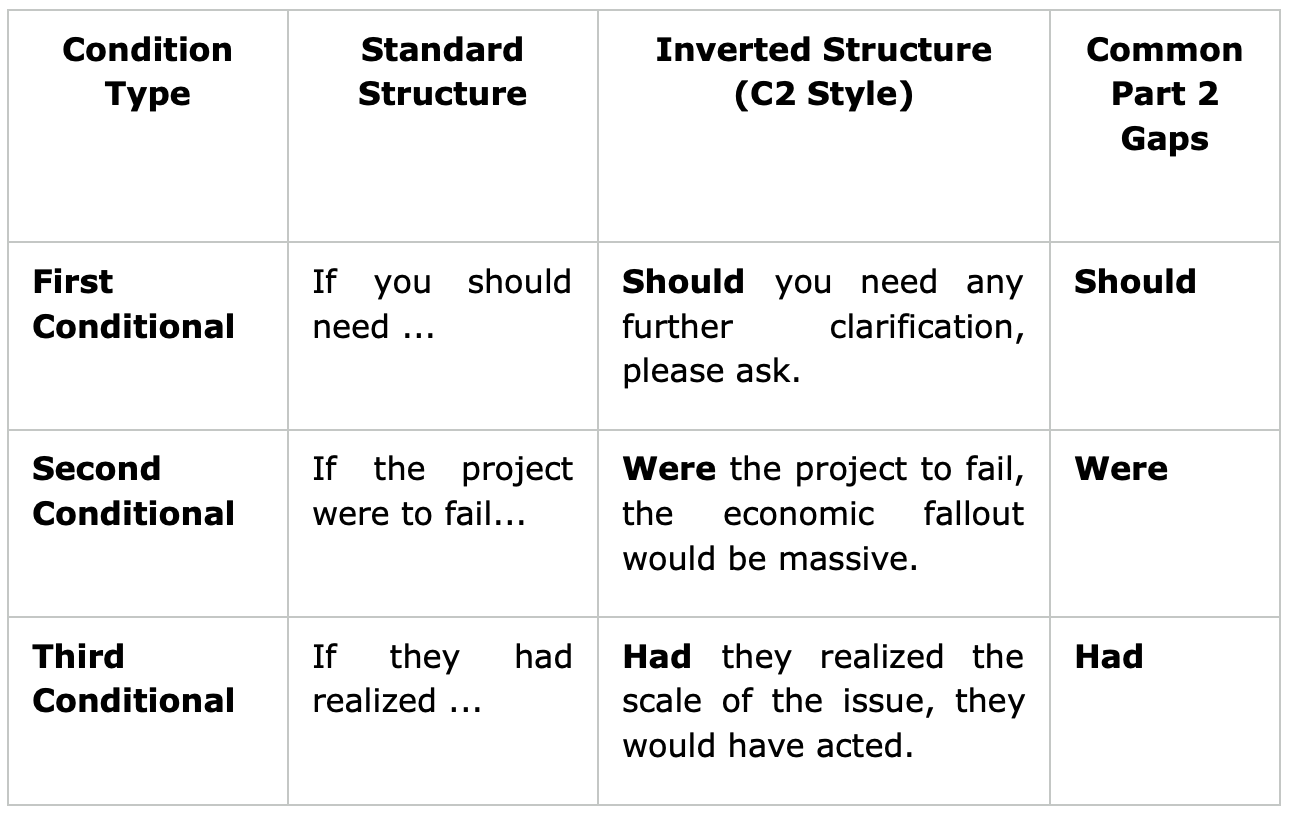
2. Conditional Inversion (Omitting "If")
C2 texts often exclude the word “if” in conditional clauses, opting instead to shift the auxiliary verb to the front:
3. "Not Only... But Also" Variations
While standard not only is tested, C2 examiners prefer more sophisticated or slightly obscured variations of this correlative conjunction:
Not only ...
Example: Not only did the study disprove the old theory, but it also laid the groundwork for a new discipline.
Part 2 Gap: Frequently gaps the initial Not.
Not until ...
Crucial Trap: The inversion occurs in the main clause, not the time clause.
Example: Not until the final data set arrived did the team realise the error.
Part 2 Gap: Often gaps until or the auxiliary did.
4. Under No Circumstances / On No Account
These fixed idiomatic phrases act as negative adverbials and mandate inversion at the start of an emphatic clause.
Structures:
Under no circumstances should this valve be opened.
On no account are candidates permitted to leave early.
In no way does this compromise the integrity of the data.
Part 2 Gap: You may have to gap the initial prepositions (Under, On) or the determiner (no). The key here is to recognise the inverted verb phrase later in the sentence to figure out the negative trigger.
5. "So" and "Such" Inversion
Used for emphatic descriptions, where an adjective or intensive phrase is shifted to the very front of the sentence.
So + Adjective:
Example: So profound was the impact of the speech that it silenced the entire auditorium.
Part 2 Gap: Typically gaps So.
Such + Be (meaning "so great"):
Example: Such was the complexity of the puzzle that even experts were baffled.
Part 2 Gap: Typically gaps Such.
Exam Day Mindset
When reading a open cloze C2 part 2 text, if you notice an auxiliary verb sitting directly before a subject noun phrase (e.g., "...was the scale of ..." or "... did they know ..."), your brain should instantly flag an inversion pattern. Scan backward to the front of the clause - the missing word is almost certainly the negative or restrictive element driving that structure.
_____
Here is a custom-designed, C2-level Open Cloze text. It is calibrated to match the exact density, tone, and lexico-grammatical traps typical of the C2 Proficiency Examination, heavily featuring the inversion patterns and structural linkers just discussed:
Directions: Read the text below and think of the word which best fits each gap. Use only one word in each gap. There is an example at the beginning (0).
The Architecture of Genius
Example: (0) RARELY
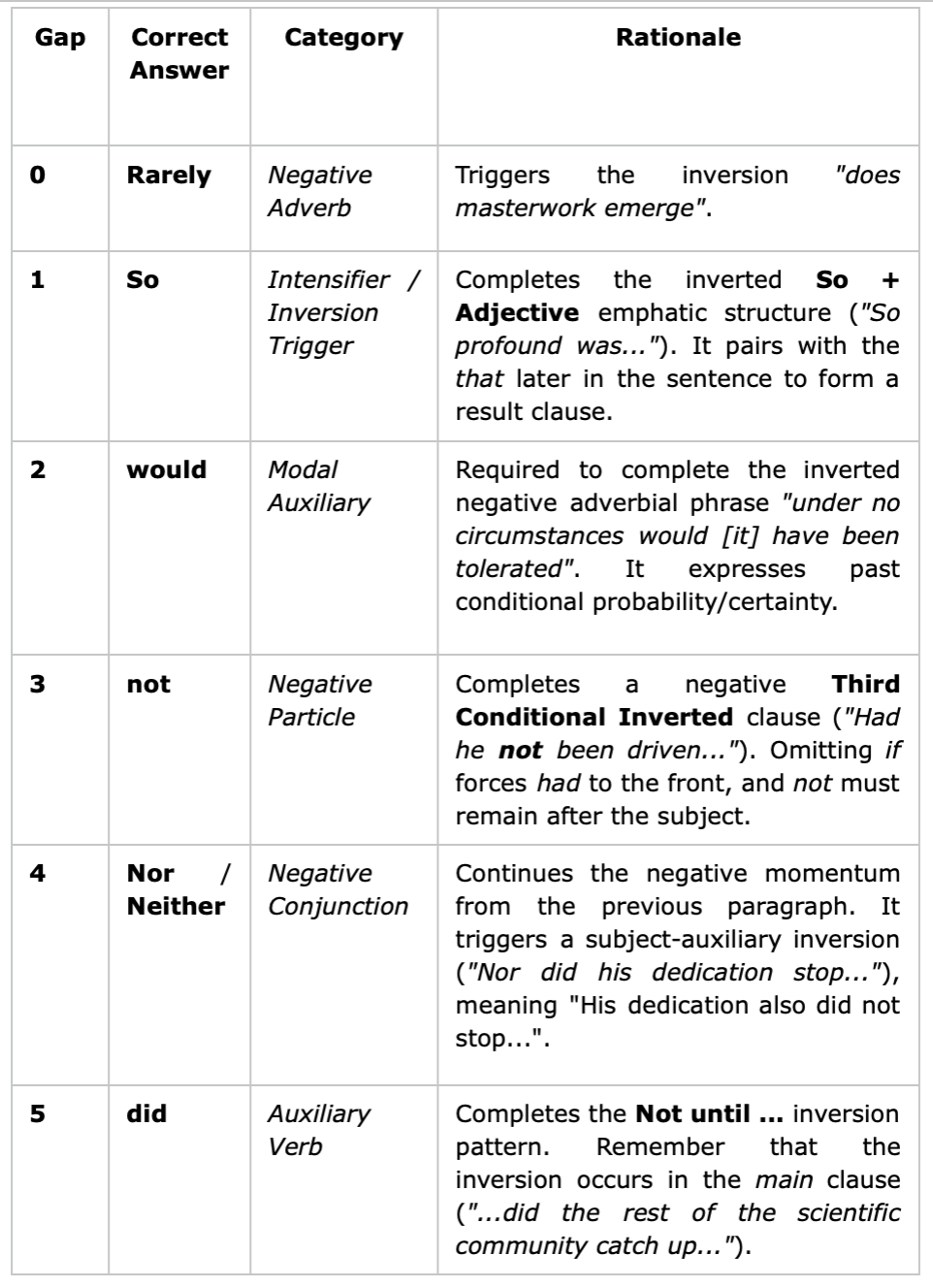
It is often assumed that artistic genius strikes like lightning, entirely unbidden. Yet, historically, (0) RARELY does masterwork emerge from a vacuum. Long periods of intense, unseen labor almost invariably precede public acclaim.
(1) ____________ profound was Leonardo da Vinci’s obsession with anatomical precision, for instance, that he dissected dozens of human corpses, an underground practice that (2) ____________ under no circumstances have been tolerated by contemporary religious authorities. Had he (3) ____________ been driven by this unyielding desire to map the physical form, the ethereal realism of his paintings would simply not exist.
(4) ____________ did his dedication stop at anatomy; he meticulously recorded observations on flight, botany, and optics. Not until centuries later (5) ____________ the rest of the scientific community catch up with his insights.
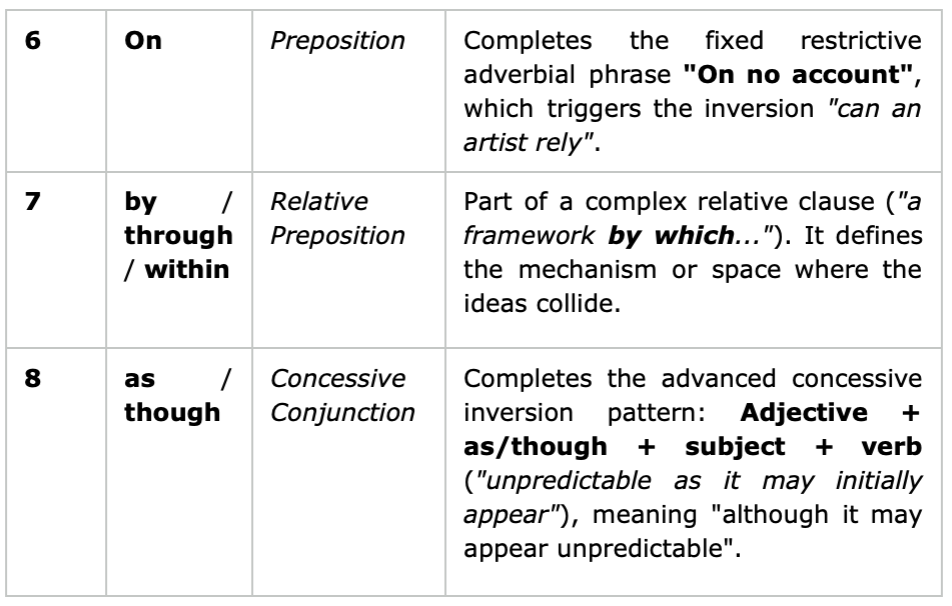
Genius, it seems, demands a rare synthesis of isolation and acute observation. (6) ____________ no account can an artist rely solely on fleeting inspiration. Mastery requires a cognitive framework (7) ____________ which disparate ideas can collide - and it is only through such relentless synthesis that true innovation is born, unpredictable (8) ____________ it may initially appear to the casual observer.
Answer Key and analysis
The Perfect In-Exam Execution Strategy for the C2 Open Cloze Task
Now that you have a good idea about which common parts of speech you may be tested on in the open cloze task, I will now outline the perfect three-step in-exam execution strategy which is worth adopting in order to maximise your chances of getting top marks in this part:
1. Read to get to know the "Big Picture" First
Before you even contemplate filling in any gaps, it’s worth looking at the title and skimming the entire text for a minute. You really want to get to know the author’s tone and pinpoint where negative ideas, contrasts or shifts occur. Missing a not or a shift in contrast in the opening sentences might tempt you into putting the exact opposite word in a gap later.
2. Analyse the Grammar Surrounding the Gap
You should now focus on the words and structures which appear before and after each gap as they may make up part of a phrase or expression which is completed by the missing word.
The vast majority of answers for the open cloze C2 task require candidates to recognise the flow and connections between ideas and information in the text. Indeed, being mindful of the author’s train of thought and logical argument is crucial when it comes to scoring highly on the C2 Proficiency Reading and Use of English paper. Assessing each gap in isolation may lead you to writing an answer which seems plausible within the narrow context of the few words either side of the gap. However, deeper analysis and rereading will light up the fact that the answer does not make sense within the context of the text.
Each gapped word is nearly always a functional word, such as a preposition, article, pronoun, linker, or auxiliary verb. The gapped word is seldom a heavy content word such as a noun or adjective.
If you find you’re struggling to fill a certain gap, it may help you to try to identify the part of speech for troublesome gaps, e.g. a question word, a preposition, a verb or a noun etc. You might also reach the conclusion that the missing word is part of a relative clause or makes up a phrase or idiom.
Always look for clues to determine the part of speech of problematic gapped words in the clauses and sentences surrounding each gapped word. In the sample text below, it is apparent that:
(1) is an adjective preceding a noun (possible answers - direct / natural)
(4) is an adverb which introduces a logical conclusion and modifies a participle phrase to show how an action leads directly to a consequence (possible answers - thus / thereby)
The Art of Deep Listening
In our fast-paced, digital world, the ability to truly listen seems to have (0) GONE the way of the dahlia—a fading art. We are constantly bombarded with stimuli, and as a (1) ____________ result, our attention spans have dwindled dramatically. Most of us do not listen with the intent to understand; rather, we listen with the intent to reply, treating conversations as a mere launching pad (2) ____________ our own ideas.
Deep listening, however, goes (3) ____________ beyond the passive act of hearing words. It requires us to suspend judgment and quiet our internal chatter, (4) ____________ allowing the speaker to feel fully heard and validated. This level of attention demands a great (5) ____________ of effort and emotional maturity, as it forces us to sit with discomfort or disagreement without immediately jumping in to defend our stance.
Furthermore, deep listening is not (6) ____________ beneficial to the speaker; it is equally transformative for the listener. By stepping out of our own ego, we gain insights that (7) ____________ otherwise have remained entirely closed to us. In a society fractured by polarisation, mastering this skill is no longer just a social nicety—it is an absolute (8) ____________.
Other solutions: (2) - for / (3) far; well / (5) deal / (6) only; merely; solely / (7) would; might; could / (8) necessity
3. Don’t jump the gun
I occasionally complete mock C2 Reading and Use of English tasks, just to stay sharp as an online C2 Cambridge exam tutor.
When I completed the task below, I was far too overhasty when I came up with the answer spite for gap 12. The correct answer is view. In spite of the fact is a common phrase - more common than in view of the fact that:
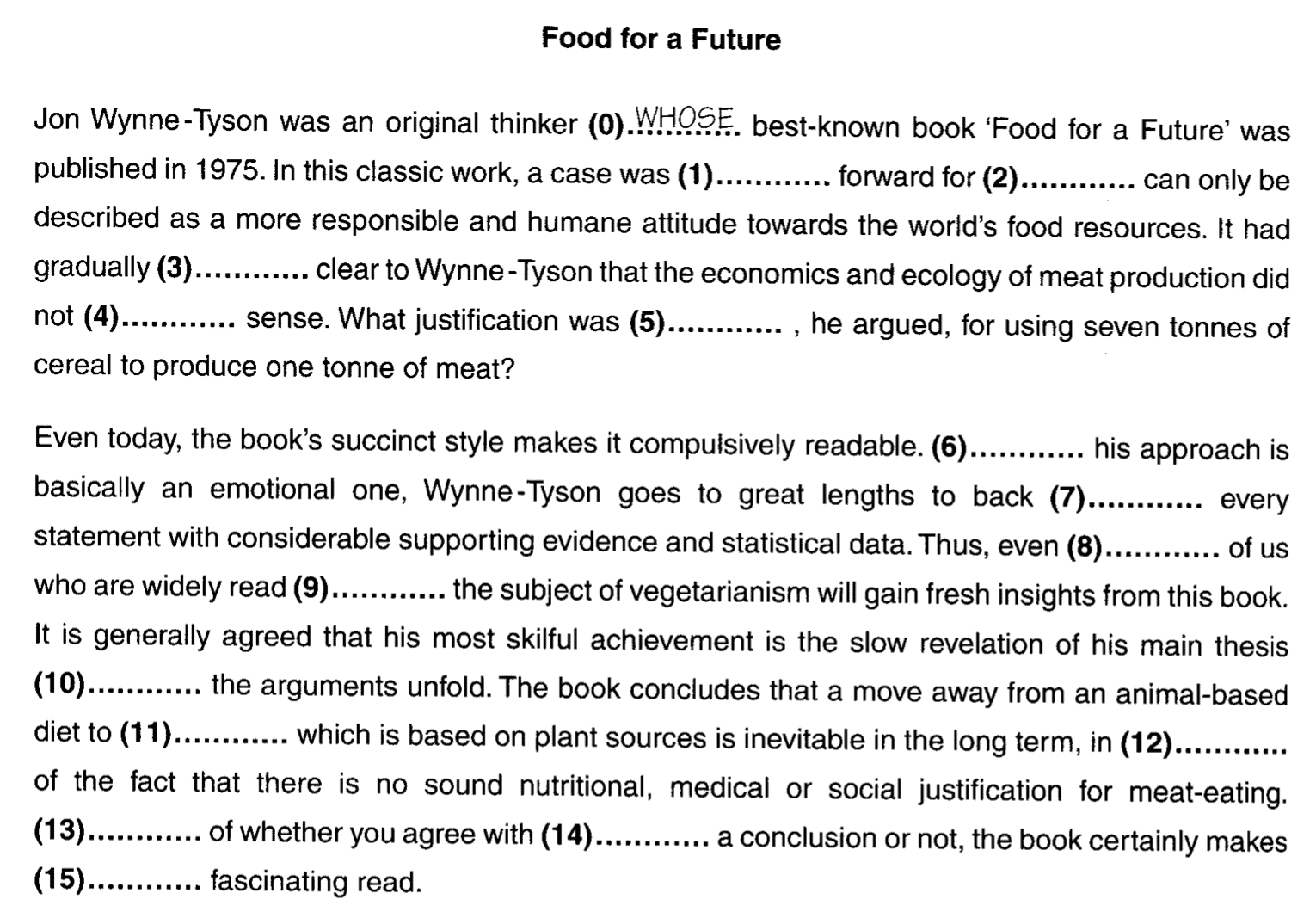
When in the exam room, be mindful that there are no easy marks in the C2 Proficiency exam. Alarm bells should ring if you instantly recognise a gapped word based on surrounding words which combine to create a common phrase such as in spite of the fact that. Reread the sentence carefully; the missing word may not be the most obvious choice. You need to ensure that each sentence sounds grammatically correct and complements the logic of the paragraph. If it disrupts the rhythm, it is probably wrong.
Practice Open Cloze C2 Proficiency Use of English Tasks with Answers, Explanations and Analysis
Using the tips you have picked up in previous sections, try to gain maximum points in the following open cloze tasks:
(1) The Evolution of Language
Read the text below and think of the word which best fits each gap. Use only one in each gap. There is an example at the beginning (0).
Example: (0) HOWEVER
For many years, linguists held the view that language learning is an innate ability, a framework hardwired into the human brain from birth. (0) HOWEVER, recent developments in cognitive science have begun to challenge this monochromatic view. Language is now increasingly seen not as a static biological blueprint, but rather (1) _________ a fluid, dynamic system that evolves through social interaction.
Under close scrutiny, the traditional boundaries between grammar and vocabulary begin to blur. Instead of operating with rigid syntactic rules, native speakers rely heavily on "lexical chunks" - pre-fabricated phrases and collocations that are retrieved whole from memory. It is this mastery of formulaic language, (2) _________ than the abstract computation of grammar rules, that allows for fluent, real-time communication.
Furthermore, spoken discourse relies immensely on subtle cues. Connectors and discourse markers serve to navigate the listener through the speaker's train of thought, anchoring what is being said (3) _________ a broader context. (4) _________ wonder, then, that language acquisition is a lifelong process. We are constantly expanding our repertoire, fine-tuning our understanding of nuance and connected speech (5) _________ response to the shifting environments we find ourselves in.
It is also worth noting that languages are inherently social tools. They morph to fit the needs of their speech communities, shedding obsolete structures while seamlessly incorporating new lexical items. No sooner does a technological or cultural shift occur (6) _________ the language adapts to reflect it. (7) _________ individual can claim ownership over a language; it belongs entirely to the collective. In the grand scheme of things, language is less a product of individual biology and (8) _________ a reflection of our shared human experience.
Answer Key and Analysis
Check your answers and see the grammatical rationale behind each gap:
1. as
Why: The structure here is seen ... as. "Seen not as [X], but rather as [Y]" creates a parallel contrastive structure.
2. rather
Why: Part of the phrasal linker rather than, which is used to contrast the importance of formulaic language against abstract grammar rules.
3. within / in
Why: Collocates with context. You anchor or place something within or in a broader context.
4. Little / Small / No
Why: Part of the idiomatic fixed expression (It is) little/small/no wonder, then, that..., meaning it is not surprising. At C2 level, the introductory "It is" is frequently omitted.
5. in
Why: Completes the fixed complex preposition in response to.
6. than
Why: Part of the correlative inverted structure No sooner... than. Whenever a sentence begins with No sooner + inversion, it must be followed by than to introduce the next action.
7. No
Why: A determiner used to create a negative statement at the start of the clause ("No individual can claim..."). It fits the absolute tone of the sentence ("it belongs entirely to the collective").
8. more
Why: Completes the correlative comparison less [X] and more [Y]. The text argues that language is less biology and more a reflection of experience.
At play here is something known as contrastive parallelism. This structure balances two ideas by setting them against each other, often using correlative conjunctions to emphasise a shift in perspective.
Example from the text: Language is less a product of individual biology and more a reflection of our shared human experience.
The Structure: Less + [Noun Phrase] + and + more + [Noun Phrase].
Why it’s used: It provides a sophisticated mechanism to nuance an argument. It rejects the binary "X is Y" and replaces it with a sliding scale of importance.
(2) The Architecture of Silence
Read the text below and think of the word which best fits each gap. Use only one in each gap. There is an example at the beginning (0).
Example: (0) FROM
In an increasingly hyper-connected world, silence has transitioned (0) FROM being a mere absence of sound to (1) _____________ highly prized commodity. Architects are now tasked with designing spaces that do not merely isolate noise, but actively cultivate stillness. Historically, architectural acoustics focused almost exclusively (2) _____________ mitigating the din of urban life - think double-glazing and thick insulation. Today, however, the paradigm has shifted. Designers are leaning (3) _____________ materials that manipulate sound waves rather than simply blocking them, creating environments where silence feels expansive rather than oppressive.
(4) _____________ makes this acoustic engineering so challenging is the subjective nature of human perception. A completely dead space - one devoid of any ambient resonance whatsoever - can induce a profound sense of unease, bordering (5) _____________ vertigo. Therefore, the goal is often to strike a delicate balance: introducing subtle, organic soundscapes, such as the gentle rustle of leaves or the trickle of water, (6) _____________ mask the jarring frequencies of mechanical ventilation. It is (7) _____________ so much about the elimination of noise as it is about its curation. In essence, modern architecture is beginning to treat silence not as a void, but as a structural element in its (8) _____________ right.
Answer Key and Explanations
1. a (Article: paired with "highly prized commodity")
2. on / upon (Preposition: dependent on the verb "focused")
3. into / towards (Preposition: phrasal verb meaning to lean in a certain direction of preference)
4. What (Wh-clef clause acting as the subject of the sentence)
5. on (Preposition: dependent on the idiom "bordering on" meaning almost identical to)
6. to (Infinitive of purpose: "in order to mask")
7. not (Correlative structure: "It is not so much X as it is Y")
8. own (Fixed idiomatic phrase: "in its own right")
(3) The Evolution of Foraging
Read the text below and think of the word which best fits each gap. Use only one in each gap. There is an example at the beginning (0).
Example: (0) FOR
Foraging (0) FOR wild food, once the absolute baseline of human survival, has undergone a remarkable cultural metamorphosis. No (1) _____________ is it viewed as the desperate recourse of the destitute; instead, it has been elevated to the vanguard of haute cuisine. Elite chefs worldwide now base entire menus around ingredients that cannot be bought through conventional supply chains, relying (2) _____________ on the expertise of professional foragers. This resurgence, however, is not without its paradoxes. (3) _____________ the face of it, gathering wild garlic or sea beet seems the epitome of ecological sustainability. Yet, as foraging shifts from a niche hobby to a mainstream trend, it risks falling victim to its own success. Over-harvesting has already depleted fragile ecosystems near major urban centres, prompting calls (4) _____________ stricter regulation. Furthermore, the commercialization of foraging raises thorny questions about common land rights and heritage. Who, (5) _____________ anyone, owns the wild berries growing on public paths? While some advocate for complete freedom of forage, others argue that without stringent management, the practice will inevitably result in a tragedy of the commons, (6) _____________ the very environments people seek to connect with are inadvertently destroyed.
Ultimately, the modern forager must tread a fine line, balancing culinary passion (7) _____________ an unwavering commitment to leaving (8) _____________ trace behind.
Answer Key and Explanations
1. longer (Adverb: forming the negative frequency phrase "No longer")
2. instead / solely / heavily (Adverb: adding qualification to how they rely)
3. On (Fixed prepositional phrase: "On the face of it")
4. for (Preposition: collocated with the noun "calls for [action]")
5. if (Conjunction: used in the fixed rhetorical insert "who, if anyone, ...". It explicitly leaves open the option that the answer might be "nobody.")
6. whereby / wherein (Relative adverb: meaning "by which" or "in which context")
7. with (Preposition: paired with "balancing X with Y")
8. no (Fixed environmental idiom: "leave no trace")
Final Thoughts
Do not forget that roughly 90% of the missing words in an Open Cloze text fall into just four categories:
- Prepositions and Dependent Prepositions: Is the blank part of a fixed pairing? (e.g., coincide with, in accordance with, shrouded in mystery).
- Pronouns and Relative Pronouns: Does the sentence need a connector like which, whom, whose, or what? Watch out for advanced structures like in which case or by whom.
- Articles and Determiners: Little words that change everything: each, every, any, all, none, or neither.
- Linkers and Conjunctions: Words that change the direction of the argument: whereas, albeit, lest, provided (that), or inasmuch (as).
The open cloze C2 Proficiency task doesn’t test how many sophisticated words you know. That’s what parts 1 (multiple-choice cloze) and 3 (word formation) are for. Cambridge English wishes to check whether you understand the invisible "glue" that holds the English language together.
The Time is Now
Enrol on my Full C2 Proficiency Preparation Course (discount available if you enrol before 30 September 2026):