

How to Get Band 9 in IELTS Speaking
If you’re wondering how to get band 9 in IELTS speaking, you’re in the right place. In this comprehensive guide, I share a wealth of Band 9 IELTS Speaking tips, strategies and practical examples. I draw not only on my extensive teaching experience but also on a deep understanding of how language acquisition and fluency development work.
Introduction: IELTS Speaking Guide
Achieving an IELTS Band 9 in Speaking requires you to demonstrate expert user proficiency. According to the official IELTS Band Descriptors, a Band 9 speaker has "fully operational command" of English. Moreover, their use of English is “appropriate, accurate and fluent, and shows complete understanding”. You don't want to force overly formal discourse markers into everyday conversation. Expressions such as "moreover" and "consequently" have their place, but natural spoken English often calls for more conversational alternatives. Your IELTS speaking examiner will listen out for natural, effortless, and precise communication across four specific criteria.
The aim of this post is to go through what you need to do to get an IELTS band score of 9 across the four criteria you will be assessed on. By summarising the IELTS speaking band descriptors for the four criteria for bands 8 and 9, it will be plain to see what is demanded of you to get a 9. Before I walk you through each part of the IELTS speaking test, I will cover what I believe is the best way to prepare for IELTS Speaking, namely the acquisition of lexical and grammatical chunks. After that, I will provide tips on how to prepare for each part before exam day, along with key strategies to use during the test itself. Sample answers of a Band 9 quality will be frequently included to emphasise certain tips.
Moving on, I will compare two IELTS Speaking test samples - one of Band 7 quality and the other from a Band 9 candidate. Before sharing my final thoughts, I will share some more general tips about how best to prepare for the IELTS Speaking test.
Understanding the IELTS Speaking Test
The first point to make about the IELTS Speaking section is that it is the same in both the General Training and the Academic tests. You can take the IELTS Academic at a test centre or remotely online via a video call with a human examiner. However, you must take the IELTS General Training test at a test centre.
The Speaking test is a face-to-face interview between the test taker and an examiner. IELTS Speaking tests are conducted by trained and certified IELTS examiners. The speaking test takes between 11 and 14 minutes and is recorded.
There are three parts to the IELTS Speaking test:
- Part 1 - Informal interview - general questions about the test taker on some personal/familiar topics, e.g. home and family
- Part 2 - Individual long turn - talking about a set topic and answering one or two rounding off questions
- Part 3 - Two-way discussion - discussing issues related to the topic in Part 2 in a more general and abstract way
The examiner assesses your speaking performance throughout the test with the aid of four assessment criteria:
- Fluency and coherence (FC)
- Lexical resource (LR)
- Grammatical range and accuracy (GRA)
- Pronunciation (P)
Your total speaking score is the average of four individual band scores (0–9), with each of the four criteria weighted equally at 25%.
IELTS Speaking Band Descriptors: Scoring criteria for Academic and General Training tests
Your speaking examiner will grade you on four distinct scoring criteria. In order to score a Band 9 overall, it is not necessary to score a 9 for each of the four criteria. The overall band score is calculated by taking the average (mean) of your four individual criterion scores on the 0-9 IELTS scale.
To achieve an overall band 9.0, your four-component average must be at least 8.75. If the average ends in .25 or .75, it is rounded up to the nearest half or whole band. Anyway, we are concerned with scoring a Band 9 and there are two ways to achieve this:
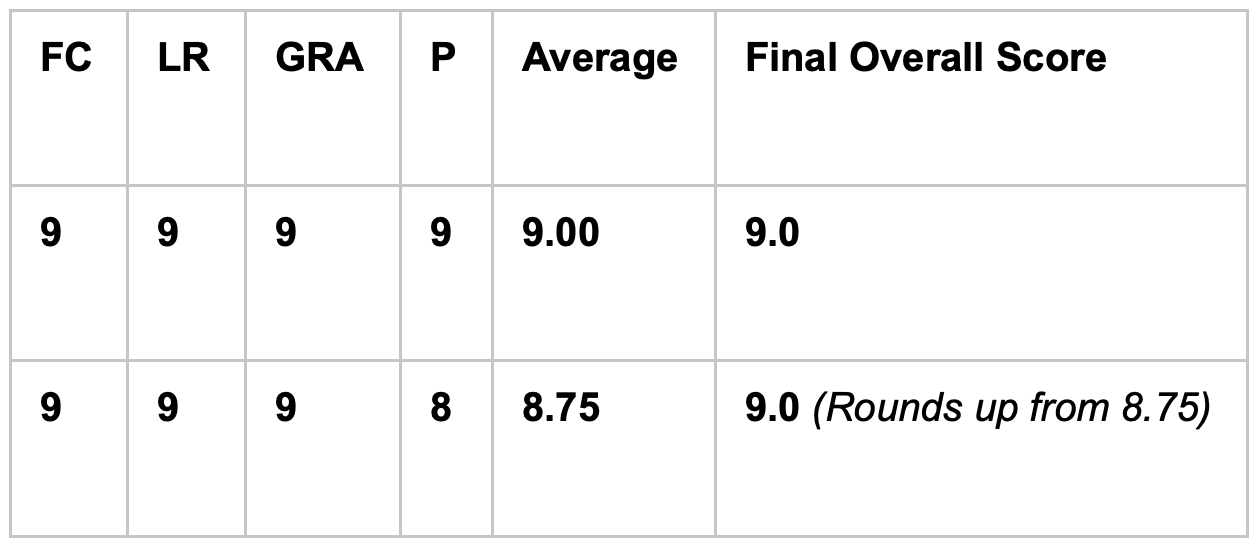
The key takeaway from this table is that you can score an 8 for ONE criteria only (such as Pronunciation or Lexical Resource) and still receive an overall Band 9. However, you must score a 9 in the remaining three criteria.
If you receive two 8s and two 9s, your average would be 8.50, which results in an overall score of 8.5.
I will now go through the four IELTS Speaking Key Assessment Criteria. Pay special attention to what separates Band 9 test takers from Band 8 test takers:
1. Fluency and Coherence
The first criteria you will receive a score for is Fluency and Coherence. This refers to a candidate’s capacity to speak with standard levels of speech continuity and speech rate:
- speech continuity - flow of speech will not be hampered by false starts, backtracking, the needless repetition of words and phrases, and/or unnatural pausing/hesitation in order to search for words.
- speech rate - natural, comfortable pacing and intelligibility
Key indicators of coherence:
- logical sequencing of ‘spoken sentences’*
- clear marking (with appropriate use of pausing, and spoken discourse markers and fillers) of stages in a discussion, narration or argument
- relevance of spoken sentences to the general purpose of a turn
- employing cohesive elements - such as logical connectors, pronouns, and conjunctions - to maintain coherence within and across spoken utterances.
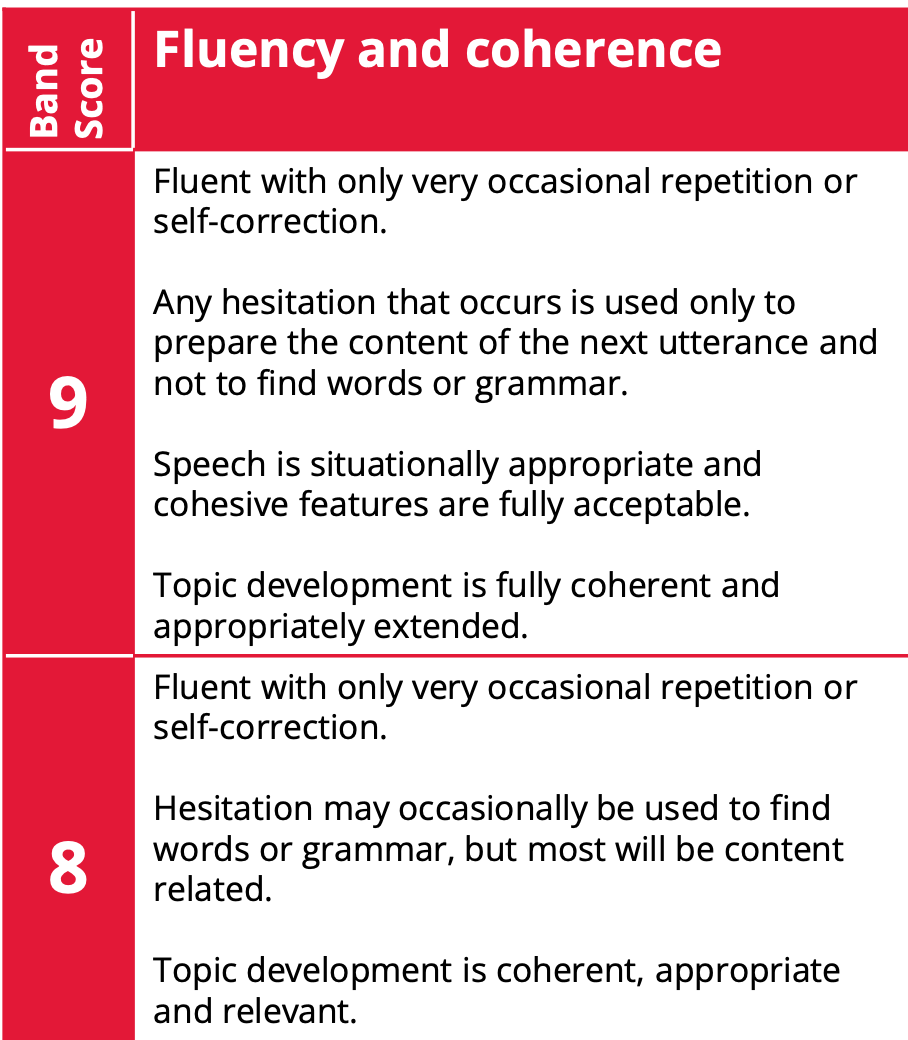
Summarising all of the above, and with reference to the Band 8 and Band 9 descriptors below, candidates need to speak at a natural speed without excessive self-correction, hesitation and unnatural pausing to get ielts Band 9 speaking. Everything appears effortless, while any hesitation is solely content-related (thinking about what to say, not how to say it). Discourse markers (e.g., consequently, mind you, besides, having said that) flow seamlessly and naturally into the text, avoiding any forced or tacked-on feel.
* What is a ‘spoken sentence’?
A spoken sentence is the oral counterpart to a written sentence. While it often mirrors simple or complex written structures, it can also include incomplete or verbless phrases that function like full sentences in context. In speech, these units are typically marked by a falling intonation at the end and a brief pause.
2. Lexical Resource
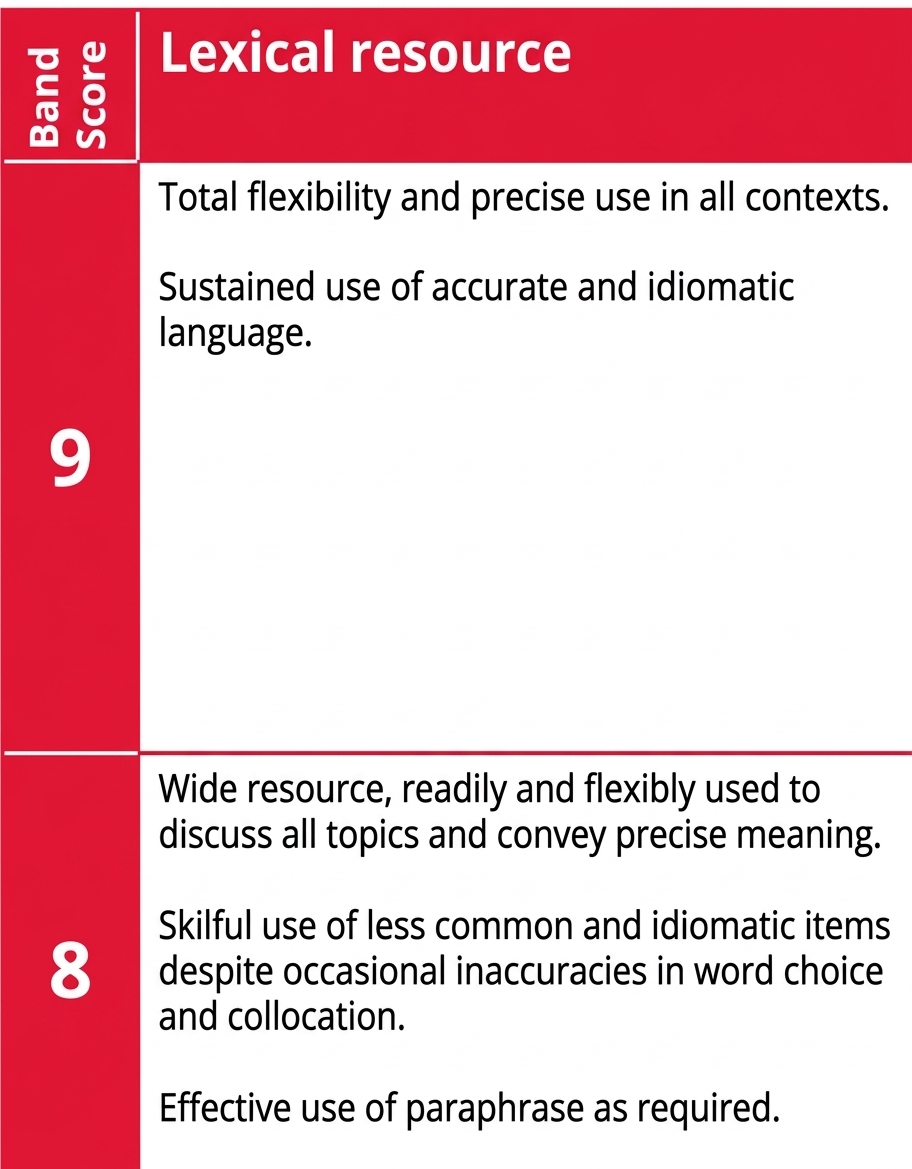
Lexical Resource refers to the range of vocabulary at the test taker’s disposal. It determines how wide a variety of subjects they can address, as well as how flexibly and accurately they can communicate specific ideas and nuances.
To gain a Band 9 score for Lexical resource, you need to accurately use higher-level or idiomatic expressions in the right context. In the months leading up to your IELTS test, it is well worth dedicating time to the thorough study and personalisation of collocations and uncommon multi-word expressions. By personalisation, I mean creating authentic sentences about your current life situation and personal experiences that incorporate these language chunks.
3. Grammatical Range and Accuracy
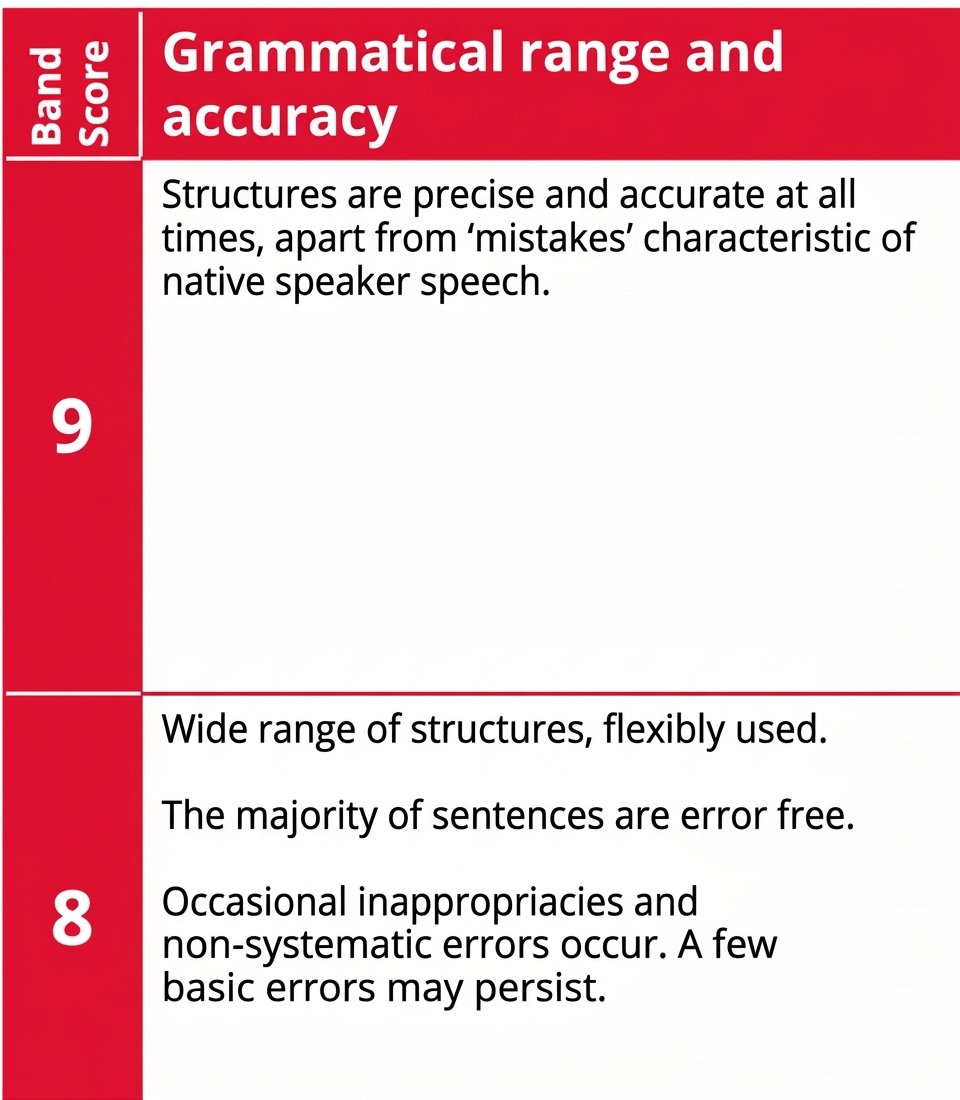
To score a Band 9 for Grammatical Range and Accuracy, it’s essential that you use a variety of structures with accuracy at all times. Rare minor “slips of the tongue” may occur but they don’t point to a lack of grammatical control.
Key indicators of range:
- the length of spoken sentences
- appropriate use of subordinate clauses within clauses and phrases
- complexity of the verb phrase (correct use of auxiliaries in continuous/perfect aspect, modality and passive voice)
- complexity of other phrases (use of pre- and post-modification: items before and after the head noun/adjective, etc.)
- range of sentence structures, especially to move elements around for information focus.
Key indicators of accuracy:
- error density (how frequently grammatical mistakes occur within a spoken sample)
- the communicative impact of error (how severely mistakes impair clarity, exactness, and overall comprehension).
4. Pronunciation
To score a Band 9 for Pronunciation, you are required to use a full range of phonological features to convey precise and/or subtle meaning. Namely, your use of word stress (emphasising the correct syllable in a word), sentence stress (emphasis on certain words), intonation, and rhythm should be natural and effortless.
Sounds are ideally linked using features such as elision, schwa and assimilation to produce connected speech.
Examiners will also pay heed to your ability to group words into meaningful units and pausing where appropriate to organise ideas, highlight information and build suspense.
- “The main problem, / as I see it, / is the lack of investment.”
- “I was expecting something special … but it was actually rather disappointing.”
Dividing your thoughts into clear chunks and phrasing them thoughtfully improves clarity and helps express nuances such as hesitation, emphasis, or anticipation.
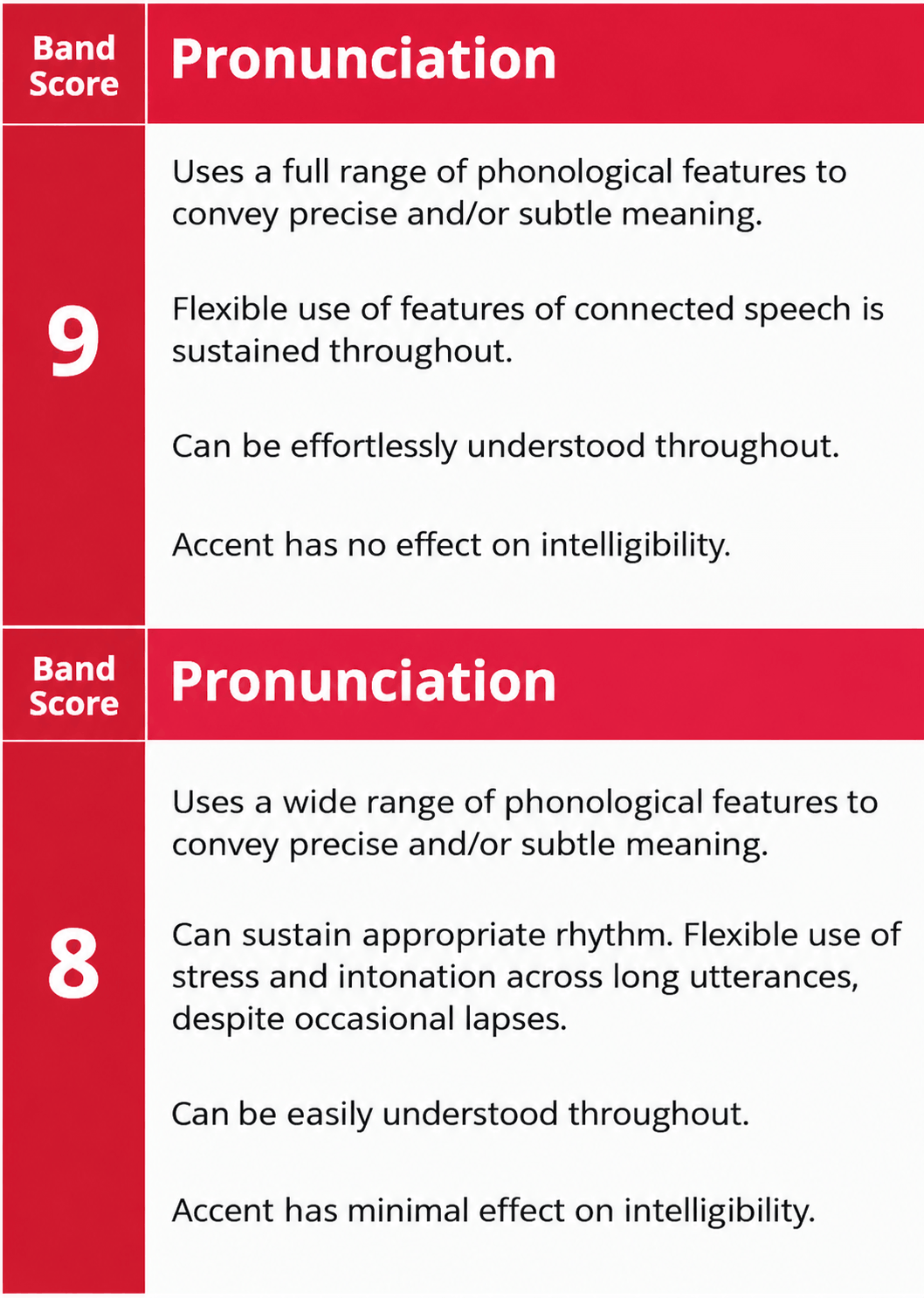
Don't feel pressured into deliberately demonstrating every phonological feature.
For example, linking, assimilation, elision and schwa are useful features of connected speech. However, they shouldn't become a checklist that you consciously work through.
The main goal is flexible, intelligible speech, with stress, rhythm and intonation used to convey meaning.
The Best Way to Prepare for IELTS Speaking
IELTS speaking examiners favour candidates who use natural, idiomatic collocations and fixed phrases as opposed to cramming complex vocabulary into basic topics. Therefore, two or three months before your IELTS Speaking test, I advise you to start reading widely and making a note of interesting multi-word combinations/lexical chunks.
It would be a particularly prudent move to focus on phrases which contain delexical verbs. Delexical verbs are common verbs such as have, make, do, take, give, get and go which contribute relatively little of their usual concrete meaning. However, the important part of the meaning is put into the noun the verbs are used with to form a collocation or common expression.
To achieve a Band 9 score, you should look past common collocations such as have a rest and take a shower. If you want to pick up on nuanced meanings, formal versus informal register, complex word combinations, and key grammar patterns, you'll need to upgrade your focus from basic to advanced delexicalisation.
Take, for example, the collocation “pay lip service to”. This may be defined as:
to say that you agree with something but do nothing to support it.
Example: Previous governments have paid lip service to the idea but achieved little
“Pay lip service to” is an example of advanced delexicalisation due to its more sophisticated context and the fact that the learner is expected to use the attached grammatical pattern - the preposition “to” - accurately. However, remember that native speakers tend not to piece language together word-by-word. The essence of fluency lies in the ability to retrieve chunks such as ‘pay lip service to’ as whole units, rather than having to make a series of lexical and grammatical choices to retrieve individual words in the heat of conversation.
All in all, paying heed to advanced delexicalisation is not simply a vehicle to memorise longer and more sophisticated phrases. It involves grasping how English bundles meaning into familiar word patterns, how these patterns function within grammar, and how they foster natural and accurate expression.
Grammatical chunks
In his book Lexical Grammar: Activities for teaching chunks and exploring patterns, vocabulary and lexical approach expert, Leo Selivan, compellingly argues that fluency equates to “fast processing” (2018, p.4). In other words, fluent speakers of a language are able to produce language quickly, automatically and with little conscious effort.
Rapid retrieval is particularly essential for recall of grammatical structures compared to purely lexical items. Selivan provides the example of the present-perfect dominated chunk, I haven’t seen you for ages. If you bump into an old friend on the street, you wouldn't really want to go through a series of lexical and grammatical choices in order to assemble “I haven’t seen you for ages” word-by-word. Fluent speakers recall this chunk as a whole unit. In such a way, they free up processing energy which enables them to plan what to say next (Selivan, 2018, p.4).
Selivan (ibid.) mentions that:
… there is growing evidence that chunks memorized as whole units of language сап also actually drive the process of grаmmаr acquisition.
When it comes to preparing for the IELTS Speaking test, there is certainly no harm in taking Selivan’s advice by experimenting with chunks, teasing them apart and using them as templates to create new sentences. Therefore, our target chunk - I haven’t seen you for ages - may evolve into more productive patterns, and subsequently natural grammar acquisition, if you follow Selivan’s guidance:
I haven’t sееn уоu for ages.
I haven’t sееn her for ages.
I haven’t seen him siпсе high school.
I haven’t heard from hеr for ages.
You should avoid memorising whole answers to potential questions. However, there’s nothing wrong with using flash cards or a Word-Phrase Table to record short sentences which expand upon a target structure. Ideally, these sentences should be ‘personalised’; in other words, they should reflect a true life experience, personal opinion or future goal etc. People remember information much better when they can relate it directly to themselves, a phenomenon in cognitive psychology known as the Self-Reference Effect. Therefore, let’s continue the present perfect theme with the following potential personalised sentences:
I’ve never been to Asia
I haven’t seen my grandfather for two years
I haven’t eaten out for a long time
Of course, you can engage in spaced repetition to test your recall of these sentences:
HINT - Asia
RECALL - I’ve never been to Asia
Finally, don’t get bogged down with terminology (present perfect) and rules of use of certain structures. To understand how to get Band 9 in IELTS Speaking, you need to have these chunks top of mind from the get-go in Part 1 of the test. Overanalysing structures before the exam won’t help you when it comes to the automatic processing and retrieval of personalised sentences and chunks on test day.
IELTS Speaking Part 1: Strategies and Examples
Part 1 of the IELTS Speaking test begins with the examiner introducing himself or herself and checking the candidate’s identification. It then continues as an interview. Essentially, the examiner will ask you roughly 12 questions about your daily life, personal interests, whether you work or study, your family and anything related to your background.
The questions you will have to answer are not mentally taxing at all. Therefore, treat this part as a warm-up whereby you are able to ‘break the ice’ with the examiner. You will be more fluent and relaxed throughout parts 2 and 3 if you aren’t afraid to be yourself in part 1. Freely open up about your day-to-day activities, what life is like at home and what you like doing in your free time.
How long does part 1 last?
This part of the speaking test lasts for 4 to 5 minutes.
What skills are tested?
In Part 1, candidates are assessed on their capacity to provide opinions and details across a variety of questions related to routine, real-world scenarios.
Tips for acing IELTS Speaking Part 1
Maximise your chances of getting a Band 9 for IELTS Speaking by paying heed to the following tips for part 1:
How to prepare for part 1 before the IELTS Speaking Test?
#Tip 1: Practice answering IELTS speaking questions with newly-learned structures and expressions
With all the structures, collocations and multi-word combinations you have picked up as a result of following the advice in the previous section, aim to categorise the structures and chunks by topics. Practise using these expressions and structures in ‘personalised’ sentences at home in front of the mirror. Alternatively, you can record yourself speaking and listen to the playback to check your pacing, grammar, vocabulary, tone, and how long your answers are.
The next step is to practise answering IELTS speaking questions which contain some of the expressions and structures you’ve already learned. Go through your repertoire of lexical chunks and grammatically-focused multi-word combinations and pick out five or six which you think are appropriate to answer a certain question.
For example:
Question: Do you enjoy spending time outdoors?
Target expressions and chunks your flash cards etc:
- One of the main reasons is that …
- The main attraction is …
- disconnect from my daily routine
- get some fresh air
- stay physically active
- I've always found being in nature incredibly peaceful
Response:
"One of the main reasons I enjoy spending time outdoors is that it gives me a chance to disconnect from my daily routine. What makes it particularly appealing is the fact that I can get some fresh air while also staying physically active. What’s more, I've always found being in nature incredibly peaceful."
#Tip 2: Preparation - not Memorisation
IELTS examiners are trained to spot memorised answers. In the official IELTS Speaking Band Descriptors, the word “memorised” appears in Bands 1, 2, and 3 to describe candidates who rely almost entirely on rehearsed language. Although memorising answers for part 1 won't automatically cap your score at Band 3, examiners will ignore memorised material when assessing your level, which can significantly lower your overall score.
Answer questions in front of the mirror using set structures and pre-learned multi-word combinations. You can even practise answering the same question several times. However, don’t get drawn into learning answers by heart. You will sound robotic if you give memorised answers.
Overall, part 1 is supposed to reflect everyday conversation. Examiners easily see through rehearsed answers and may interrupt you and change questions if they suspect memorised answers.
What should you do during part 1 of the IELTS Speaking Test to maximise your chances of getting a Band 9 score?
#Tip 3: Paraphrasing
You should aim to paraphrase the examiner’s question instead of repeating the vocabulary they use.
Question: Have you visited any other countries?
Answer 1 (NOT PARAPHRASED): Yes, I’ve visited around 20 foreign countries. My favourite foreign country was definitely Italy because the architecture in all the cities I went to is stunning. Another country I would like to visit is Australia.
Answer 2 (PARAPHRASED): Yes, I’ve been abroad many times before. The first country I went to was Greece, while I spent my last holiday in Thailand. I particularly enjoyed Italy because the architecture in all the cities I went to is stunning. My lifelong dream though has been to travel around the United States.
#Tip 4: Engage naturally with the questions
Admittedly, most IELTS questions are somewhat dull. When someone answers a boring question, their voice is monotone - the pitch sounds very flat. If you speak like this, you won’t achieve a high mark for the Pronunciation criterion as the examiner will take the quality of your intonation into account.
Overall, it’s crucial that you engage naturally with the examiner’s questions. This will cause your intonation to become more varied.
#Tip 5: Avoid One-Word Answers, but Don't Give an Essay
The mistake: Answering "Do you work or are you a student?" with just "I work." or attempting to launch into a two-minute narrative about your career history.
The sweet spot: Three or four well-structured sentences (roughly 15–20 seconds). Answer the question directly, give a supporting detail or reason, and stop.
#Tip 6: Don’t go off topic
If, for example, the examiner asks you about what kind of films you enjoy watching, you shouldn’t start talking about the following:
- the history of the film industry
- how Hollywood influences society
- the impact of streaming platforms on the entertainment industry
- the importance of cinema in modern culture
These topics might demonstrate sophisticated vocabulary, but they don't directly answer the question.
To get IELTS band 9 speaking, you need to give a RELEVANT developed answer such as this:
"Well, I'm particularly fond of psychological thrillers and films with unexpected plot twists. I find them intellectually stimulating because they often challenge you to think outside the box and question your initial assumptions. Having said that, I occasionally watch light-hearted comedies, especially when I want to unwind after a demanding day at the office."
Why is this better?
- directly answers the question.
- provides specific examples.
- explains personal preferences.
- uses sophisticated but natural vocabulary.
- develops the answer without losing focus.
To avoid going off topic, you would do well to master the Answer + Reason + Example (ARE) technique:
- Answer: state your position clearly.
- Reason: explain why you feel that way.
- Example: offer a concrete micro-detail and develop your point.
Here is an answer to the question “Do you like spending time outdoors in winter?” which makes use of the ARE technique:
"I actually prefer staying in during the winter. It’s mostly because I can’t stand the cold, so I’d much rather curl up with a book than brave the weather outside."
The answer below to the question “Do you like shopping?” is of Band 9 quality. It gives a direct response, a reason, a brief specific example and a personal reflection:
"It really depends on what I’m buying. If it’s grocery shopping, I find it a bit of a chore, to be honest. But if I’m browsing independent bookshops or hunting for vintage vinyl records, I can easily lose track of time."
#Tip 7: Don’t list without development
To my mind, it would be difficult to score above Band 3 for IELTS Speaking if you merely list without development:
❌ Band 3 response:
Q: “What kind of jobs do the people in your city, town or village do?”
A: “Well, people do many jobs. There are teachers, doctors, nurses, police officers, shop assistants, builders, drivers and office workers. Some people work in restaurants and some work in factories. There are also farmers. Yes, many different jobs.”
✅ Band 9 response:
Q: “What kind of jobs do the people in your city, town or village do?”
A: “Well, I'd say the job market in my city is fairly diverse, although it's largely dominated by the service sector. A considerable proportion of the population are employed in retail, healthcare, education and hospitality. We also have quite a few people working in the construction industry, particularly given the ongoing development in the area. Having said that, traditional occupations haven't disappeared altogether, and there are still plenty of small business owners and skilled tradespeople.”
#Tip 8: Don’t worry if your examiner interrupts you
Don’t take it personally if the examiner interrupts you during the test. In addition to assessing your language skills, their job is to manage time. Once the examiner realises that you have understood the question and have answered it sufficiently using a range of grammatical structures and expressions, together with adequate organisation and pronunciation, they move on to the next question.
#Tip 9: Vary your sentence structures seamlessly
In order to get IELTS band 9 speaking, it’s essential that you vary your sentence structures. Examiners reward flexible and natural use of grammatical structures.
Compare these examples:
Band 5-6 style
“I like living in Barcelona. It is really lively. There are plenty of restaurants. I can meet my friends there. It is a great place to live.”
Band 9 style
“What I particularly enjoy about living in Barcelona is its lively atmosphere. Not only does it have a wide range of restaurants, but it also offers plenty of opportunities to socialise. Having said that, it can get rather congested during rush hour."
The Band 9 answer demonstrates:
- a greater variety of grammatical patterns
- complex sentence construction
- relative clauses and more sophisticated clause structures
- inversion: Not only does it ...
- concession: Having said that ...
Another structure I recommend that all my exam candidates master is the second conditional. The second conditional allows candidates to express hypothetical situations, preferences, wishes and imagined possibilities in the present or future. For example:
If I had more days of annual leave, I’d travel more frequently
If I were offered a job abroad, I would seriously consider taking it
#Tip 10: Prioritise fluency over Perfect Truth
The examiner may ask you about a topic you have very little interest in (e.g. street markets, museums, advertisements). If that happens, don’t freeze attempting to remember a real experience. Don’t forget that the examiner is assessing your range of language and speech rate, not your life experiences. So, for example, let’s imagine you are asked the following question:
Q - “When was the last time you visited a museum?"
It may be the case that you haven’t been to a museum since you were a child. Therefore, you can’t remember the exact details of the visit. Don’t get bogged down with trying to remember dates and the museum’s main highlights unless all the details are top of mind:
A - “I vaguely recall visiting a Science Museum in Madrid when I was around 10 years old. That was around 10 years ago so, unfortunately, I can’t remember the museum’s main highlights. However, I can remember there were so many interactive exhibits which were truly fascinating.”
IELTS Speaking Part 2: How to Develop a Two-Minute Talk
Part 2 of the IELTS Speaking test is the individual long turn. You will be handed a cue card which asks you to talk about a certain topic based on your own experience. The card contains three bullet points which act as prompts to give you ideas about what to talk about and help you organise your turn. There will be a final instruction under the last bullet point, usually beginning with ‘and explain’ plus a question word such as ‘why’ or ‘what’.
Example task card:
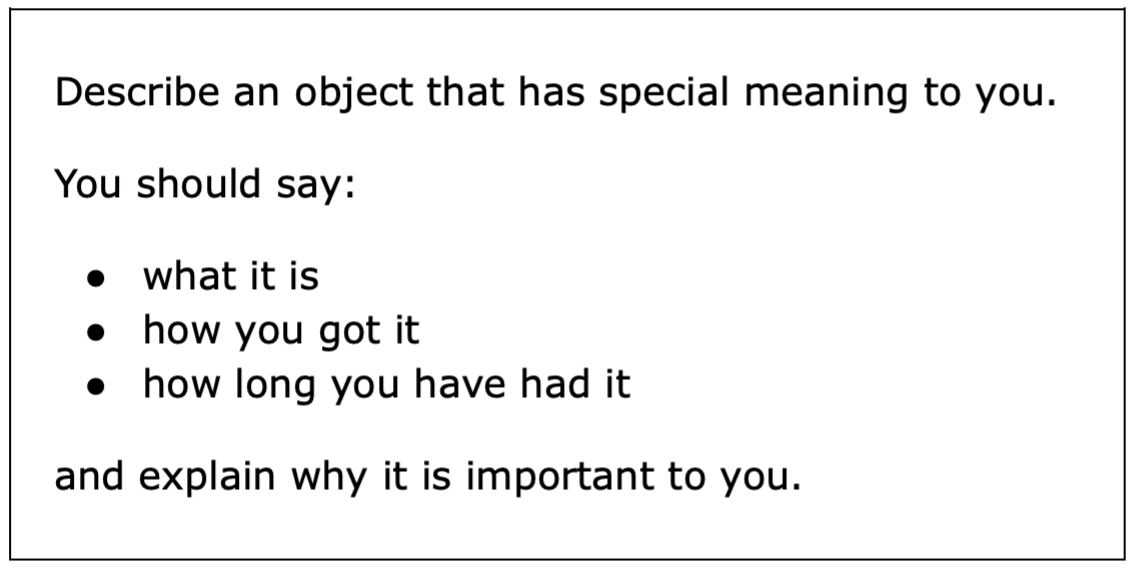
The examiner will give you a pencil and paper to make notes. Preparation time is limited to one minute. It’s not compulsory to plan for an entire minute, but I advise you to do so to make sure you are well prepared.
You will have to talk about the topic for 1 to 2 minutes. Try to keep talking until the examiner stops you, which will be at around the 2-minute mark. Aim to develop your talk for as close to two minutes as you comfortably can. If you finish earlier, the examiner may ask one or two brief questions before moving on. For example:
1. Is it valuable in terms of money?
2. Would it be easy to replace?
If you speak for the full 2 minutes, there is a greater chance the examiner will move straight on to Part 3. However, they’re still within their rights to ask one or two ‘rounding off’ questions as part 2 may last a maximum of four minutes.
Overall, don’t tempt fate. If you stop speaking too early, the examiner could mark you down for Fluency and Coherence.
How long does part 2 last?
This part of the speaking test lasts 3 to 4 minutes, including preparation time.
What skills are tested?
Part 2 evaluates candidates on their ability to speak continuously and elaborate on a given topic with original thoughts. You will be credited for using appropriate language and organising your ideas logically.
Tips for acing IELTS Speaking Part 2
Maximise your chances of getting a Band 9 for IELTS Speaking by paying attention to the following tips for part 2:
#Tip 1: Don’t stress too much about the topic you will be asked about in the run up to your IELTS Speaking test
The range of potential topics you will be asked about is vast. Therefore, it’s not worth stressing about whether you’ll be presented with a tricky or awkward topic. It will be what it will be. Nevertheless, you can be sure that the topic will be related to you in some way, for example, something you have experienced.
#Tip 2: Become familiar with what two minutes feels like in your practice sessions before the test
During all four modules of the IELTS test, you are not allowed to have a watch with you. Therefore, it’s vital that you use a timing device in your practice sessions in order to familiarise yourself with what two minutes feels like when you are speaking at a natural pace.
#Tip 3: The bullet points are only there to guide you
Before we consider planning strategies for your part 2 talk, it’s vital that you treat the bullet points and final instruction as a guide to help you organise your turn. Feel free to view the bullet points as flexible guidelines rather than a strict checklist that must be completed mechanically.
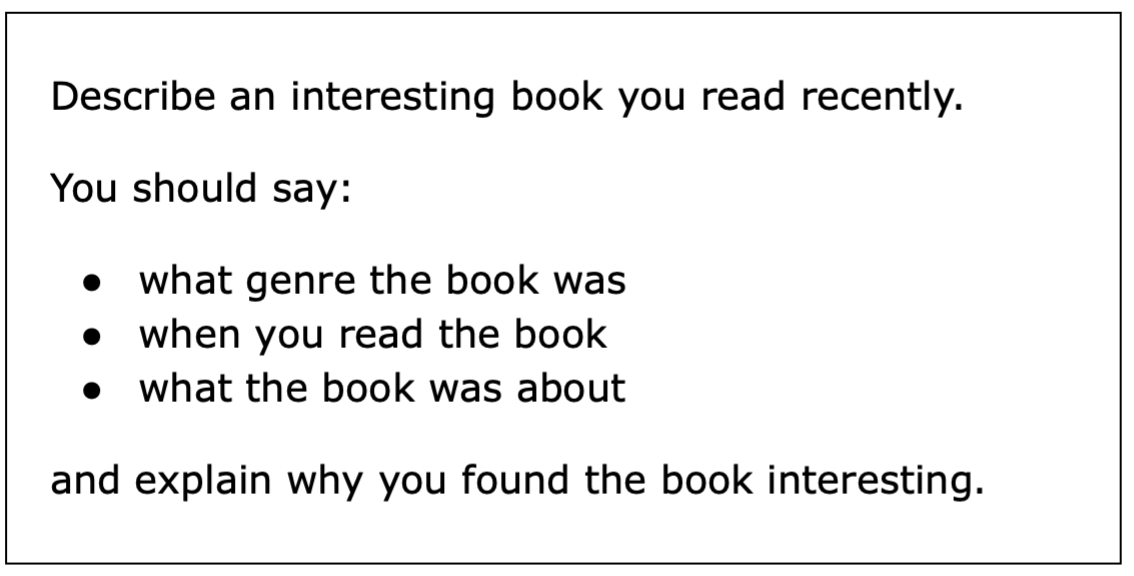
With reference to the task card above, you will very quickly run out of things to say if you follow the bullet points rigidly. Realistically, you would only need around 10-15 seconds to cover the first two bullet points. As for the third bullet point, you would require around 20 seconds to say what the book was about. That leaves you with around 1 minute and 25 seconds to explain why you found the book interesting. In this case, you would almost certainly run out of things to say even though the ‘explain why’ instruction should produce more informationally-heavy speech than the three bullet points.
Another danger of unyieldingly following the bullet points is that you might get stuck on one or more of them. For instance, you might not know what the word ‘genre’ means, which could make you feel insecure and cause you to become stressed out. All of this could affect your fluency and coherence.
#Tip 4: Always put Fluency and Coherence first
When considering how to get Band 9 in IELTS Speaking, the Fluency and Coherence criterion should take precedence over the other criteria. If there is no fluency and coherence, you will lose control of your pronunciation, lexical choices and grammatical accuracy. This is more true for parts 2 and 3 where topic development is fully coherent and appropriately extended and you shouldn’t hesitate to find words or grammar.
You need to do things that help you speak for 2 minutes about the given topic as fluently and coherently as possible. Avoid anything that prevents you from speaking continuously, for example:
- feeling compelled to talk about bullet points you don’t know how to talk about;
- attempting to speak about each bullet point for an equal length of time;
- working through the bullet points one by one, only to find yourself with nothing more to add before the time limit expires.
#Tip 5: Make the long turn YOUR long turn
As we have already established, it’s not essential to give equal weight to the bullet points or expand upon them at all. You need to choose other points related to the main topic that you feel comfortable talking about, such as:
- introducing the topic
- providing details about the topic
- telling a personal story or anecdote
- expressing your feelings and thoughts about it
- sharing sensory details rather than merely state what happened
- your opinion
- the present situation
- the past
- the future
- highlighting a lesson learned
- spending more time speaking about the final ‘and explain’ instruction
The task card is just a task card. You need to make use of the freedom you have to essentially tell a compelling story for 2 minutes.
Putting Your IELTS Speaking Part 2 Planning Strategy into Practice
I will now apply tips 4 and 5 to put together a plan that will help me talk about this topic:
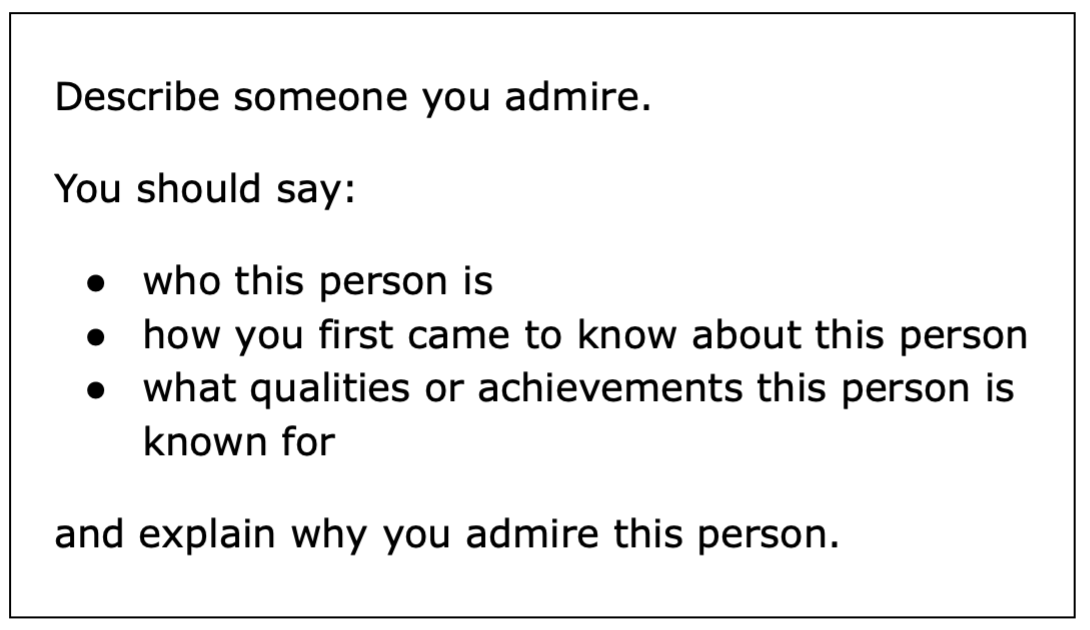
Here is my plan:
- Ronnie O’Sullivan - arguably greatest snooker player ever
- achievements - multiple titles / world champion / centuries
- started to follow snooker in 1993 and rooted for Ronnie after about 1997 - maximum! / still competitive - longevity
- Perfectionist - Steve Peters - matured to handle emotions on snooker table better
- Honesty - wears heart on sleeve / burst into tears 2022
- me - play 25 years - mentally demanding sport - extraordinary technical precision - exceptional cue-ball control
IELTS Speaking Part 2 – A Model Answer Demonstrating Band 9-Level Language
“Someone I really admire is the snooker player Ronnie O’Sullivan.
To my mind Ronnie O’Sullivan is arguably the greatest snooker player who’s ever lived. The number of titles he’s won, especially his 23 Triple Crown titles, speaks for itself, I think. He’s been World Champion seven times and even made over 1,300 century breaks in tournament play.
I started rooting for Ronnie in 1997 when he made the fastest maximum 147 break in professional snooker history. I couldn’t believe the nerves of steel he showed during that break. Now, some 30 years after that magical day, he’s still competitive in major tournaments in his fifties. His longevity is simply incredible.
Apart from his achievements on the table, I also admire how Ronnie’s come to terms with his perfectionistic tendencies. He’s made no secret of his work with the renowned sports psychologist Steve Peters. Ronnie occasionally loses his temper but, on the whole, he’s able to handle his emotions much better than he used to when playing snooker.
I also respect Ronnie for wearing his heart on his sleeve. He may sometimes downplay his achievements and his own phenomenal ability; however, he’s never been one to hide his feelings. It was particularly moving to see Ronnie burst out crying after winning the 2022 World Championship.
I’ve been playing snooker myself for around 25 years. I know how difficult this game is. It's an incredibly mentally demanding sport which requires extraordinary technical precision and exceptional cue-ball control. So it's mind-boggling that Ronnie can compile century breaks with both hands. He’s an authentic genius and we can’t say that about many people.”
Analysis of Grammatical Range and Accuracy and Lexical Resource
If you're aiming for Band 9 in IELTS Speaking, you should be striving to produce a long turn such as the one above in part 2. Overall, the turn demonstrates a solid command of natural idiomatic language, complex grammatical structures and, importantly, the ability to develop ideas as opposed to a list of someone's achievements or a biographical account of a role model.
Here’s a summary of three of the speaker’s response based on three of the criteria you will be assessed on - Fluency and Coherence, Lexical Resource and Grammatical Range and Accuracy:
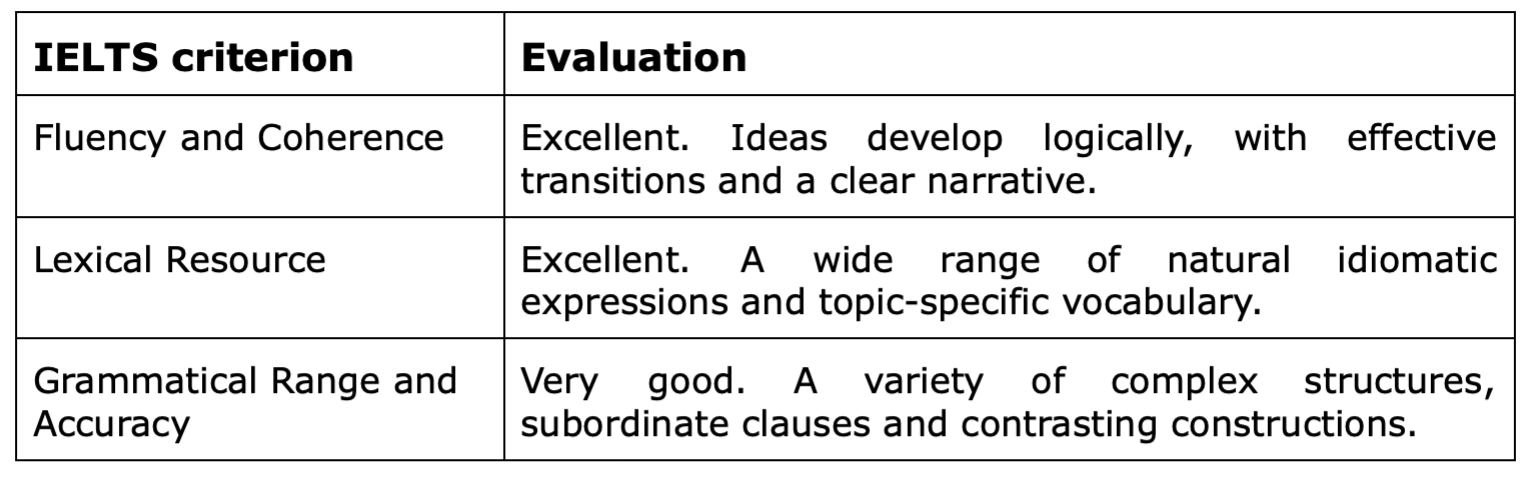
Three things stand out in the speaker’s response:
- Personal engagement: The speaker explains when he started admiring Ronnie and why.
- Psychological depth: The progression from Ronnie’s professional achievements to his perfectionistic tendencies, psychological development and personality gives the answer depth.
- Personal connection: The speaker’s 25 years of playing snooker gives him a credible reason to appreciate his role model’s extraordinary abilities.
The last point is particularly important. The speaker is not simply telling the examiner that Ronnie is brilliant; he’s explaining why he understands just how brilliant he is.
Another strength of this answer is the speaker’s willingness to bring in his own experience.
The sentence:
"I've been playing snooker myself for around 25 years. I know how difficult this game is."
works particularly well for a number of reasons:
- It makes the answer personal. The speaker explains why he admires Ronnie rather than simply listing his achievements.
- It provides justification. Bringing in his own experience gives credibility to his appreciation of Ronnie’s technical abilities.
- It creates a natural transition from discussing Ronnie’s achievements to explaining why the speaker finds them so impressive.
- It demonstrates grammatical flexibility, particularly through the present perfect continuous: “I’ve been playing snooker myself for around 25 years”.
It’s fine to bring in personal experience whenever they are relevant to the topic. However, personal experience should only give weight to an answer, not take it over. In this Band 9 response, the speaker got the balance exactly right as Ronnie remains the focus throughout.
The strongest aspect of the response is that it doesn't sound like a memorised collection of impressive expressions. Most of the vocabulary is integrated naturally into the narrative.
Lexical Variety and Idiomatic language
What makes this answer especially outstanding is the use of lexical variety without artificial complexity.
For example, consider these multi-word combinations:
- I really admire...
- To my mind...
- I started rooting for...
- Apart from his achievements...
- On the whole...
- I also respect...
- It was particularly moving...
- I've been playing... myself.
These expressions help organise the response and make it sound like an actual person talking rather than someone delivering a prepared essay.
Here’s a summary of some of the expressions in the speaker’s response together with their meaning/function:
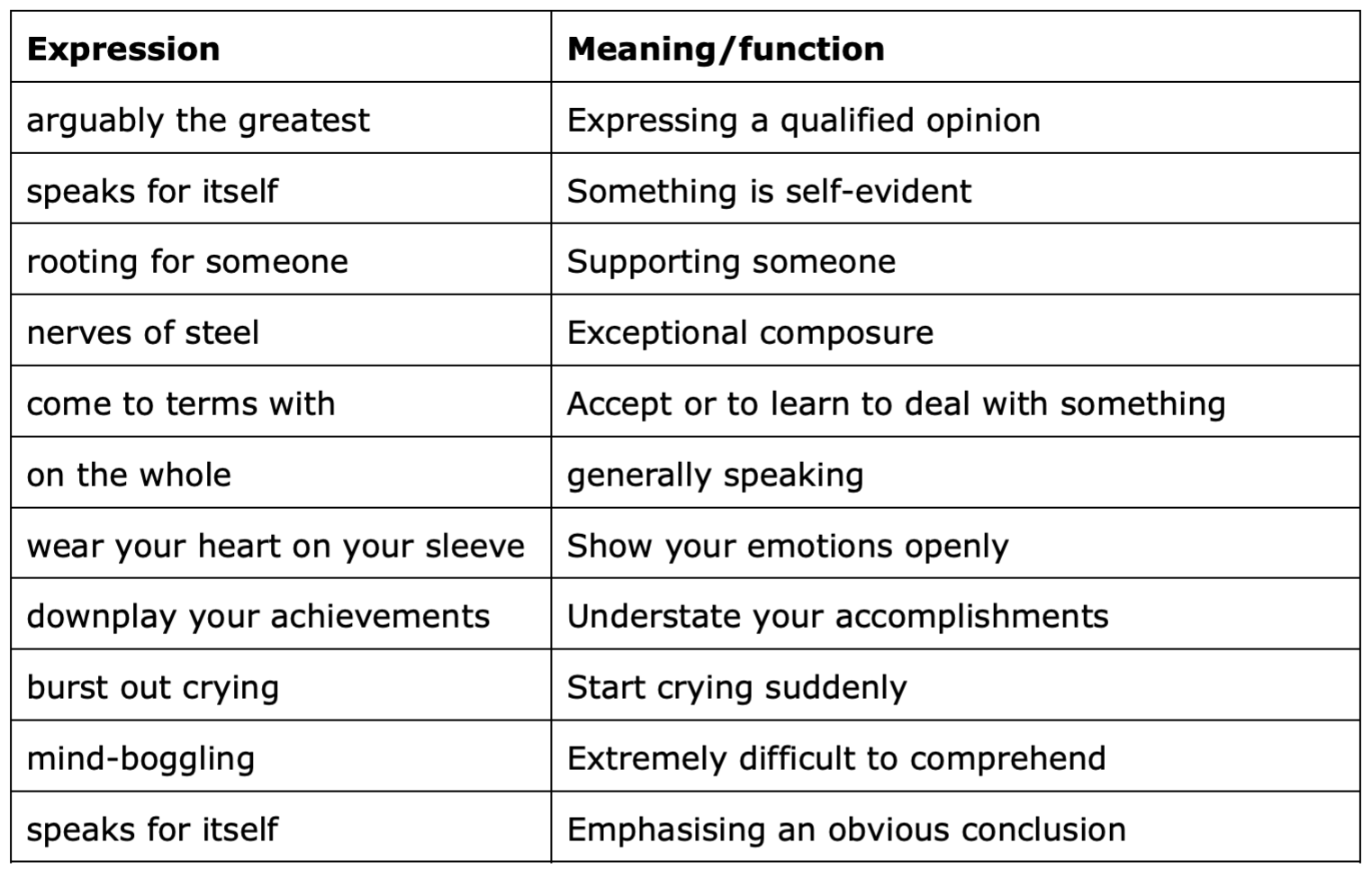
Grammatical features
Whenever a student asks me how to get band 9 in IELTS speaking, I show them the model response about Ronnie O’Sullivan due to its grammatical range, accuracy and the natural use of complex structures. It contains an excellent mixture of simple, compound and complex sentences, a variety of subordinate clauses, different verb forms and sophisticated grammatical constructions.
Let's examine the grammatical features in detail:
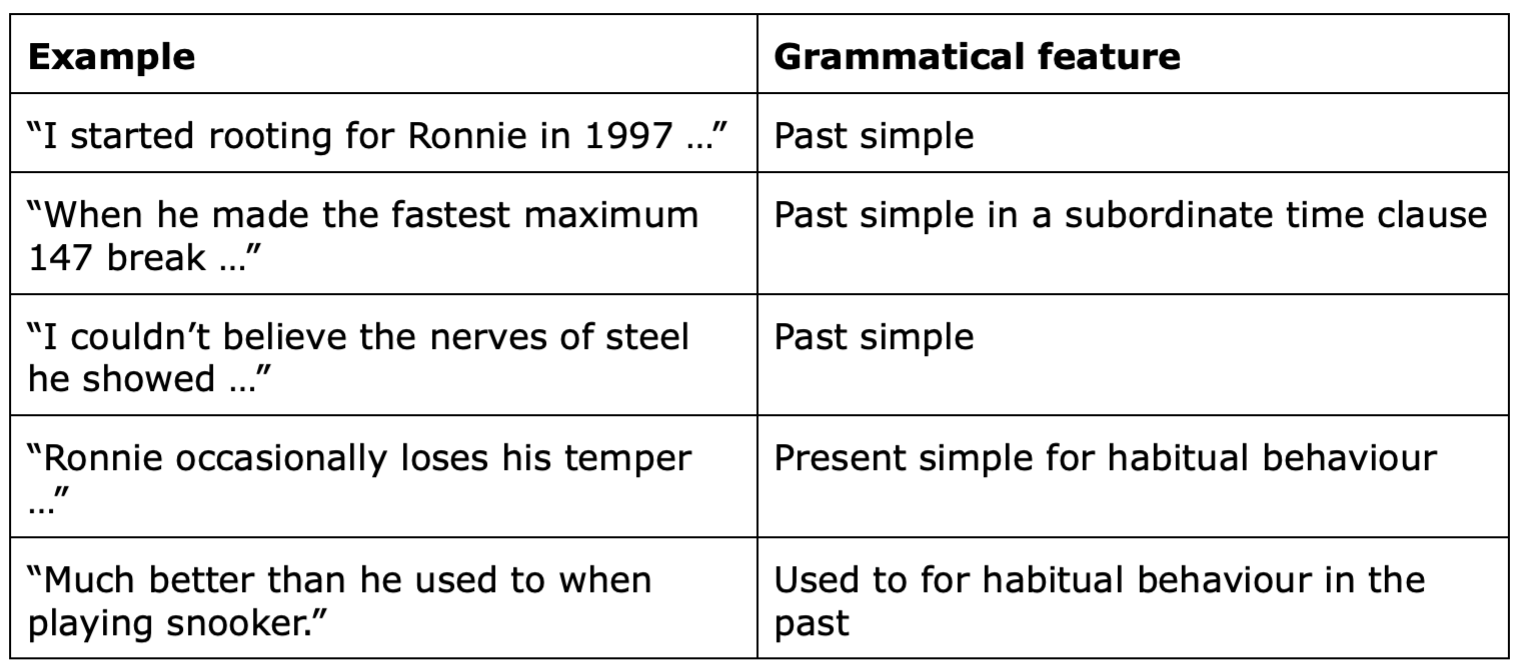
1. Past tenses and habitual actions
The speaker seamlessly switches between past and present tenses to describe Ronnie's career and development:
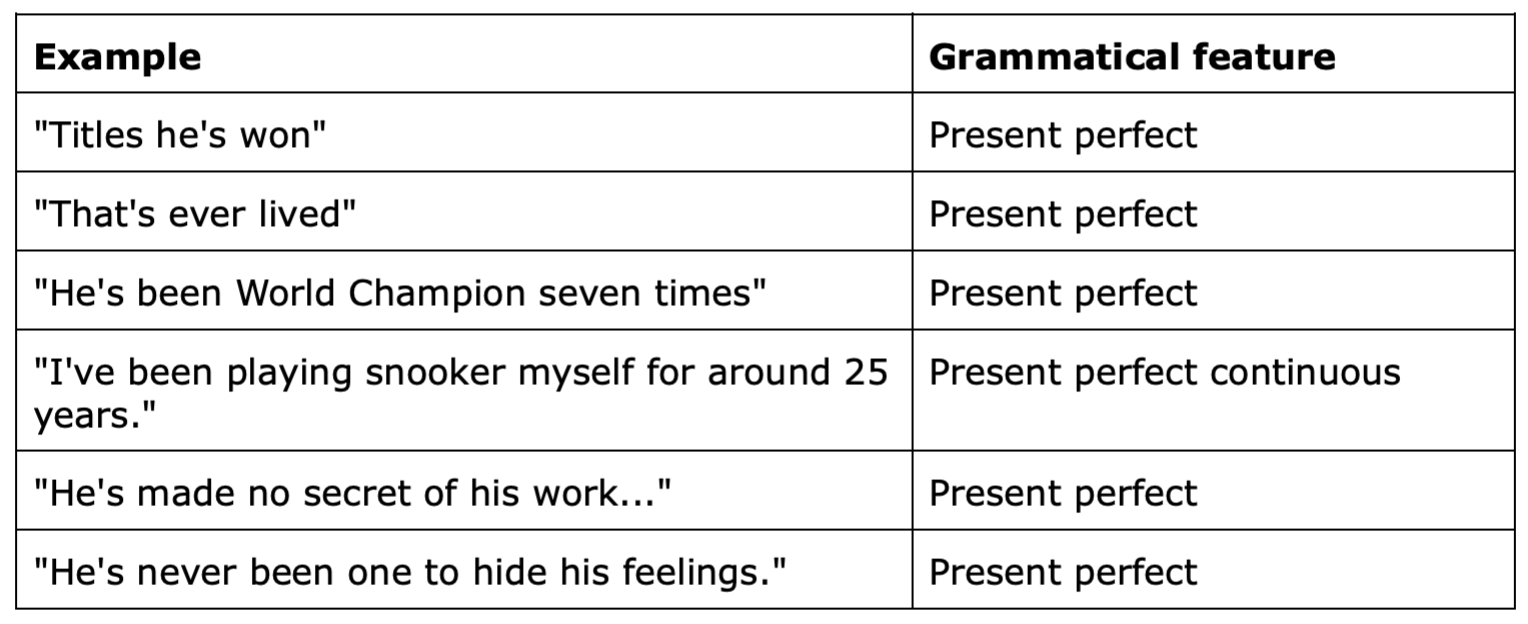
2. Perfect tenses
3. Discourse organisation and adverbial clauses
The speaker uses a variety of adverbial expressions to organise information and establish relationships between ideas:
- “When he made the fastest maximum 147 break” – time.
- “After winning the 2022 World Championship” – time.
- “Apart from his achievements on the table” – addition.
- “On the whole” – qualification/generalisation.
- “Especially 23 Triple Crown titles” – emphasis.
- “So it's mind-boggling” ... – result.
These adverbial phrases serve to help your thoughts flow naturally so the answer reads as one unified argument, not just a random list.
4. Modal verbs and modal expressions
The response demonstrates flexibility when it comes to expressing possibility and ability.
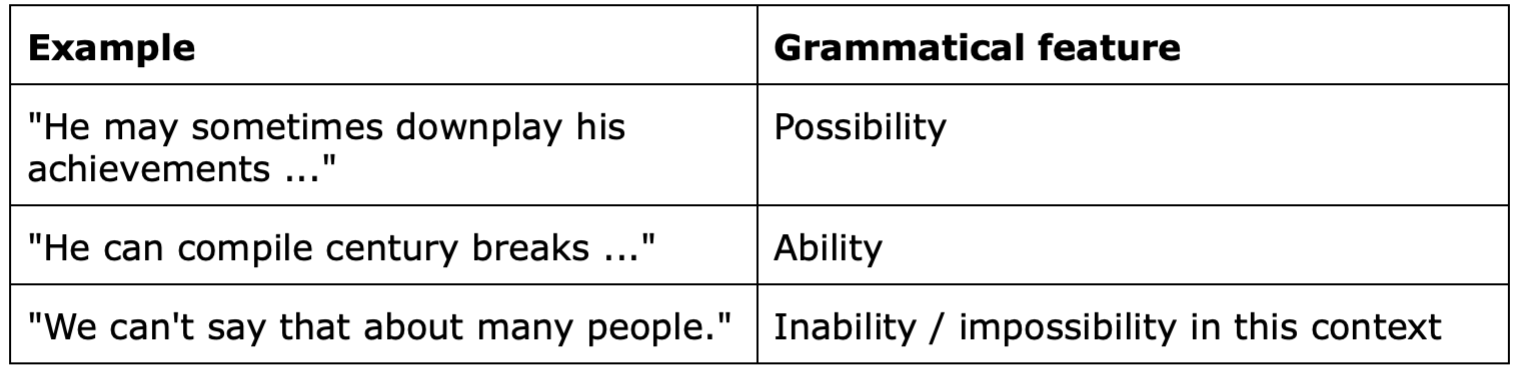
The first example with ‘may’ stands out for its effectiveness as it is a form of softening, or hedging, a statement. The speaker is aware of Ronnie’s tendency to minimise (downplay) his achievements, but uses ‘may’ so as to avoid stating it as an absolute certainty. Therefore, "Ronnie may sometimes downplay …” sounds more polite than “Ronnie downplays …”.
‘May’ also sets up a concessive clause in the speaker’s turn:
… ; however, he’s never been one to hide his feelings.
Although Ronnie doesn't show much pride or excitement when he performs well or receives praise in interviews, he's quite open about his innermost feelings.
5. Complex sentences and subordinate clauses
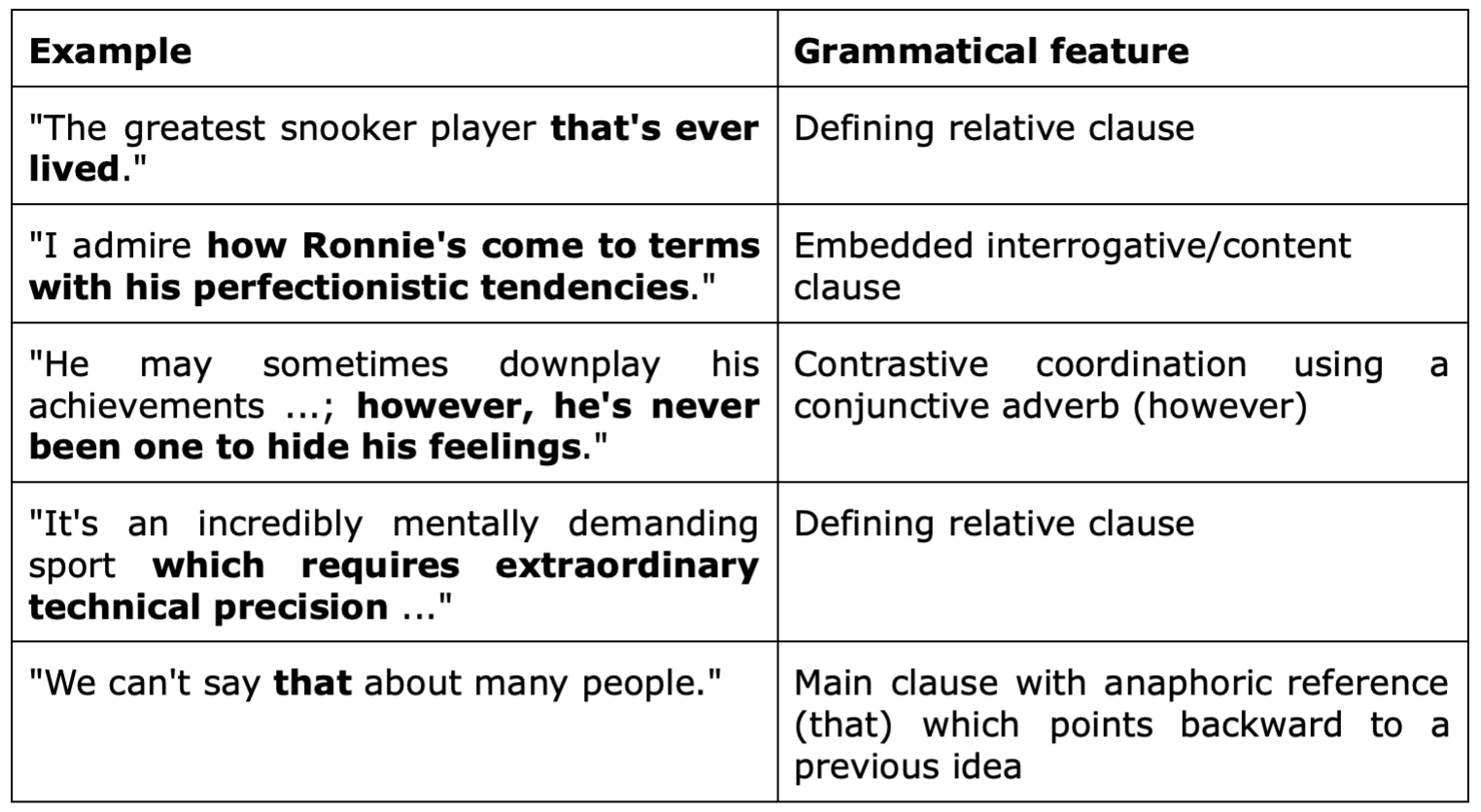
6. Emphatic constructions
There are several examples of emphatic constructions which are representative of natural spoken English.
For example:
(a) "It's mind-boggling that Ronnie can compile century breaks with both hands."
Compare:
- “Ronnie's ability to compile century breaks with both hands is mind-boggling.”
- “It's mind-boggling that Ronnie can compile century breaks with both hands.”
The second construction is particularly natural in spoken English.
Other natural combinations include:
- simply astonishing
- utterly remarkable
- truly exceptional
- absolutely phenomenal
- quite extraordinary
- incredibly impressive
Band 9 IELTS candidates should strive to express stronger opinions with such adverb + adjective combinations rather than relying on basic adjectives such as good, great, excellent or amazing.
Summing up
If you display grammatical variety within single sentences, the examiner will reward you generously for the Grammatical Range and Accuracy assessment criterion. This sentence does just that:
Ronnie occasionally loses his temper but, on the whole, he's able to handle his emotions much better than he used to when playing snooker.
Notice the combination of:
- present simple (loses)
- modal construction (is able to handle)
- comparative structure (much better than)
- used to - expressing a past state or habitual behaviour
- reduced time clause (when playing snooker)
IELTS Speaking Part 2 – A Model Answer Demonstrating Band 5.5-Level Language
“Someone I admire is Ronnie O'Sullivan. He is a famous snooker player from England and I know him because I sometimes watch snooker on TV.
I first knew about him many years ago when I was watching a snooker competition with my father. He was playing very well and I thought he was a very good player. After that, I started watching more of his matches and became interested in his career.
He is famous because he has won many competitions and he is one of the best players in the world. He has won the World Championship seven times and he can make very high scores. I think he is also famous because he can play with both hands, which is not very common in snooker.
The main reason why I admire him is because he is very talented and he works hard. I also like his personality, although sometimes he gets angry when he doesn't play well. But I think this is normal because professional sport is very difficult and players have a lot of pressure.
I have played snooker a few times myself, but I'm not very good at it. When I watch Ronnie playing, I can see that it's not easy to play like him. He is very good at controlling the balls and he can make difficult shots look easy.
So, I think he is a great sportsman and I hope he will continue playing for many more years. That's why he is someone I really admire.”
Analysis of Grammatical Range and Accuracy + Lexical Resource
This response would only score around Band 5.5 for several reasons, including:
- basic organisation
- repetitive linking (e.g. “I think …)
- limited development of ideas
- repetition of basic vocabulary such as good, play, famous and very
- heavy reliance on simple sentences
- basic expressions (e.g. look easy and very talented)
IELTS Speaking Part 3: Handling Abstract Questions
In Part 3, you will have to answer questions related to the topic on your part 2 task card. Due to the abstract, deep and philosophical nature of the questions, your answers will also have to be abstract, analytical, elaborate and of greater depth than the answers you gave to the questions in part 1. In general, the examiner’s questions in part 3 will provide you with an opportunity to express your views and personal reflections.
The examiner may go off script here. They are free to adjust, add and leave out questions which are on their exam sheet. They may ask strong candidates more challenging questions.
Remember that this is a test of your English language skills rather than the content of your answers.
Comparing IELTS Speaking Part 1 and Part 3 Questions
The following examples of part 1 and part 3 questions illustrate the difference between personal questions (part 1) and abstract questions about ideas and concepts (part 3):
Example 1: Education
Part 1 – Personal questions
- Did you enjoy studying at school?
- What was your favourite subject?
- Do you prefer studying alone or with your classmates?
- Is there anything you would like to learn in the future?
Part 3 – Abstract questions
- How has the education system changed over the last few decades?
- Should schools place greater emphasis on practical skills than traditional academic subjects?
- To what extent is a university degree necessary for career success?
- What role should governments play in ensuring equal access to education?
Example 2: Technology
Part 1 – Personal questions
- What do you mainly use the internet for?
- Did you use technology much when you were a child?
- What app do you use most?
- Is there any piece of technology you would like to own?
Part 3 – Abstract questions
- Do the advantages of social media outweigh its disadvantages?
- To what extent should parents monitor their children's use of technology?
- Will technology replace teachers in classrooms - do the pros outweigh the cons?
How long does part 3 last?
This part of the speaking test lasts for 4 to 5 minutes.
What skills are tested?
Part 3 assesses candidates' ability to explain their opinions and to analyse, discuss and speculate about issues.
Common Types of Questions for IELTS Speaking Part 3
There are very many types of questions in part 3. This doesn’t mean that the examiner will ask you every type of question. Most of the examiner’s questions will build on what you have said in your previous response. However, they will mix it up to ensure that you answer a variety of question types.
1) Opinion questions
One of the most straightforward question forms in part 3 is being asked to give your opinion. The examiner may ask you to share your perspective on a general social or cultural issue.
- What they test: Your ability to express a clear position and substantiate it with logical arguments and relevant examples.
- Common phrasing: “Do you think that …”, “Should governments …”, “What is your opinion on …”
You can use one of the following phrases to give your opinion:
- From my point of view …
- As far as I’m concerned …
- As I see it …
- I’d say that …
- I feel sure that …
Question: Do you think a university degree is still necessary for a successful career?
Model response: “ I wouldn't go so far as to say that a university degree is essential for a successful career, although I think it certainly gives people a competitive edge in certain professions. For instance, if you want to pursue a career in law, medicine engineering, having a relevant academic qualification is pretty much a prerequisite. Having said that, I think we're seeing a shift towards a more skills-based job market, where employers are increasingly concerned with what candidates can actually bring to the table rather than simply what qualifications they hold. In the technology sector, for example, practical experience, problem-solving abilities and a strong portfolio can sometimes carry more weight than a university degree. So, on balance, I'd say that while higher education can open doors and provide a solid foundation for a career, it's certainly no longer the only route to professional success.”
Why is this a strong IELTS Speaking Part 3 Band 9 answer?
- presents a balanced viewpoint rather than an overly simplistic yes/no response
- supports ideas with relevant examples
- uses a range of expressions and lexical chunks which are very natural
- develops the argument logically using contrasting and qualifying expressions (e.g. having said that …)
- finishes with a clear, nuanced conclusion
2) Compare and contrast questions / Changes and trends questions
Compare and contrast questions and ‘change’ questions may require you to compare past and present, or contrast two different methods, places or groups.
- What they test: Your ability to employ comparative structures to emphasise differences between periods of time, generations, or genders.
- Common phrasing: "How has [X] changed compared to the past?", "What is the difference between [X] and [Y]?"
Example questions:
- How do shopping habits today differ from those of your parents' generation?
- How do the reading habits of young people today differ from those of their grandparents?
- How do you think people's lifestyles have changed over the last 50 years?
- How do the attitudes of younger and older people towards work differ?
- What are the main differences between living in a city and living in the countryside?
- How has the education system changed since your parents were children?
- How has public transport changed in your country over the last decade?
- Are children today more independent than children were several decades ago?
Question: How do people's leisure activities differ depending on their age?
Model response: “ I believe people's leisure activities tend to vary quite considerably depending on their age, mostly because their priorities and lifestyles change over time. Younger people are generally more inclined to engage in physically demanding or socially oriented activities, such as going to music festivals, playing team sports or socialising with friends. By contrast, older adults may favour more leisurely pursuits, such as gardening, reading or going for walks. Having said that, I wouldn't want to generalise too much, as individual interests and personality traits also play a significant role. Ultimately, I think the main difference is that people's leisure preferences tend to evolve as their circumstances and responsibilities change.”
Why is this a strong IELTS Speaking Part 3 Band 9 answer?
This response compares two age groups, uses a range of comparative structures (e.g. By contrast …), explains the reasons behind the differences and introduces a qualification rather than making sweeping generalisations.
3) Future / prediction questions
It’s possible that the examiner will ask you a question where you have to speculate about the future. This is another type of question which demands an opinion. However, this time you will have to answer using forms which express future time.
- What they test: Your ability to speculate and use future tenses and modal verbs of probability (e.g., might, could, are likely to).
- Common phrasing: "How do you think [X] will change in the future?", "What will happen if..."
Example questions:
- Do you think traditional newspapers will completely disappear in the next ten years?
- How might people's relationship with technology change in the next few decades?
- Do you think people will work fewer hours in the future?
- What challenges will young people face when entering the job market in the future?
- Do you think renewable energy will eventually replace fossil fuels?
- Do you think future generations will have a better work-life balance?
- How might technological developments change the way people travel?
- Do you think social media will become even more influential?
Question: How do you think cities will change in the future?
Model response: “ I imagine cities will become considerably more technologically advanced and environmentally friendly. For instance, we might see far more green spaces incorporated into urban landscapes, with buildings featuring rooftop gardens and vertical forests to improve air quality.
I’m also inclined to believe that autonomous vehicles will become commonplace, while public transport systems will be increasingly automated. That said, I doubt these changes will happen at the same pace everywhere, as less affluent cities may struggle to keep up with technological advancements.”
Why is this a strong IELTS Speaking Part 3 Band 9 answer?
- Speculation: I imagine ... / I suspect ... / I doubt ...
- Future predictions: will become commonplace / will be increasingly automated
- Advanced chunks and collocations: urban landscapes / autonomous vehicles / technological advancements / improve air quality / keep up with
- Contrast and qualification: That said ... / I wouldn’t necessarily say that …
4) Hypothetical questions
Hypothetical questions demand that you speculate about unreal or imagined scenarios.
- What they test: Your ability to discuss hypothetical situations using conditional structures, especially the second conditional.
- Common phrasing: "What would happen if ...", "If you could change ..."
Example questions:
- What would happen to society if people no longer needed to work for money?
- What would happen if university education were free for everyone?
- How would you feel if artificial intelligence replaced teachers in schools?
- How would society change if everyone worked a four-day week?
- What would happen if private cars were banned from city centres?
- How would people's lifestyles change if petrol and diesel cars were no longer available?
Question: How would society change if everyone worked a four-day week?
Model response: “ If everyone had to work a four-day week, I imagine people would enjoy a much better work-life balance, as they would have more time to spend with their families, pursue hobbies and simply unwind. It could also lead to higher levels of productivity, as employees might feel more motivated and less stressed. Having said that, I suppose businesses in certain industries, particularly healthcare and hospitality, might struggle to implement such a system.”
Why is this a strong IELTS Speaking Part 3 Band 9 answer?
- Hypothetical language: If everyone had to work a four-day week... (second conditional).
- Speculation: I imagine ... / I suppose ... / I might ...
- Advanced vocabulary: work-life balance / productivity.
- Natural collocations: pursue hobbies / implement a system.
- Developing ideas: explains the potential benefits before considering practical limitations.
- Contrast: 'having said that ...' introduces a counterargument.
5) Cause and effect questions
- What they test: Your ability to explain why a phenomenon occurs and what wider consequences it has for society.
- Common phrasing: "Why do you think ...", "What are the reasons for ...", "What is the impact of ..."
Example questions:
- What impact does a lack of physical education have on children's development?
- What are the consequences of employees working excessively long hours?
- What effect does social media have on people's relationships?
- Why do so many people choose to move from rural areas to big cities nowadays?
- What impact can climate change have on future generations?
- What are the consequences of not getting enough sleep?
- What impact does parental pressure have on children's development?
Question: Why are increasing numbers of people leading sedentary lifestyles, and what consequences can this have for society?
Model response: “ I think one of the main reasons is the increasing reliance on technology, both at work and in people's everyday lives. Many people spend several hours sitting in front of a computer, and when they get home, they tend to unwind by watching TV or browsing social media rather than engaging in physical activities. Over time, this can lead to various health issues, including obesity and cardiovascular disease. On a wider scale, it could place additional strain on a nation’s healthcare system, as governments may have to allocate more resources to treating preventable conditions.”
Why is this a strong IELTS Speaking Part 3 Band 9 answer?
- Cause: Increasing reliance on technology.
- Explanation: More time spent sitting at work and at home.
- Immediate effects: Obesity and cardiovascular disease.
- Wider consequence: Greater pressure on healthcare systems.
Learning how to get Band 9 in IELTS Speaking involves mastering a range of non-linguistic skills and this is one of those. For many types of questions, you could use a simple chain of reasoning to develop your answer.
Cause → Immediate effect → Wider consequence
If you do follow this chain of reasoning, you will be able to produce extended, logically developed answers as opposed to listing reasons and ramifications.
6) Advantages and disadvantages questions
- What they test: Your ability to consider an issue unbiasedly from two opposing sides.
- Common phrasing: "What are the benefits and drawbacks of ...", "Do the advantages of [X] outweigh the disadvantages?"
Example questions:
- What are the advantages of living in a city compared to living in the countryside?
- What are the advantages and disadvantages of working from home?
- How can living in a large city benefit individuals?
- What are the advantages and disadvantages of online education?
- What are the benefits and drawbacks of working abroad?
Question: What are the advantages and disadvantages of living in a large city?
Possible response: “ I think one of the main advantages is the wider range of opportunities available, particularly when it comes to employment, education and entertainment. People also tend to have access to better public transport and a greater variety of services. Having said that, one significant downside is the higher cost of living, which can make it difficult for people to afford decent accommodation. Another drawback is the increased levels of noise and pollution, which can have a detrimental effect on people's health and overall quality of life.”
Why is this a strong IELTS Speaking Part 3 Band 9 answer?
- Addressing both sides: The candidate discusses several advantages and disadvantages.
- Developing ideas: Each point is explained rather than simply listed.
- Comparative language: A wider range of opportunities, a greater variety of services.
- Advanced vocabulary: A significant drawback, a detrimental effect, overall quality of life.
- Discourse markers: The cohesive devices Having said that and Another drawback help organise the response and introduce contrasting ideas.
7) Problem and solution questions
- What they test: Your ability to identify challenges in society and put forward practical fixes.
- Common phrasing: "What problems are caused by ...", "How can [X] be solved?", "What can individuals or governments do about ..."
Example questions:
- What can governments do to reduce traffic congestion in major cities?
- What challenges do elderly people face in modern society, and what can be done to support them?
- Why is obesity becoming increasingly common, and what measures could be taken to tackle this issue?
- What problems can excessive tourism create, and how could these be overcome?
Question: What problems are associated with increasing levels of traffic congestion, and what could be done to address this issue?
Possible response: “ I think one of the main issues is the additional time people have to spend commuting, which can lead to increased stress and have an adverse impact on their work-life balance. Another concern is the environmental damage caused by vehicle emissions, particularly in densely populated built-up areas. As for possible solutions, governments could invest more heavily in public transport infrastructure and make it more affordable and convenient. They could also introduce incentives for people to walk or cycle as opposed to relying on their cars for shorter journeys.”
Why is this a strong IELTS Speaking Part 3 Band 9 answer?
- Identifying problems: The candidate identifies traffic-related stress and environmental damage.
- Explaining consequences: The response explains how congestion affects commuting times and work-life balance.
- Suggesting solutions: Two practical measures are proposed: improving public transport and encouraging alternative forms of transport.
- Advanced vocabulary: Vehicle emissions, densely populated built-up areas, public transport infrastructure.
- Grammatical range: Modal verbs (could invest, could introduce) are used to propose possible solutions.
IELTS Speaking Part 3 strategy: The Five-Layer Approach
Conventional advice on the Internet regarding how to score highly for part 3 revolves around giving an opinion, explaining it and providing an example.
However, the strategy I will outline below, which we shall call ‘The Five-Layer Approach’, will help you to build stronger answers, one layer at a time. Essentially, it’ll help you to expand your answers as you move from giving an immediate response to offering a broader perspective.
If you want to know how to get band 9 in IELTS speaking, you have to engage in deeper thinking and the ability to sustain a discussion without sounding rehearsed.
The Five-Layer Approach
This strategy will help you to develop more substantial, coherent and sophisticated answers in IELTS Speaking Part 3.
Layer 1 - Direct response
State your opinion or stance clearly. Avoid repeating the question or rambling introductions.
Useful expressions:
- I would argue that...
- To a certain extent, I think...
- Generally speaking, I'd say that …
Layer 2 - Explanation
Explore why you hold the opinion you introduced in Layer 1. Identify the underlying reasons, causes, factors or justifications.
Useful expressions:
- One of the main reasons for this is ...
- This is largely because ...
- The underlying reason is that …
Layer 3 - Consequences
Now you should explain the implications of the phenomenon or situation you have already begun to discuss.
Useful expressions:
- This can potentially lead to ...
- As a consequence, ...
- One of the wider implications is that ...
Layer 4 - Wider Perspective
Now you need to look beyond the individual and respect the bigger picture. Consider the impact of the issue on society, local communities, the economy, businesses or future generations.
Useful expressions:
- On a broader level, ...
- From a societal perspective, ...
- Looking at the bigger picture, ...
Layer 5 - Qualification
The final layer demands that you acknowledge exceptions, limitations or opposing arguments. You need to demonstrate that you can evaluate an issue as opposed to simply defending a single stance.
Useful expressions:
- Having said that, ...
- That isn't necessarily the case for everyone, though
- Admittedly, there is another side to this issue
- There are certain circumstances under which this might not work
Putting the five layers into practice
IELTS Speaking Part 3 question: Do you think working from home is beneficial for employees?
Layer 1 – Direct response
"Yes, I would argue that working from home is generally beneficial for employees."
Layer 2 – Explanation
"One of the main reasons for this is that it gives people considerably greater flexibility when planning their working day."
Layer 3 – Consequences
"Consequently, they may find it easier to balance their professional responsibilities with their personal commitments, which could ultimately reduce stress."
Layer 4 – Wider perspective
"On a broader level, businesses could also benefit from improved employee retention and lower expenditure on office space."
Layer 5 – Qualification
"Having said that, I wouldn't suggest that it's necessarily suitable for everyone, particularly those who rely heavily on face-to-face interaction to remain motivated and productive."
The complete response
" Yes, I would argue that working from home is generally beneficial for employees. One of the main reasons for this is that it gives people considerably greater flexibility when planning their working day. Consequently, they may find it easier to strike a balance between their professional responsibilities and personal commitments, which could ultimately reduce stress. On a broader level, businesses could also benefit from improved employee retention and lower expenditure on office space. Having said that, I wouldn't suggest that it's necessarily suitable for everyone, particularly those who rely heavily on face-to-face interaction to remain motivated and productive."
The Power of the Five-Layer Approach
The five-layer approach develops several abilities that are important for achieving a Band 9 IELTS speaking score across the four assessment criteria:
- Fluency and Coherence - Develops answers logically instead of through disjointed statements
- Lexical Resource - Encourages multi-word combinations relating to causes, consequences, implications and qualifications
- Grammatical Range - Creates opportunities for subordinate clauses, conditionals, concessive structures and modal verbs
- Pronunciation - Creates the conditions for using sentence stress, prominence and intonation across extended stretches of speech
An important point is that you shouldn't feel obliged to incorporate all five layers into every response. You shouldn't feel compelled to introduce a societal perspective or qualification when it adds little to the discussion. It's vital that you adapt the depth of your response to the examiner's question.
Remember that your responses don’t necessarily need to be longer. They do, however, need to be effectively developed, coherent and flexible in order to promote natural, spontaneous English rather than formulaic IELTS performance.
Overall, treat the Five-Layer Approach as a thinking framework rather than a rigid response template.
IELTS Speaking Part 3 - Band 7 vs Band 9: Comparing two IELTS Speaking Test Samples
Let’s now turn our attention to two IELTS Speaking test samples for part 3. The first candidate achieved Band 7, while the second got Band 9.
IELTS Speaking test Part 3 - BAND 7 sample
In this Speaking test sample, Hendrik, who is from Germany, talks about ‘Famous people’.
Let’s assess the four marking criteria to see why this test taker was given a Band 7:
Fluency and coherence
In general, Hendrik can speak at length with ease and there is no loss of coherence.
For example:
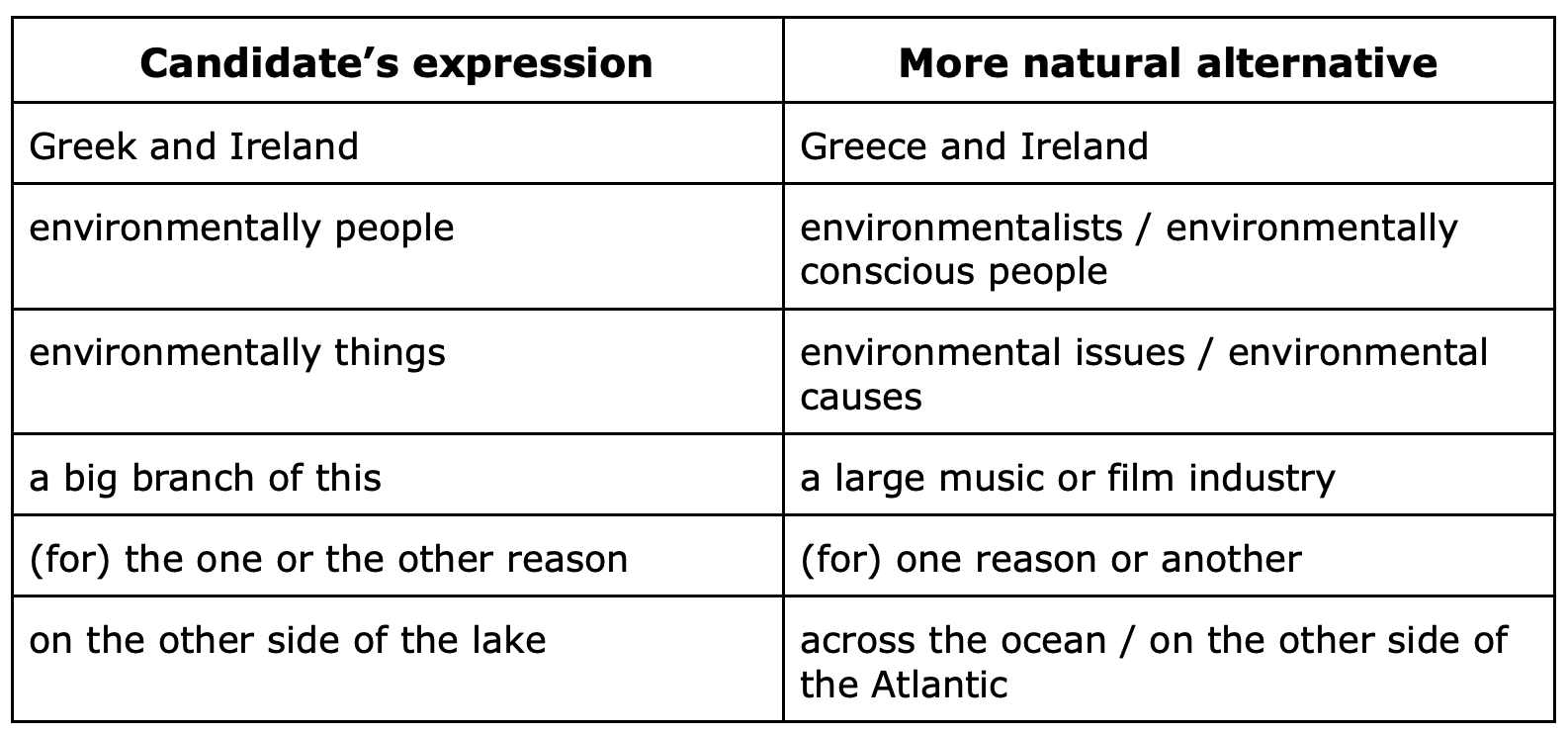
" They are only famous because it's easy to blame them for everything what happens. At the moment we have the financial crisis in Europe, especially Greek and Ireland really have to suffer at the moment. And yeah, it's easy to blame something. You can't blame a soccer player, but it's easy to blame the politicians."
Despite a few grammatical slips, Hendrik avoids giving short answers. Other positive features here include:
- an explanation to support his opinion
- the use of contrasting ideas to develop his argument
- an attempt to illustrate his point with a real-world example
Hendrik also uses a reasonable range of discourse markers:
- I would say...
- I think so, definitely.
- As I said...
- That's a good question.
- As long as...
Unfortunately, Hendrik overuses the filler yeah which makes his speech sound less controlled and is more typical of a Band 5 candidate.
Between 2:25 and 2:33, he uses many conversational fillers (“erm” and “err”) due to the fact he hasn’t got any examples of famous people used in advertisements.
There are also some problems with referencing and cohesion:
"A celebrity has done something in his life and many people admire him for the one or the other reason."
The expression for the one or the other reason is not particularly natural. He probably wanted to say ‘for one reason or another’.
Lexical resource
Hendrik fares very well in this category. He uses a wide range of vocabulary, including some less common and idiomatic items and effective collocation:
- easy to blame
- global warming
- financial crisis
- he stands for something
- can’t stand the pressure
He also demonstrates an ability to discuss abstract issues, including moral responsibility, celebrity influence and the environmental movement.
Despite demonstrating a relatively wide vocabulary, the main factor which prevents a higher score is a lack of precision. Consider the following examples:
Grammatical range and accuracy
This criterion is Hendrik’s weakest one.
Although there may be some issues with execution, Hendrik demonstrates a reasonable range of grammatical structures, including:
- simple sentences
- complex sentences
- relative clauses
- conditional structures
- subordinate clauses
- coordinating conjunctions
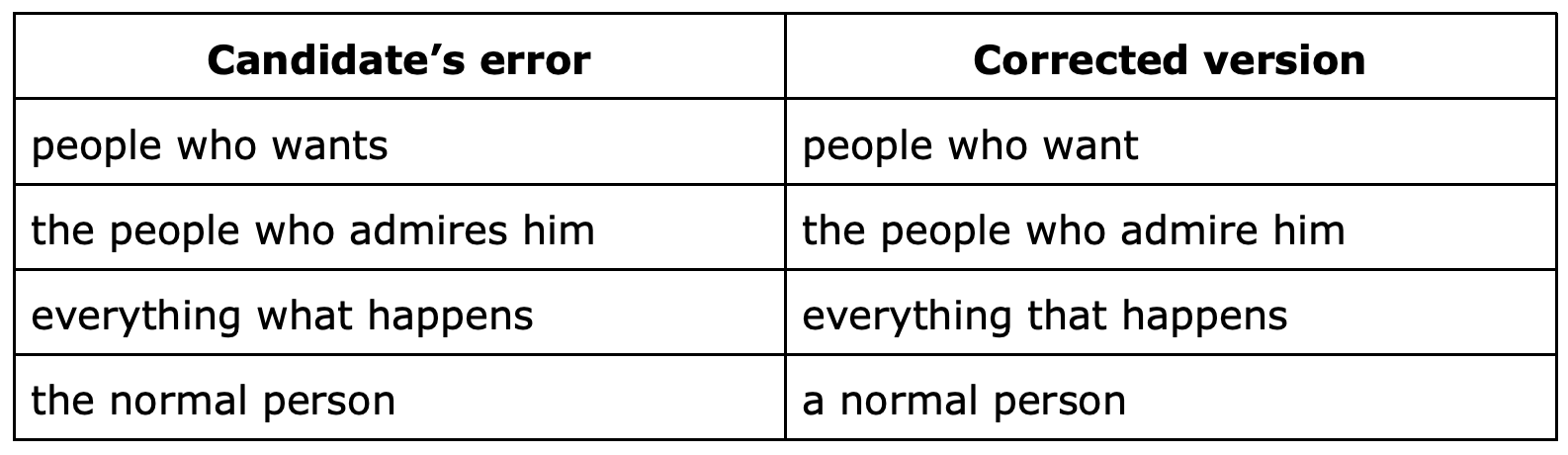
There are recurring grammatical errors, including subject-verb agreement, articles and relative pronouns.
Here are some examples from the official examiner comments:
Pronunciation
Hendrik’s pronunciation is clear and easy to follow.
In particular, he demonstrates effective use of:
- sentence stress
- intonation
- emphasis to convey meaning
One standout example is:
"You can't blame a soccer player, but it's easy to blame the politicians."
Hendrik makes excellent use of sentence stress and intonation to emphasise the contrast between the two groups.
He mispronounces several words :
- wole model for ‘role model’
- wong for ‘wrong’
- serf the planet for ‘serve the planet’
These mispronunciations occasionally affect clarity.
IELTS Speaking test Part 3 - BAND 9 sample
In this Speaking test sample, Anuradha, who is from Malaysia, talks about ‘Famous people’.
Let’s assess the four marking criteria to see why this test taker was given a Band 9:
Fluency and coherence
Overall, Anuradha speaks fluently and develops abstract ideas coherently. She extends her answers smoothly across numerous historical shifts, such as 1950s–60s vs. today, future globalisation and youth body image. Therefore, her handling of topic development is of Band 9 quality.
Only very occasional repetition or self-correction is present in Anuradha’s answers. Any hesitation is not to search for words or expressions but to prepare the content of the following utterance (Band 9 in the IELTS Speaking descriptor notes).
She has occasional filled pauses (um), minor restarts, and self-repetitions when formulating complex points or shifting perspective mid-thought, such as revising her stance on celebrity endorsements and consumerism (00:18 and 02:48).
Anuradha’s use of discourse markers and contrasts to structure her reasoning is entirely natural:
- compared to now
- on the other hand
- other than that
- as you can see
- whereas
Lexical resource
Anuradha handles abstract, sociological, and media-related topics effortlessly and with accuracy, using terms and idiomatic expressions such as:
- materialistically
- globalised
- consumerism
- endangered animals
- strike a chord
- have a tendency
- be exposed to
- the norm
Minor phrasing and collocation slips are present. For example, saying communication tool for movies in the 1950s-60s instead of a closer collocation like medium of entertainment/communication [00:41], and stripped with reference to animals being skinned or hunted for fur [05:03].
Grammatical range and accuracy
Anuradha uses a wide and natural range of complex structures and sentence types, including:
- conditionals/hypotheticals - would have a tendency, could cause them to go into, if you can see
- passive voice and passive infinitive structures - Anuradha uses the present simple passive on a number of occasions. Other examples of the passive infinitive and modal passive include: "have a tendency to be exposed to ..." [01:23], "... young girls would be exposed to thin models ..." [03:35], "... young boys could be influenced in a way ..." [04:06].
- relative/subordinate clauses - where people follow ..., that they should buy
- "compared to" (Group & Era Comparisons) - [00:50] - Uses compared to as a discourse anchor to pivot from the 1950s-60s to the present day; [01:30] - combines more + adjective + noun with compared to to contrast international celebrities against local public figures
- Progressive / Changing Comparatives (becoming + comparative and more + adjective) - "... the world is becoming more globalised … " [01:18] - Uses becoming + more + adjective to express a gradual, ongoing trend driving future change; "... models and celebrities ... are becoming thinner ..." [03:29] - Uses are becoming + comparative adjective (thinner) to describe a shift in body ideals witnessed in the media
- Contrastive Clauses with "whereas" (Opposing-State Comparisons) - " … because they think being thin is a norm whereas being healthy and being normal bodied is actually the norm ..." [03:46] - Uses whereas to contrast a perceived norm with what she believes is the healthier/actual norm
Overall, Anuradha’s responses are not without grammatical slips, e.g. possessive/article omission. However, these mistakes don’t impede comprehension.
Pronunciation
Anuradha's demonstrates clear articulation, as well as natural word and sentence stress. Her intonation is varied rather than monotone, especially when illustrating how an audience responds to a campaign poster [05:12].
Final Thoughts: How to get band 9 in IELTS speaking
I cannot promise that the techniques outlined in this extensive post will guarantee a Band 9 score in your IELTS Speaking Test. However, if you start preparing for the test several months in advance, you will be in the best possible position to develop the linguistic and analytical skills required to perform at Band 9 level.
What you don’t want to do before the speaking test is to endlessly worry about common myths. For example, it is fine to speak with your geographic accent. Your examiner will be more interested in intonation, word stress and clarity. Moreover, don’t feel you need to use long, obscure words. Your examiner will be looking out for collocational competence. Finally, don’t be afraid of making grammar mistakes. Even Anuradha, a clear Band 9 candidate, made some unexpected slips. The reality is - even native speakers slip up. In general, you will be rewarded if your control of complex structures is consistently flawless.
One of the keys to success
One of the keys to success in the IELTS Speaking test, particularly parts 2 and 3, is to buy precious thinking time without breaking flow. Proficient users of English do that by using conversational discourse markers. Conversational discourse markers are words and phrases that speakers use to organise their speech, signal forthcoming intentions, express attitudes, connect concepts and make conversational sound natural. The Band 9 descriptor Fluency and Coherence mentions ‘cohesive devices’ so don’t be afraid to use conversational markers.
Don’t go overboard with discourse markers. The objective is to use them appropriately and spontaneously. What is notably admirable about Anuradha’s part 3 sample is that she doesn’t produce dull mechanical signposts you’d usually find in a textbook, such as first of all, on the one hand and in a nutshell. At the right moments, high-scoring speakers inject their speech with natural interpersonal markers like other than that, it goes without saying that, whereas, the thing is and I suppose.
And finally ... Do you want to achieve Band 8 or 9 in IELTS Speaking?
I provide personalised IELTS Speaking coaching to help advanced English learners improve their fluency, vocabulary, grammatical range and pronunciation.
Reference
Selivan, L. (2018). Lexical Grammar: Activities for teaching chunks and exploring patterns, Cambridge: Cambridge University Press