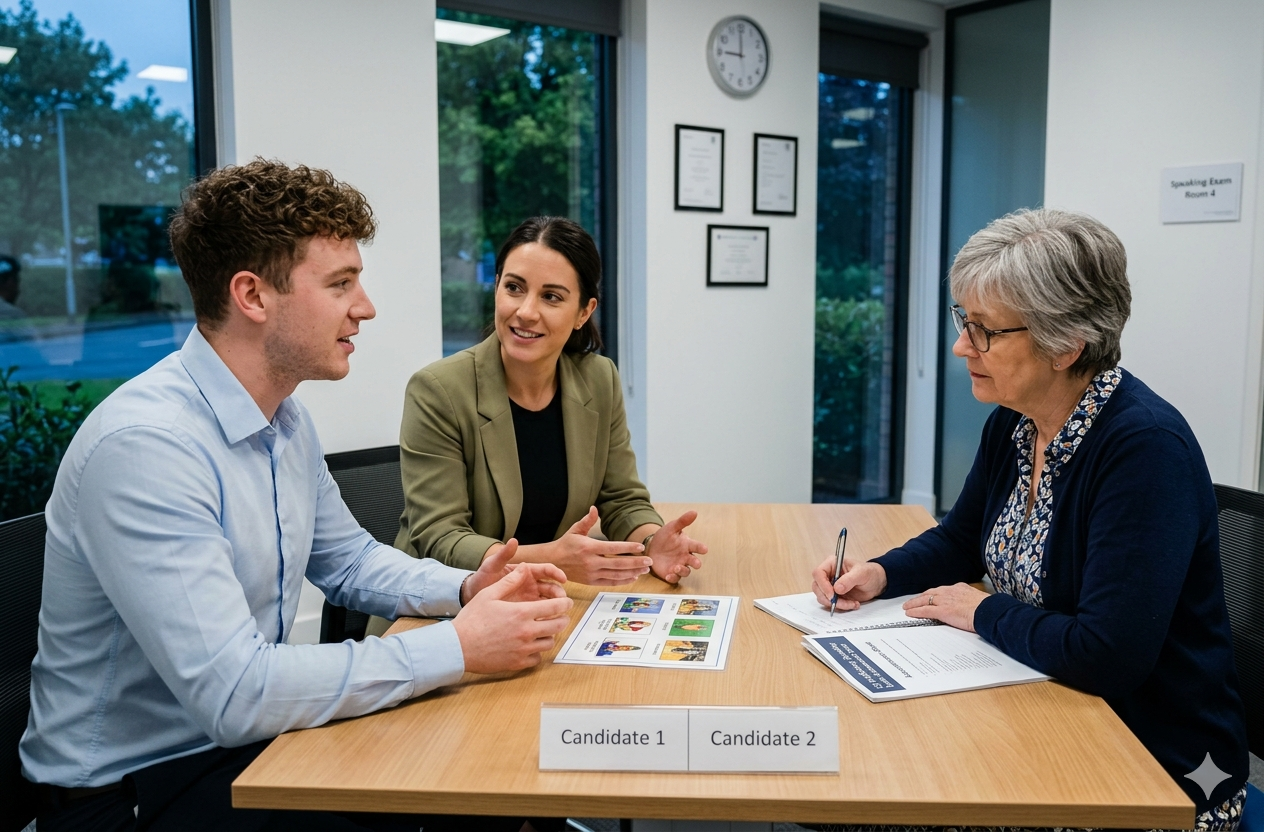

C2 Proficiency Speaking Test Sample
If you’re looking for a thorough analysis of a C2 Proficiency Speaking Test sample to help you prepare for your own speaking exam, you’re in the right place.
As a handy accompaniment to my complete guide to the C2 Proficiency speaking test, I present a breakdown of the strengths and weaknesses of each of the three candidates in each part of the test. Based in Madrid at the time of the recording, the candidates are Manuel (on the left), Jules (in the middle) and Thiago (on the right):
Part 1 - A Conversation on Familiar Topics
The opening task of the C2 Speaking test is a conversation on familiar topics. The interlocutor asks each candidate questions in turn. Candidates should respond to questions using general interactional and social language.
Timing:
- Pairs - 2 minutes
- Groups of three - 3 minutes
Question: Where do you live …?
Manuel: “Well I’m here from Spain and I live here in Madrid - mostly in the outskirts of the city.”
Comments: A rather nervous start. With “Well I’m here from Spain and I live here in Madrid”, there appears to be unnecessary wordiness and redundancy. Manuel could have said “I’m from Madrid” and then gone on to mention “on the outskirts of the city”, perhaps with an extra comment about the district he lives in.
_______
Jules: “I live as well here but I live on the heart of the city”.
Comments: An adequate response albeit with some surprising grammatical lapses:
- “I live as well here” (incorrect) → I live here as well (correct)
- “on the heart of the city” → IN the heart of the city (correct)
_______
Thiago: “I also live in Madrid - but I live in the leafy suburbs.”
Comments: There is little doubt that Thiago is an extremely proficient user of the English language. However, as with the other two candidates, I still think he could have constructed a longer sentence here along the lines of:
“I live in the leafy suburbs in a district called ______. It’s in the northern/southern/eastern etc part of the city.”
Question: Are you working or studying at the moment …?
Thiago: “I’m currently studying. It’s my second to last year of high school.”
Comments: This answer does the job, content-wise and in a grammatical sense.
______
Jules: “as well.”
Comments: I think Jules missed an opportunity here. First of all, her answer is barely grammatical. She should have added the personal pronoun ‘me’ - “Me as well” or “Me too”. Furthermore, the answer is too succinct. Even though she is in the same boat as Thiago, it’s still better to produce a more expansive sentence, or two. For instance:
“I’m also in my second to last year of high school and I’m planning to study xxxxxx at university in a few years’ time.”
______
Manuel: “Same thing.”
Comments: As with Jules, Manuel also missed an opportunity with his answer.
Question: What would you say is special about your home town …?
Manuel: “Well, I’d probably say the complete lack of noise because it’s actually quite peaceful around my area. There’s usually little to no cars and the peacefulness really helps you concentrate on certain things."
Comments: Manuel’s answer ticks the boxes in terms of grammar and content. However, his answer concerns his local area rather than his home town - Madrid. I think the question is getting at, for example, what the main attractions are in a city, or what the architecture is like.
Question: Are there many opportunities for you to speak English in your country …?
Jules: “Yes I think there are, mostly in school but as well in order to communicate and create new friendships with people all around the world.”
Comments: At C2 Proficiency level, it’s vital to learn collocations in the lead-up to the exam. This is evident with Jules’ use of “create friendships”. While ‘create new friendships’ is grammatically correct, it can sound a bit mechanical or forced to native speakers. More natural collocations include ‘make new friends’, ‘form friendships’, ‘forge friendships’ and ‘strike up friendships’.
With “people all around the world”, I have a feeling that Jules wanted to say “with people from all around the world”. Omitting the word ‘from’ makes a difference to the overall meaning of the utterance as the listener can only gather that people make friends with people when travelling around the world as opposed to making friends with foreigners in Spain.
Question: Apart from English, what other languages might be useful for you to study …?
Thiago: “So I think having a little bit of everything is useful. I speak Portuguese and I have plans to continue studying in Brazil so that would be very useful - it would very much come in handy to me.”
Comments: A very good answer with signs of interactional and social language, including “a little bit of everything” and “come in handy to me”. To avoid repetition, Thiago perhaps could have omitted “very useful” and just stuck with: so that would very much come in handy to me. However, given the pressure candidates are under, I think examiners would overlook such repetition and respect their efforts to weave chunks and collocations into their speech.
Thiago can also be commended for using the preposition ‘to’ after ‘come in handy’. One should use the preposition ‘to’ when the phrase (come in handy) connects a person receiving the benefit of that particular usefulness. Conversely, the phrases requires ‘for’ when connecting a useful item to a specific task, purpose of situation, as in:
This torch comes in handy for camping
Part 1 - Overall summary
For this part of the test, it appears that Cambridge English is content with very short answers which get straight to the point. However, I still think there’s tremendous potential for all of the candidates in our C2 Proficiency Speaking Test sample to elaborate their answers. Revelations such as “I live in the leafy suburbs” sound rather scripted and rehearsed.
Part 2 - A Collaborative Task Based on Photos
Part 2 is a collaborative task based on a set of photos. First of all, candidates discuss a question about two of the photos (1 minute for pairs, 2 minutes for groups of three). After that, they take part in a collaborative decision-making task, making reference to all the photos (3 minutes for pairs, 4 minutes for groups of three).
Skills tested include sustaining an interaction, exchanging ideas, expressing and justifying opinions, agreeing and/or disagreeing, speculating and reaching a decision through negotiation.
Timing:
- Pairs - 4 minutes
- Groups of three - 6 minutes
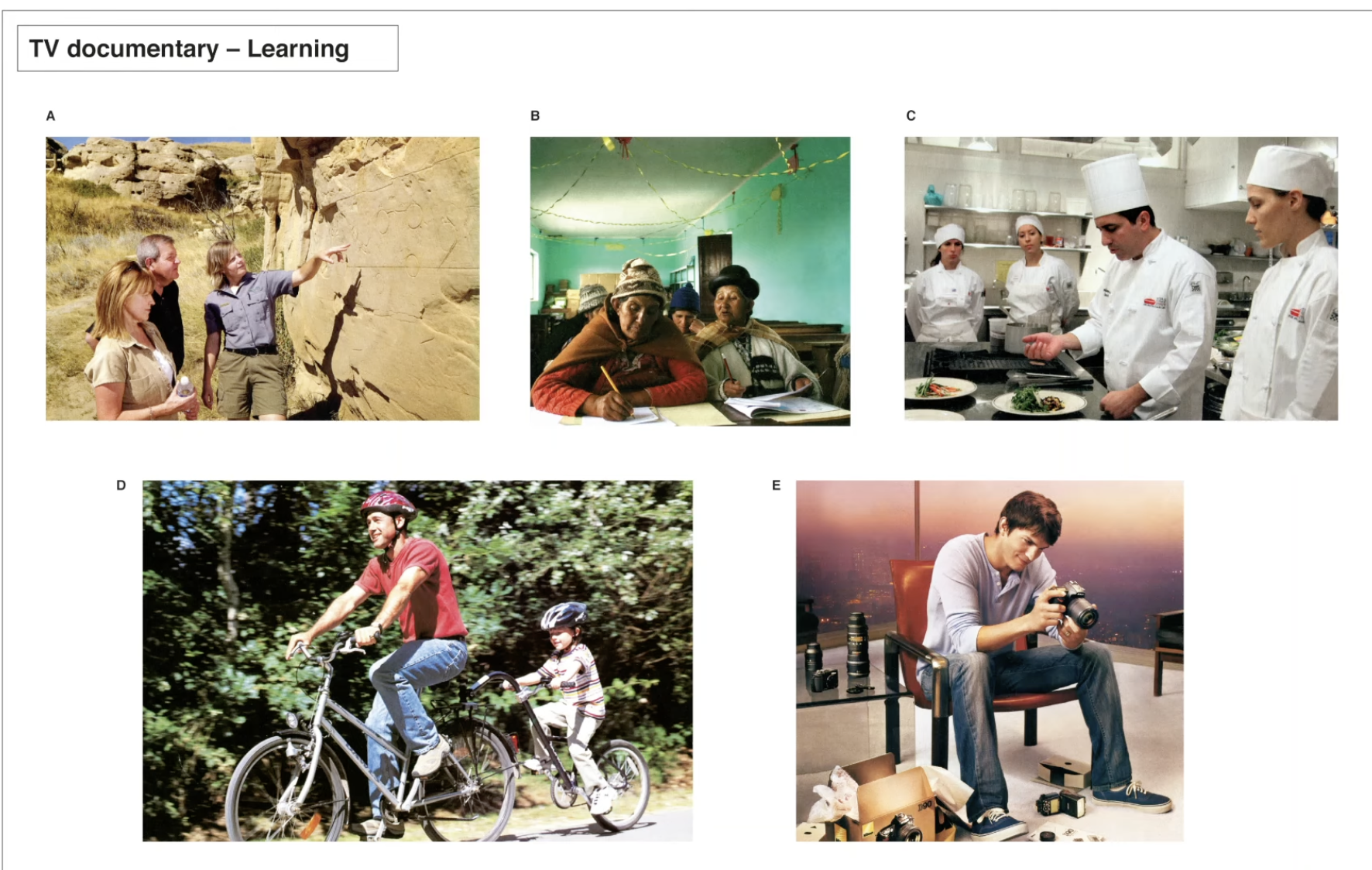
Task: Look at pictures D and E and talk together about what might happen in the next 30 minutes
Thiago (2:27-2:44): “So firstly we see a father and presumably his child and they’re going on a biking ride and they’re wearing helmets and it looks like they’re in a rural town or at least they’ve gone away from the city.”
Comments: Thiago sets the scene well, making good eye contact with the other candidates and the interlocutor. Despite the odd mistake (e.g. “going on a biking ride”, instead of bike ride), Thiago’s contribution illuminates just how natural his language can be (presumably, it looks like, at least). His confidence has already begun to shine through.
_______
Manuel (2:45-3:05): “It also seems that this might be a normal daily activity that they - that they perform. Or maybe it’s something special. Maybe they're out for a trip, that they're somewhere - they're going somewhere special or going to take a hike maybe.”
Comments: This is a good example of Manuel using extended language with a reasonable amount of ease and flexibility. It is a relevant and coherent contribution with some stumbling over thoughts: (“they’re somewhere they’re going somewhere”).
_______
Jules (3:05-3:15): “I see your point. I think maybe they might stop somewhere near because it looks as if they were on the countryside so maybe they’re going to make a stop to have lunch or something.”
Comments: Jules is able to produce continuous speech with a minimal amount of hesitation. However, she perhaps relies on unnecessary filler words, such as ‘maybe’, which do little else but to ‘fill the gaps’ and give off the impression that she’s hesitating, unsure or doesn’t really know how to develop her arguments.
Mistakes include “on the countryside” instead of in the countryside.
_______
Thiago (3:15-3:34): “Yes, maybe it’s something they do for fun. Umm - we also see a man with a camera and a lot of parts on the floor so maybe that’s his hobby as well and we can gather from these pictures that maybe these things are different things that people do for leisure time or just to have fun.”
Comments: Thiago agrees with Jules (“Yes”) and adds another argument as well in the same sentence (“maybe it’s something they do for fun”). This is certainly more effective than merely agreeing with another candidate.
Thiago’s use of ‘we’ is effective in the sense that it promotes conviction and a sense of collaboration with Jules and Manuel.
_______
Manuel (3:34-3:46): “Well, presumably, I - I think it’s that he’s actually trying to fix the camera and that’s why (err) he has all the spare parts on the floor”.
Comments: We see here the extent to which Manuel uses phonological features effectively to convey and enhance meaning. For instance, stress for emphasis is used on the words fix and parts. In fact, his word stress is invariably accurate, while his intonation and sentence stress are completely natural.
_______
Jules (3:46-4:00): “Or probably it might be a new camera and he’s trying to set it up. I do see your point so maybe he’s trying to start a new hobby instead of already being a permanent one.”
Comments: In terms of grammatical resource criteria which Cambridge considers when marking candidates in the speaking test, we are already beginning to see how much Jules is over-dependent on familiar verbs and other forms such as might and trying to. Moreover, she overuses certain phrases such as I (do) see your point.
Towards the end of this contribution, we can see that Jules struggles to formulate sentences in a natural way. Namely, “instead of already being a permanent one” could be replaced with instead of continuing a current one.
_______
Thiago (4:00-4:21): “And the settings are also very different from one another. We can see the contrast between the trees and the high (like) skyscrapers so I think it contrasts the different hobbies that we can have today. We live in an - an age where we’re - (like) we have open access to really (like) big cities and metropolitan areas but also the quiet (err) countryside.”
Comments: More appropriate vocabulary from Thiago with settings and metropolitan areas. For all his strengths, however, Thiago, as the leader of the group, still fails to steer his peers in the direction of answering the question at hand - what might happen in the next 30 minutes?
Thiago holds the floor a lot with the filler ‘like’. If I had to find fault with his speech, I think this would be it. In my mind, the ubiquitous use of ‘like’ in everyday English should not be transferred to a C2 speaking test.
Task: Look at all the pictures. I’d like you to imagine that a television documentary series is being planned on the experience of learning. These pictures show some different ways of learning. Talk together about how effective learning can be in these different situations. Then decide which approach to learning should be the focus of the first programme.
Thiago (4:54-5:22): “Right so we can see here a group (err) of people and they’re at an archaeological site and it looks like a tour or someone who knows very much about the topic is instructing them and pointing to the walls and the cliffs and so that’s more of a way of - that’s more expository (err) whereas you can see, for example, (in) a couple of chefs and they’re working on dishes and I think that’s more hands-on."
Comments: Thiago sets the scene well, encouraging his peers to begin tackling the question of how effective learning can be in the situations shown in the pictures. Again, he uses a wide range of appropriate vocabulary, such as expository and hands-on.
_______
Jules (5:22-5:34): “I do see your point. I think it’s more of a first-hand experience and it’s a great way, in my opinion, to get to (like) more comfortable with a new activity.”
Comments: In this turn, Jules relies heavily on what Thiago has said. Therefore, her turn is rather short and bereft of detail for the level. Many of Jules’ subsequent turns follow a similar pattern. Once again, Jules repeats “I do see your point.”
_______
Manuel (5:35-6:00): “Well … while I do agree that a hands-on experience does allow for better learning, I also believe that, actually, working more directly with each person and actually assessing their doubts and what they have to say about what they’re learning can help them gain a better understanding of what they’re actually learning.”
Comments: One of Manuel’s better contributions in terms of organisation of ideas and phonological prowess.
He opens his turn with a complex sentence (While I do agree …) which sets up a contrast after the initial concession. A complex sentence contains one independent clause (a complete thought that can stand alone) and at least one dependent clause (an incomplete thought that depends on the rest of the sentence). In this case, “while I do agree that a hands-on experience does allow for better learning …” is a dependent clause because it relies on the rest of the sentence (I also believe that ..) to make sense.
As with previous turns, Manuel uses stress for emphasis on the words in bold below:
While I do agree that a hands-on experience does allow for better learning, I also believe that …
_______
Jules (6:01-6:18): “I do see your point but I do think, for instance, parents helping their kids to learn new skills is really useful and it’s a better way for them to get to know the activity without getting into much risk.”
Comments: The same old cliches (I do see your point) and an over-reliance on simple lexis and chunks, such as a better way, really useful and get to know.
Jules attempted a collocation - getting into much risk. Presumably, she wanted to say ‘getting into too much danger’.
_______
Thiago 6:18-6:44: “Yes but there is also another way of learning - (like) is there. For example, now with a lot of access to the Internet we can just search up tutorials and look everything up on our own so maybe this person fixing or building, making his camera - (err) presumably he’s (err) watching a video or at least has some instructions so I don’t think that should be ruled out as well.”
Comments: Another thoughtful contribution from Thiago with regard to being self-taught. Perhaps he missed a few natural collocations, including:
- widespread access (to the Internet) / reliable access (to the Internet)
- assembling a camera
_______
Manuel 6:44-7:15: “Well I also believe that finding the correct (err) source of information for when you’re searching up these videos or tutorials is crucial to the learning experience because if you don’t search up the correct tutorial or maybe a tutorial that doesn’t go that in depth into a subject, it may give you a different view on a certain subject and it might alter your perception.”
Comments: Further appropriate and natural use of vocabulary with: go in depth into a subject and alter your perception. There is also evidence here that Manuel is willing to add ideas rather than simply confirm what Thiago has said.
_______
Jules (7:16-7:39): “I do agree with it but I also think maybe just fidgeting around with (for instance?) in this example the camera it can be as well a really useful way of getting to know it and just without any (like) tutorial or instructions you can get a good (like) idea of what it’s like and then you can develop on a subject with, as you said, (like) some type of external help.”
Comments: One of Jules’ more relevant and well-developed contributions which doesn’t solely rely on what another candidate has said.
_______
Thiago (7:39-7:57): “Yes I see what you all mean but in my opinion I believe that a hands-on experience is the best way to learn how to do some things so - chefs making a dish - you’re actually preparing something and so you know what you’re doing and you remember the steps from this procedure so you can put them to use next time.”
Comments: Another thoughtful contribution from Thiago, emphasising his belief that hands-on learning is more effective than other learning styles. The expression ‘put something to use’, meaning to apply a skill or ability, is another indication of Thiago’s knowledge of collocations/informal expressions.
_______
Jules (7:59 - 8:11): “I agree as well. I think we do all see eye to eye although we shouldn’t forget about the other types of learning experiences cos they - I think altogether might be the best.”
Comments: Jules can be credited for at least beginning the process of summarising and showing some evidence of taking the initiative.
Nevertheless, this turn is still somewhat confusing. Frankly, it is not really clear what Jules is trying to say about “the other types of learning experiences”. Which ones are best exactly?
_______
Thiago (8:11-08:30): “Yes like you said Manuel, maybe private teachers they can help you assess your doubts more closely and I think that appeals more to the individual but if you’re looking more at the experience and the product you’re making then I think - yes the hands-on experience working together with other people who are doing the same thing that you are - I think that’s the best way to learn.”
Comments: Following on from Jules’ effort to summarise, Thiago takes over here by summarising everything and attempting to reach an outcome.
With “like you said Manuel”, Thiago displays how capable he is of relating to, and expanding on, contributions made by his peers. I believe that examiners pick up on a candidate’s attentiveness to other speakers’ turns.
Part 3 - Individual long turn speaking task and group discussion
Part 3 of the speaking test comprises an individual long turn for each candidate. After that, a discussion takes place on topics related to the long turns. Each candidate in turn is given a written question to respond to. The interlocutor initiates a discussion to explore further the topics of the long turns.
Timing:
- Pairs - 10 minutes
- Groups of three - 15 minutes
Task (a) - Long turns
In this part of the test, you’re each going to talk on your own for about two minutes. You need to listen while your partner is speaking because you’ll be asked to comment afterwards.
So [CANDIDATE NAME], I’m going to give you a card with a question written on it and I’d like you to tell us what you think. There are also some ideas on the card for you to use if you like.
1a - Manuel:
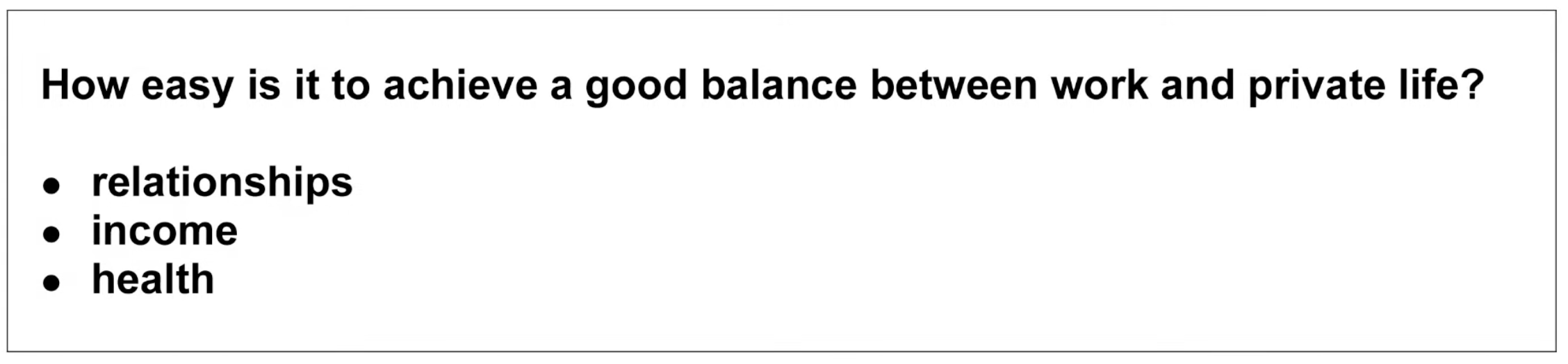
Manuel (9:20-10:10): “Well I believe that finding a balance between interpersonal and work life is actually quite difficult. There’s so many little things that you have to put your focus on when it comes to your work and then there’s the people around you in your (in your) private life. You have to focus on them as well.
It’s really hard to actually find time to, you know, both enjoy your leisure time with some friends or with family and actually focus(ing?) on your work - not to mention that sometimes you might want to take - take some days off to maybe set some time for your family or some colleagues, and that can be a detriment to your income in some aspects so I believe that it’s not as simple.”
Comments: First of all, Manuel didn’t make use of the two minutes available to him. His turn only lasted 50 seconds. I feel that he could have exploited the third bullet point - health - in order for his turn to last at least another 30 seconds.
In terms of language, I would say that Manuel stuck with rather simple forms and expressions, although there is still plenty of evidence of natural language use with finding a balance between, put your focus on and detriment to.
_______
Interlocutor to Jules (10:12 - 10:17): Do employers have a responsibility to help people achieve a work-life balance?
Jules (10:18 - 10:40): “I personally believe they do because, in my personal opinion, in order to get the most out of the work and just get the better work done possible (thi) this type of balance should be really taken to consideration and by helping the employees to achieve it they will be receiving a better feedback from them.”
Comments: Again, a rather poor response to the question, particularly at the end. Whether an employer receives feedback from employees or not is totally irrelevant to the question at hand.
As we have already established, Jules has a habit of using redundant filler phrases which negatively impact upon her responses. In this turn, she uses “in my personal opinion”. This particular phrase functions as "verbal clutter" because it merely adds word count without adding any new meaning. In technical terms, “in my personal opinion” is a pleonasm - a phrase which uses more words than necessary to express an idea. An opinion is, by definition, personal. Therefore, adding the word “personal” is entirely redundant. Jules would sound much more confident if she cut out such filler phrases. Besides, in this case, she had already begun her turn with “I personally believe …” which is more than enough when it comes to initiating a response to a question.
There are some grammatical lapses in Jules’ turn, such as the use of to instead of into (‘taken into consideration’).
_______
Interlocutor to Manuel (10:42-10:43): What do you think Manuel?
Manuel (10:43-10:55): “I completely agree. I think employers should really put their focus on what their employees have to deal with in their work and their private life and they should manage that as well.”
Comments: Manuel did the job, albeit with some repetition of previously used phrases such as ‘put focus on’.
1b - Jules:
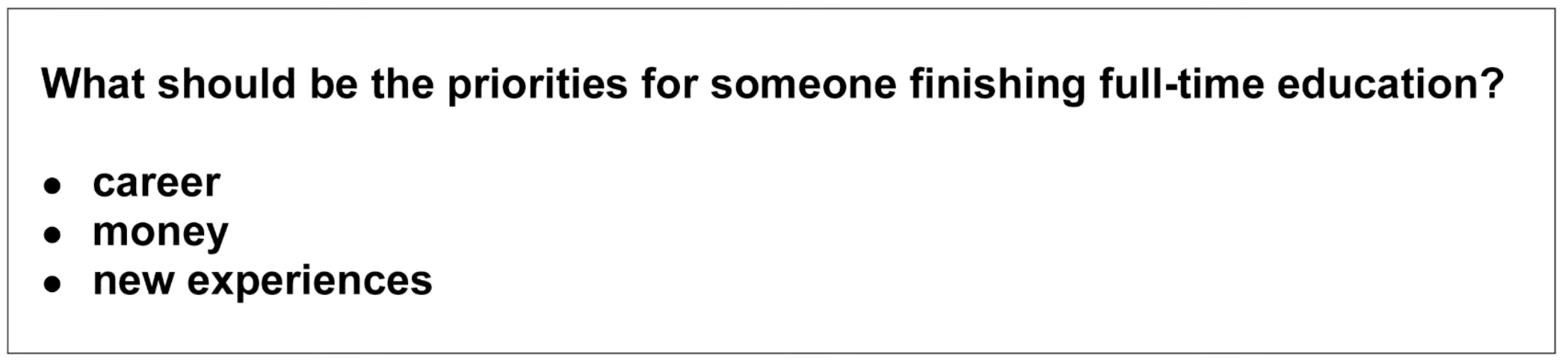
Jules (11:19-12:33): “So when studying full-time many things should be taken into consideration, for instance, making the most out of the time you’re studying, getting to know as much information and getting as comfortable as possible with the subject you’re learning. And it’s a great experience to - it’s a great way to get that experience and just have more open doors once you’ve finished studying.
As well another thing that should be really thought about is the new experiences that this might bring. For instance, having … creating new friendships and just getting to know new people and doing new things because you are not going to get bored because you’re learning new things and you might have many opportunities that you wouldn't (leave if?) otherwise.
As well just having and looking for that balance that we talked about with your personal space and your mental health and then just getting your work done and having some time management and just being productive once you’re studying - it’s something that should, as well, be really looked into.”
Comments: Jules relatively successfully organises and sustains a larger unit of discourse with little hesitation. However, she does rely on the word ‘and’ a great deal in this turn, using it as a verbal bridge - essentially a filler like "um" or "uh."
Throughout the exam, Jules struggles to use natural collocations. This C2 Proficiency speaking test sample, in general, illuminates the value of engaging in extensive study of English collocations related to education, life and living and work.
‘Get to know information’ feels unnatural as ‘get to know’ is almost exclusively used for people, places, or cultures. ‘Information’ is an abstract concept which you process or gather. A more viable alternative to ‘get to know information’ in the context of learning or discovering might be ‘gather information’ or ‘acquire information’.
Another unnatural collocation is ‘create friendships’. We tend to ‘create’ physical objects, systems or art, whereas relationships develop in a more organic way. Therefore, there are several highly specific collocations for what Jules wished to say, including build friendships and form friendships.
_______
Interlocutor to Thiago (12:36 - 12:41): How useful is it for students to take a year off after finishing their studies?
Thiago (12:41-13:26): “Well I’m of the opinion that students personally shouldn’t take a year off. I’m definitely not going to do so. I don’t think - I think some students might need it - to take a breather and relax a bit, especially since high school can be very stressful and they might be looking into their career options for university or whatever they decide to continue their studies with. But I also think that if you take a year off, you miss a lot of the momentum that you gain from high school and I think your entire life you do almost eighteen uninterrupted years of school and (you) that momentum is something that you can really learn to manage and I think carrying that forward and bringing that to university or wherever else - I think that’s very useful.”
Comments: A comprehensive and thoughtful response to the question from Thiago. His argument - related to losing momentum if one decides to take a gap year - is a convincing and thought-provoking one.
Once again, Thiago’s choice of vocabulary and expressions is entirely natural, e.g. take a year off, take a breather, momentum.
_______
Interlocutor to Jules (13:27): Do you agree Jules?
Jules (13:27-13:42): “I see his point but I beg to differ in some aspects. I do think for many people it is really important to get that year off because, in most cases, with 18 years old you usually don’t have a clear idea of what your life to be as - so it’s a great way.
Comments: Jules occasionally uses some less familiar phrases, in this turn “I beg to differ in some aspects.”
Again, Jules struggles when it comes to Grammatical Resource (“what you want your life to be as” sounds a bit clumsy. A better alternative would be … what you want to do with your life.
1c - Thiago:
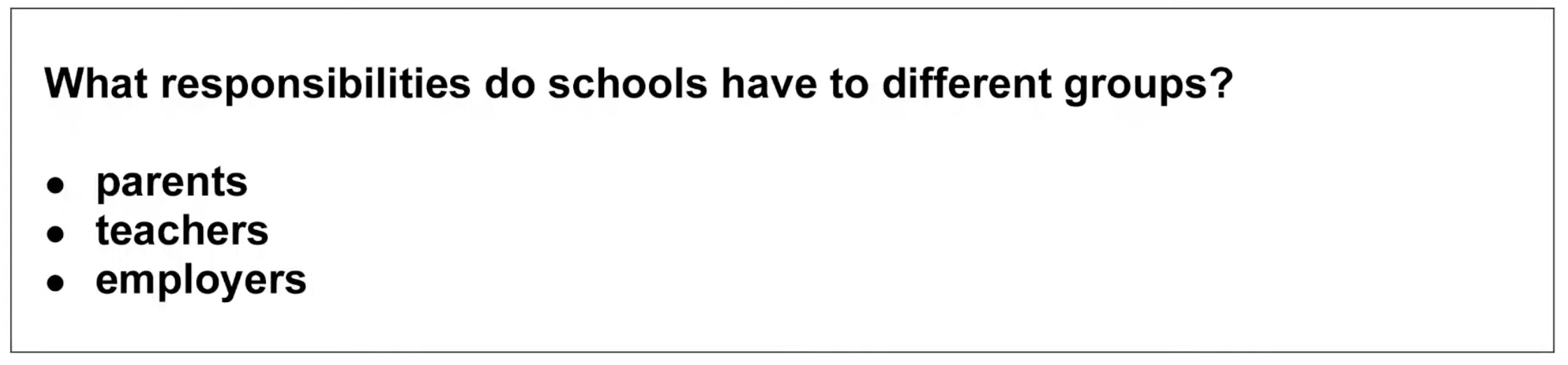
Thiago (14:05-16:02): “Well I think schools are very crucial in this day and age and more focus should be given to them since they carry out a very important task which is guiding the next generations and the future of our world. And inside the schools, I think that parents are entitled to knowing how their children are doing at school especially in grades because that’s something that they have direct access to and they can change or at least try to help their children in any way they can.
I also think that they should know about any behavioural patterns that their (their) kids might show at school or if there’s some misbehaviour then I think that’s something very important that parents especially are the main people that can help them.
Aside from that, I also think that teachers are perhaps the most crucial part in the school since they are the heart of the school essentially and they are the ones who really put into practice the model of the school and everything they stand for. I think that pay should be better for teachers since most of the times they are underpaid but I do not think that that should be their main priority or motivation. I think that should come more from their insides. Yes, and I think that being suited to guide students and teach them - that’s the most important thing, and the schools should really employ people who are fit to do that.
And lastly - also different employers and staff at the school … so, for example, the janitors - they play a very important role which is sanitising the school and also higher-ups - like directors - they should really be taken into consideration as well because what they do is very difficult and I think that they should be helped by people and - as much as they can be so if students have any way to help - or even fellow teachers - then I think that (that) should be done.”
Comments: First of all, Thiago made full use of the two minutes available to him. He utilised the supporting bullet points below the question on the card, meaning that his discourse was coherent. Discourse markers such as ‘aside from that’ and ‘lastly’ help connect and direct the flow of Thiago’s turn.
Thiago is able to successfully retrieve a range of expressions from his mental dictionary, such as ‘be fit to do something’, ‘in this day and age’, ‘behavioural patterns’ and ‘put something into practice’. He deserved the top mark he achieved for Lexical Resource.
_______
Interlocutor to Manuel (16:04-16:08): How much emphasis should be placed on physical education in schools?
Manuel (16:09-16:31): “Well I think currently not enough emphasis is put - is put on physical education and I think that is incredibly beneficial for students not only in their physical well-being but in their mental well-being for them to take part in physical activities and I think schools should really focus on that.”
Comments: A solid response from Manuel with further evidence of appropriate stress on words such as ‘enough’ and ‘mental’ for emphasis.
Regarding the part with “not only in their physical well-being but in their mental well-being”, Manuel could have added extra grammatical words (e.g. also) and lexical chunks (in terms of; when it comes to) to make the sentence more grammatically authority:
not only in terms of their physical well-being but also when it comes to their mental well-being
_______
Interlocutor to Thiago (16:33-16-34): What do you think Thiago?
Thiago (16:34-16:54): “Well I completely agree since I also think that many students might not have the same opportunities to practise sports or do exercise at home since they might be lacking space or even the equipment so I think that focusing at that in school where all students have equal chances to exercise and play sports - I think that’s very important.”
Comments: A few lapses from Thiago:
(a) It may be better to say ‘equal opportunities’ instead of ‘equal chances’ as ‘equal chances’ relates to luck and odds in a mathematical sense:
Both teams are evenly matched, so they have equal chances of winning the final
Conversely, ‘equal opportunities’ refers to a systemic setup where everyone is handed the same access, resources, and fair treatment to try and achieve a goal.
(b) Instead of “focusing at”, Thiago should have said ‘focusing on’.
Task (b) - Discussion
Interlocutor (17:01-17:05): “Now to finish the test, we’re going to talk about priorities in general.”
Interlocutor (17:08-17:12): Which areas of research should governments prioritise?
Thiago (17:13-17:41): “Well I think one of the most important is health since when running - basically running - a country I think that you need to prioritise the health of your citizens and seeing if (um) it’s safe for them to walk around, if they need to carry out any procedures before going out or in general researching possible illnesses or (thing) anything you can do to help them in that case I think should be done.”
Comments: Another example of how Thiago is willing to take the lead and indeed handle communication on whatever topic comes his way. He is able to share ideas on unfamiliar and abstract topics without any prior planning and with very little hesitation throughout his turns.
_______
Jules (17:41-18:04): “I completely agree. I do think not only on the physical side of health but as well the psychological help that many people might need. In general, creating a safer place might as well help to (to) create that safe environment so (it migh…) I do think it’s a really important area of investigation.”
Comments: It seems that Jules has little capacity to engage in self-expression. In this turn, she merely hears an idea, “completely” agrees and adds a bit of a twist to what Thiago says (i.e. the switch from physical health to psychological help).
_______
Manuel (18:04-18:32): “I completely agree. I think mental health is honestly one of the most important things that a government should put all of its focus on because especially in this day and age it is something that more and more people are struggling with and a lot of people need that help - they need that safe environment like you mentioned - and I feel (err) that governments don’t place enough emphasis on that and they should be doing that.”
Comments: As the test goes on, Manuel seems to be repeating the same old phrases, such as ‘put focus on’ and ‘place/put emphasis on’.
I also feel that Manuel missed the opportunity to change the course of the debate here. Jules had already responded to Thiago’s turn related to health research. Both he and Jules rely too much on Thiago to take the lead.
_______
Thiago (18:33-19:09): “I also think that government-funded facilities or transportation should be very important as well since … (um) while paying taxes - we don’t pay taxes yet but when we do we’re gonna pay for most of that (?) so everything from the trains to metro and buses, we’re gonna pay for that and I think the government should be responsible - and take into account all the possible routes that people might take or the accessibility of some certain areas because there are many areas which don’t have as much coverage for public transportation than others so ...”
Comments: Thiago had a little trouble organising and conveying his thoughts in this turn. He could have shortened the part from “while paying taxes … I think the government should be responsible …” thus:
… since people pay very high taxes. The government should recognise this fact and take into account all the possible routes …
_______
Jules (19:09-40): “I do see your point but I (I) also think it would be really important to (to like) investigate more ways to be environmentally friendly when talking about these public transportation and transportation in general as well in the private area and just (like) creating some help in order to, for instance, prioritise using bicycles or walking in order to create a more safer space, as we talked before about, on a health - because of the environment point of view.”
Comments: Jules uses a lot of words to say that the government should promote the benefits of walking and cycling from the point of view of the environment.
There is a lack of clarity in many parts of this turn:
- “in the private area” - what does it mean?
- “creating some help” - creating some help for who?
- “create a more safer space” - what is a "safer space"?
_______
Manuel (19:41-20:16): “Well (er) since you mentioned the environment, I already see a lot of environmental (um) measures - environmental friendly measures that have been takin_ (err) that (that) have been put in place (um) in regards to public transport such as electric cars and including also some restricting certain vehicle types at specific points of the week or the month allows (um allows) for a more environment friendly (erm) transportation system.”
Comments: First of all, notice how courteous Thiago was just before Manuel’s turn. Thiago nodded at Manuel to let him speak first.
Manuel mentioned measures have been put in place “in regards to public transport such as electric cars.” Electric cars are typically considered private transport rather than public transport. If you meant vehicles like electric buses or trains, it is better to specify. If you meant cars, it shouldn't follow the term "public transport".
Manuel’s turn here gets grammatically tangled. "Including also some restricting" uses two conflicting structures (an inclusive preposition and a gerund phrase) back-to-back. A parallel verb structure would help everything to flow much better:
... such as introducing electric buses and restricting certain vehicle types ...
The true subject of the second half of Manuel’s turn is the action of "restricting certain vehicle types" (singular). However, as he inserted a long descriptive phrase ("at specific points of the week or the month"), the connection to the verb ‘allows’ feels distant and awkward because "including" shifted the sentence's direction.
Finally, Manuel should have modified the adjective friendly with the adverbial form ‘environmentally’. ‘Environment’ is a noun.
A more polished version of Manuel’s turn could go like this:
"Since you mentioned the environment, I already see a lot of environmentally friendly measures that have been put in place in regards to public transport - such as adopting electric buses, as well as restricting certain vehicle types at specific points of the week or the month - which allows for a more environmentally friendly transportation system."
_______
Interlocutor (20:17-20:24): Some people say that loyalty to the family is more important than anything else. Do you agree?
Thiago (20:25-20:59): “Well I think family is very important. I think you should never cut ties with people who you are bound by blood to … and (if) especially if you have a loving family, I think that’s the most important thing of all - that your family has to accept you for who you are. But I also think that you should give space to other relationships and fields of interests (umm) I … think family should be one of your priorities - one of your main priorities - but not necessarily the first priority you have in mind, especially when you’re trying to grow as an adult and figuring out your career.”
Comments: In terms of discourse management, Thiago applies a “thesis-antithesis-synthesis” structure. He starts with a strong claim (family is important), offers a counter-perspective (you need space for other things), and concludes with a compromise (family is a main priority, but maybe not the first priority during early adulthood). Overall, this demonstrates admirable cognitive organization.
In terms of cohesive devices, Thiago makes good use of the word ‘especially’ to add emphasis and narrow down his points.
In terms of lexical resource, ‘cut ties’ is an excellent, high-level idiomatic expression meaning to end a relationship. ‘Bound by blood’ is a strong collocation.
One area for improvement in this turn concerns repetition. Thiago repeats the phrase “I think” four times (five times if we include “I also think”). Moreover, Thiago uses the word ‘priority’ three times in the final sentence. While it anchors the point, it feels somewhat redundant. He could have substituted it with words such as focus, concern, or preoccupation.
Overall, this turn is highly communicative and grammatically astute. Thiago successfully communities a nuanced, balanced opinion on a fairly complex social topic. There are some false starts and repetitions. However, they are entirely normal features of natural, unscripted human speech.
_______
Jules (21:00-21:17): “I completely agree. I don’t think being biologically related does mean you are - you need to be fully loyal but in cases where the relationship is great and you have good connections with the people in your family, I do think they should be taken into consideration and taken care of.”
Comments: Yet again, Jules relies on the same old phrases, such as ‘taken into consideration’. There is an apparent lack of clarity here as well as why would someone take a relationship or connection with family members into consideration? ‘Taking care of’ relationships/connections also sounds a bit redundant. More natural collocations include:
- invest in relationships/connections with your family
- protect relationships/connections with your family
- cherish relationships/connections with your family
_______
Manuel (21:19-21:43): “Yes, although I do believe, however, that if those relationships aren’t as great and if even maybe your family is causing you some sort of pain or you’re dealing with something and your family’s not there to support you, then I don’t think there’s a (uh - a) complete reason that you should be a 100% loyal to them.”
Comments: Yet again, Manuel is willing to offer counter-arguments rather than play it safe and agree with his peers. I consider his ability to think outside the box to be one of the most praiseworthy features of this C2 Proficiency speaking test sample.
In terms of discourse, Manuel should be credited for his use of cautious language. There are many “hedges”. These are words which soften the impact of a statement to avoid sounding too arrogant, absolute or aggressive. Words and phrases such as ‘although’, ‘even maybe’ and ‘some sort of’ act as cushions.
There is some grammatical redundancy with the phrase “Yes, although I do believe, however …” Using both ‘although’ and ‘however’ in a row is unnecessary as they do the same job when it comes to signalling a contrast.
_______
Thiago (21:44-22:06): “Yes, by all means I see your point, and I also think that you should strive for what’s best for you and so just (um) if you don’t feel accepted by your family or if you think that you would be better off somewhere else and if you’re being negatively affected by them, I think it’s best to take some time off and I’m not saying cut ties - I think, eventually, all can be worked out (um) hopefully - but yes take some space.”
Comments: In terms of grammar and syntax, the essence of Thiago’s turn relies on three-part conditional structure ("if... or if... and if...") which act as adverbial clauses that modify the main matrix clause ("I think it’s best to take some time off"):
- “if you don’t feel accepted by your family...” (Condition 1)
- “or if you think that you would be better off somewhere else...” (Condition 2, alternative)
- “and if you’re being negatively affected by them...” (Condition 3, cumulative)
_______
Scores
Manuel
Grammatical Resource: 5
Lexical Resource: 5
Discourse Management: 4
Pronunciation: 5
Interactive Communication: 4.5
Global Achievement: 5
Jules
Grammatical Resource: 3.5
Lexical Resource: 3.5
Discourse Management: 3.5
Pronunciation: 4
Interactive Communication: 3.5
Global Achievement: 3.5
Thiago
Grammatical Resource: 5
Lexical Resource: 5
Discourse Management: 5
Pronunciation: 5
Interactive Communication: 5
Global Achievement: 5
Are the scores justified?
First of all, Thiago’s scores are entirely justified.
As for Manuel’s scores, I would have been more inclined to give him a mark of 4.5 for both Grammatical Resource and Lexical Resource. I won’t go through the reasons for that as you may decide for yourself based on the comments I have made on his performance in this post.
Regarding Jules’ speaking assessment scores, she passed the C2 speaking standard. Band 3 represents a performance that fully meets the C1 level standard or demonstrates a baseline competence expected at C2. Given that Jules scored a 3.5 or higher across every single category, her performance sits comfortably between a standard and advanced C2 level. Frankly, I am quite amazed that she passed the speaking part of the C2 Proficiency exam.
Unlike Thiago and Manuel, Jules produced so few complex sentences. In terms of the Lexical Resource category, she overused some key phrases (e.g. I see your point and take something into consideration) and I disagree with the commentary released by Cambridge English that she displayed “some evidence of a wider range” of vocabulary.
When it comes to discourse management, it is true, as the examiners’ comments reveal, that Jules “produces extended language with very little hesitation.” However, she mostly relies on what the other speakers have said and shows little evidence of independent thinking. Most of the time, I have a feeling that Jules just speaks for the sake of speaking. Worryingly, some of her sentences don’t even make sense.
All in all, Jules merely pulled the wool over the eyes of the examiners due to her excellent pronunciation and fashionable upspeak at the end of every single clause. Such incessant upspeak is painful to listen to.
Final Thoughts - A Summary Checklist for C2 Success
If you are analysing this C2 proficiency speaking test sample to prepare for your own exam, bear in the mind the following takeaways:
- Do what Thiago does: Connect your thoughts directly to what your partner just said to score high in Interactive Communication.
- Avoid what Jules does in Part 2: Don't just say "I agree" and pass the microphone back. There is such a wide variation of speaking phrases for the C2 Proficiency exam you can use. Add a new perspective, a counter-argument, or an example to prove your depth of vocabulary.
- Do what Manuel does: Use your intonation. Don't speak in a monotone voice; use natural stress to highlight the core content words of your argument.
Extra
Enrol on my Full C2 Proficiency Preparation Course or my C2 Proficiency Speaking Preparation Course (discount available if you enrol before 30 September 2026):