
How to Improve Spoken English: 6 Effective Strategies
Why do so many English learners spend years studying grammar and vocabulary yet continue to struggle with natural, spontaneous communication?
The problem often lies in the way they process language. When speaking, learners who rely on constructing sentences word by word must consciously retrieve individual vocabulary items, apply grammatical rules and assemble everything into meaningful utterances. This is an incredibly slow and cognitively demanding process.
Fluent speakers, by contrast, have access to an extensive repertoire of multi-word expressions, commonly known as lexical chunks or formulaic sequences. Rather than constructing every sentence from scratch, they retrieve familiar combinations of words as relatively complete units, allowing them to communicate more naturally and efficiently.
In this article, I'll introduce six interconnected strategies to improve spoken English, drawing on principles of the Lexical Approach, cognitive psychology and my own experience as an English language teacher and language learner.
Introduction: Why do learners struggle to speak English fluently?
The ability to retrieve multi-word units automatically during conversation can substantially reduce the cognitive demands associated with constructing utterances from individual words. Rather than having to retrieve vocabulary, formulate grammatical structures and assemble sentences incrementally, speakers can draw on previously encountered sequences of language that are stored and retrieved as prefabricated units (Wray, 2002). This facilitates more efficient language processing and can contribute to greater oral fluency (Segalowitz, 2010).
Through repeated exposure, meaningful practice and frequent retrieval in communicative contexts, learners can gradually develop greater automaticity in the production of these sequences. This process can be understood in terms of the transition from declarative knowledge (conscious knowledge about language) towards proceduralised knowledge (the ability to use linguistic knowledge more efficiently and with reduced conscious effort). Within skill acquisition theory, DeKeyser (1997) describes how systematic practice can facilitate the proceduralisation and eventual automatization of previously effortful language processes. Although declarative and procedural memory represent distinct cognitive systems (Ullman, 2001), the development of fluent speech involves the gradual automatisation of linguistic processing rather than a simple transfer of every lexical sequence from one memory system to another.
Consequently, developing spontaneous spoken English requires more than an extensive knowledge of vocabulary and grammatical rules; it also requires the ability to access and produce frequently used lexical sequences rapidly and with minimal conscious effort. This post therefore explores a series of interconnected strategies designed to strengthen lexical retrieval, promote proceduralisation and develop the automaticity necessary for more fluent, natural and spontaneous communication.
Part 1 – Understanding the science of spoken fluency
What are lexical chunks?
A lexical chunk, also known as a prefabricated chunk and formulaic sequence (see Wray, 2002), has been defined by prominent applied linguists Lindstromberg and Boers (2008, p.7) thus:
a sequence of words which native speakers feel is the natural and preferred way of expressing a particular idea or purpose.
Lindstromberg and Boers' definition suggests that a wide range of combinations of different words can convey a specific message. In most cases, however, only one or two of these pairings are considered standard usage. Therefore, a native English speaker can understand the following: the clock is ticking, the minutes are ticking, the hands are ticking … but the phrase which has become the standard expression to say that there’s not much time left for something to happen is the clock is ticking. That is to say, the clock is ticking is a ‘chunk’.
When it comes to the main characteristics of a lexical chunk, Davis and Krzyszewska (2012, p.9) share the following:
a chunk is a word partnership; two or more words that stand together, usually with a key word, and are primed to have a specific meaning. Form and meaning are one. A chunk is simply a meaningful bit of language.
Davis and Krzyszewska (ibid.) support their definition by stating that the word ‘at’ has no exact meaning on its own yet it “comes alive” in chunks such as not at all, at the table, at five, at times.
Timmis (2015, p.26) defines a lexical chunk as “a frequent meaningful sequence of words that may include both lexical and grammatical words …”
He provides the example of the chunk to a certain extent, which contains a preposition and an article.
Are Formulaic Sequences essentially Lexical Chunks?
Although the two terms ‘lexical chunk’ and ‘formulaic sequence’ tend to be used interchangeably in language teaching, they represent marginally different perspectives with lexical chunks encompassing vocabulary building and formulaic sequences focused on broader cognitive processing.
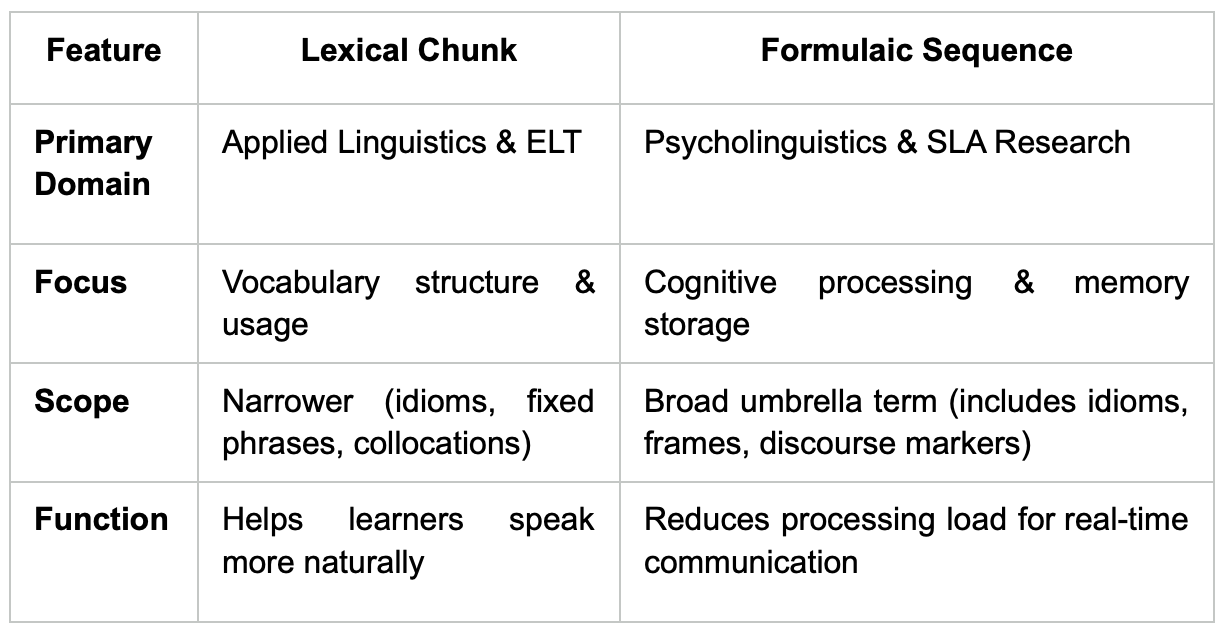
It would be unwise to overlook Wray’s (2002, p.9) definition of a ‘formulaic sequence’ due to its convincing emphasis on automatic retrieval during spontaneous conversation:
a sequence, continuous or discontinuous, of words or other elements, which is, or appears to be, prefabricated: that is, stored and retrieved whole from memory at the time of use, rather than being subject to generation or analysis by the language grammar.
Michael Lewis: “Language consists of grammaticalised lexis, not lexicalised grammar”
No study of lexical chunks is complete without referencing Michael Lewis’s 1993 book, The Lexical Approach. Indeed, in the opening pages of his work, Lewis (1993, p.vi-vii) outlines the main Principles and Implications of the Lexical Approach.
The first principle goes as follows:
Language consists of grammaticalised lexis, not lexicalised grammar.
Lexicalised Grammar - The Traditional Model
Lewis certainly flipped traditional language pedagogy on its head. The old model (lexicalised grammar) advocated a structural view of language learning whereby grammar is the foundation. With this abstract system of rules taking centre stage, vocabulary is merely passive raw material used to fill in the blanks.
When I taught in Bosnia in 2008-09, I had to teach according to a rigid lexicalised grammar framework due to the fact my Director of Studies favoured repetitive drills and memorisation over freedom of expression and the learning of multi-word units. I didn’t know it at the time but my students had to go through three sequential steps to generate even the simplest of thoughts:
1. Select the Structural Template:
Subject + Verb (Present Perfect Continuous) + Prepositional Phrase
2. Retrieve Isolated Words:
{"I","iron","for","two","hours"}
3. Apply Morphosyntactic Rules:
Apply present perfect continuous tense to "iron" (→ "have been ironing") and assemble:
"I have been ironing for two hours"
The grammatical syllabus sequences language strictly item-by-item with structures perceived to be “easy” to master coming at the start of a course/semester, while apparently more “complex” structures and tenses are taught at the tail end of a course/semester.
It may be the case that learners prefer a clear, predictable map of progression. However, no evidence exists to suggest that the acquisition of English occurs in a linear fashion. I have learners who’ve been exposed to the present simple tense for over 20 years yet they still overuse the present continuous tense.
With “lexicalised grammar”, i.e. the traditional model, language learners are expected to master abstract syntax rules and fit single vocabulary words into the slots like building blocks:

Grammaticalised Lexis - Lewis’s Model
In order to adopt my most favoured strategies to improve spoken English, you first of all need to take heed of the following model:

Essentially, drifting through the open expanse of a native speaker’s mind are thousands upon thousands of naturally co-occurring word patterns which are retrieved holistically without real-time grammatical assembly. To reiterate, the native speaker retrieves ‘chunks’ directly from memory, applying only slight grammatical tweaks if necessary.
In everyday conversation, speakers typically produce somewhere in the region of 120-160 words per minute, though this varies considerably by speaker, context and topic. Learners of English at all levels need to accept that building formulaic sequences piece by piece with the aid of grammar rules leads to slow, hesitant speech. This is not to suggest that grammatical processing disappears entirely when speakers use lexical chunks. Even highly fluent speakers continue to combine, adapt and modify formulaic sequences. The advantage is that they do not necessarily need to construct every element from scratch.
What are the various kinds of Lexical Chunks?
As pre-fabricated, multi-word sequences, lexical chunks come in a variety of forms. The first three types of lexical chunks listed below were categorised by Lewis (1997). Lewis (1997, pp.259-60) provided a fourth type - Sentence frames and heads. However, these are related to written/academic English and are therefore not a focus of this post. Types 4 and 5 below draw on other sources: sentence builders come from Nattinger and DeCarrico (1992), while binomials are a well-documented class of fixed pairs in the phraseology literature:
Type 1 - Polywords
The first type of lexical item Lewis (1997, p.256) outlines is Words and Polywords. However, as this essay is concerned with only lexical chunks as opposed to lexical items (which includes single words), I propose we identify the first type of lexical chunks as Polywords.
Polywords are short, fixed, uninterrupted phrases (usually two or three words) that have exactly the same status as single words or adverbs. They tend to have a degree of idiomaticity and are associated with a wide range of functions such as summarising, shifting topics and expressing speaker qualification of the topic at hand.
Polywords often have a single-word near-synonym. For instance, “in a flash” means much the same as “quickly”. Others, such as “so to speak”, have no neat single-word equivalent.
Examples:
up to now
by the way
sooner or later
for good
so to speak
in spite of
all at once
Willis (2003, pp.145-46) states that polywords may come in the form of or function as:
(a) verbs
- two-part verbs - verb + preposition (look at, work for) / verb + adverb (carry on, go away)
- three-part verbs (phrasal-preposition verbs) containing a verb, an adverb particle and a preposition - catch up with, get on with
(b) nouns
A large number of polywords act as nouns, particularly open compound nouns without hyphens such as washing machine and potato peeler.
Many technical terms are polywords: communicative competence, visual reaction time, autonomic nervous system.
(c) adverbials
- Time adverbials: last week/month/year; the other day/week; the day before yesterday; the day after tomorrow; next month etc.
- Place adverbials: over there; on the left/right; in the middle etc.
- Sentence adverbials: in fact; as a matter of fact; by and large etc.
(d) adjectives
There are polywords which function as adjectives: spick and span; black and blue; as old as the hills; tried and tested
(e) prepositions
in front of, next to, to the left/right of
(f) terms to express logical relations
in spite of, as a result of, owing to
Type 2 - Collocations / Word Partnerships
A collocation is “a combination of two lexical (as opposed to grammatical) words often found together or in close proximity.” (Timmis, 2015, p.24).
Examples of collocations include:
dire straits
make sense
heavy rain
unbearable heat
highly unlikely
Timmis (ibid.) follows up his definition with the following two key points:
a. If the pair of words is separated by an article, as in have a party, this still counts as a collocation.
b. Phrasal verbs such as carry out can be treated as one word, so carry out an experiment still counts as a collocation.
Many collocations are easily learnt. For example, the following words rather predictably collocate with dog: bone, kennel, bite and cat. However, there exist other collocations which do need to be learnt. Someone who knows the word strong and the word tea, for example, may not know that these two words frequently go together in English – that we talk about strong tea and weak tea.
When we compare the words tea and cheese, it’s plain to see the extent to which collocational restrictions can hinder the learner’s mastery of English. Although we talk about strong tea and weak tea, we prefer to use the words strong and mild to describe cheese.
Type 3 - Institutionalised Utterances
According to Lewis (1997, p.257), institutionalised utterances are “all those chunks of language that are recalled as wholes and of which much conversation is made.”
Chunks of this kind tend to be of sentence length, usually functioning as separate utterances. Proverbs, aphorisms and formulas for social interaction are all institutionalised expressions.
As Nattinger and DeCarrico (1992, pp.39-40) share, some institutionalised utterances may be:
general phrases used by almost everyone in the speech community (how do you do?, how are you?), while others may be more idiosyncratic phrases that an individual has found to be an efficient and pleasing way of getting an idea across (give me a break, have a nice day).
Examples:
nice meeting you
there you go
get a life
be that as it may
long time no see
That’ll do
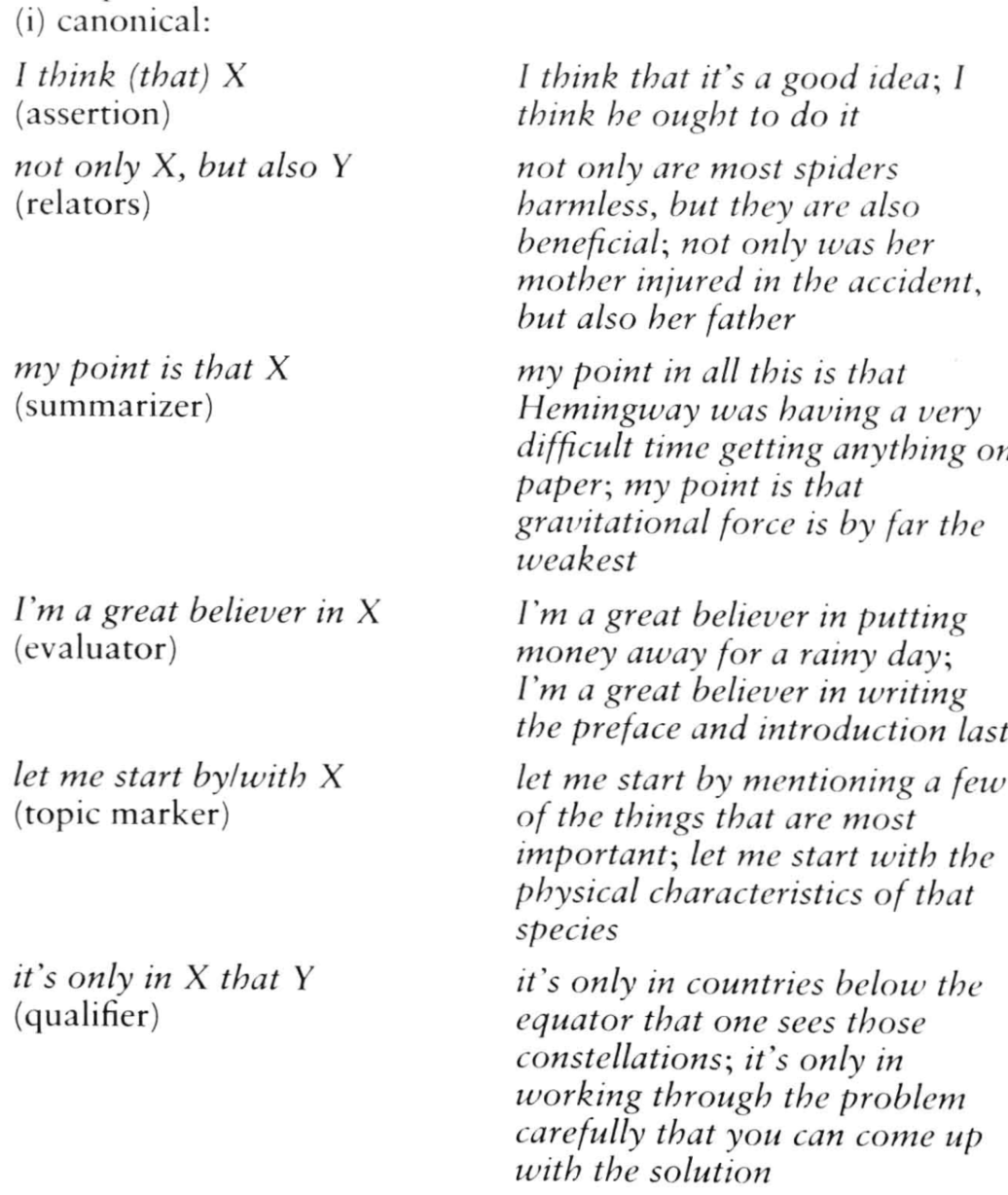
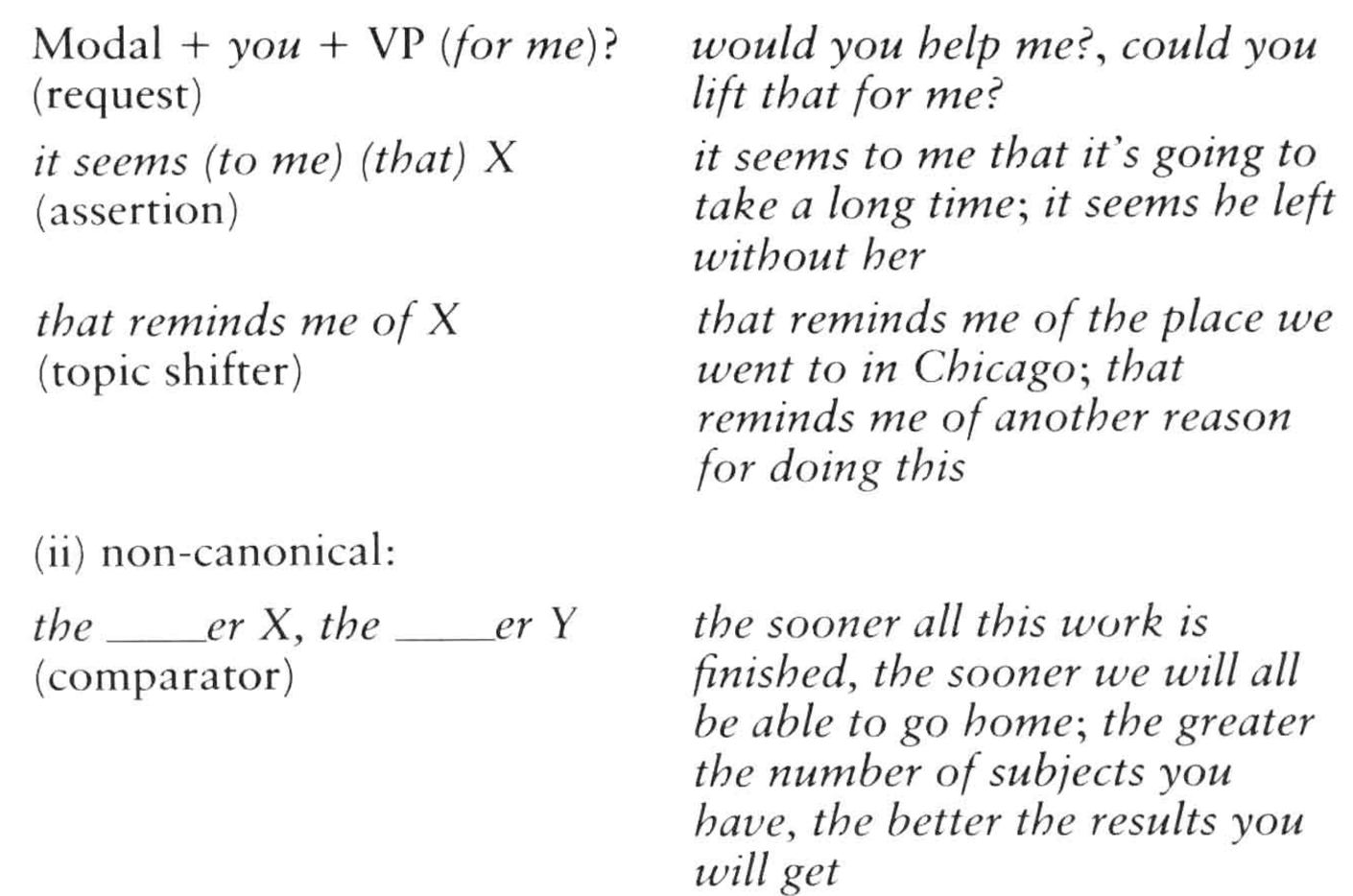
Type 4 - Sentence builders
As the name suggests, sentence builders are lexical phrases which provide the framework for whole sentences. Here are some examples provided by Nattinger and DeCarrico (1992, pp.43-44):
Type 5 - Binomial pairs
A binomial is a pair of words - typically adjectives or nouns - which are conventionally linked by a conjunction (usually and or or).
Many binomials are irreversible. This means that their word order is fixed - reversing the word order would sound unnatural to native speakers (e.g. rock and roll, never roll and rock).
Common types of binomials:
a. Synonyms / Near-synonyms - used for emphasis
- peace and quiet (calm and silence)
- pick and choose (select freely from available options)
- first and foremost (most importantly)
b. Antonyms and Opposites - show extremes or the entire range of a situation
- more or less (approximately; essentially)
- pros and cons (advantages and disadvantages)
- back and forth (moving one way and then the other)
c. Alliterative Binomials - both content words share the same initial consonant sounds
- safe and sound (unharmed)
- part and parcel (an essential part of something)
- slow and steady (consistent progress without hurrying)
- tried and tested (showed to be reliable through experience)
d. Rhyming words - catchy
- hustle and bustle (busy, noisy activity)
- fair and square (achieved honestly, without cheating)
- high and dry (be left helpless or without resources in a difficult situation)
Part 2 – Six strategies to improve spoken English
Understanding lexical chunks is only the first step when it comes to achieving fluent speech. This part how important it is for learners to adopt a systematic method of noticing, processing, storing and retrieving these multi-word combinations.
I believe that the intermediate/upper-intermediate learner needs to adopt the mindset of a young native speaker of English before implementing strategies to improve spoken English. This is because pre-literate native speaker children process lexical chunks/formulaic sequences of two or more words holistically (Boers and Lindstromberg, 2009:24). In other words, they don’t break down chunks into sequences of single words. Wray (2002: 206, 209) puts all of this into wonderful context by describing a native speaker’s first exposure to the collocation major catastrophe:
When a native speaker of English first came across the string major catastrophe in input, it would be noticed and remembered as a sequence, so long as context and pragmatics furnished it with a sufficiently clear meaning for it not to need breaking down. It would remain unanalyzed by default, that is, for as long as, when heard subsequently, the stored meaning was found satisfactory for a relevant and sufficient interpretation.
Consequently, the native speaker would know that the idiomatic way to describe a big disaster was to call it a major catastrophe. I think this is a good opportunity to present the first of our strategies to improve spoken English:
1. Make a list of common collocations with target words
Don't assume that 'major' means the same thing when paired with other words as it does in major catastrophe. It would be most unwise to single out 'major' as a separate component of the string major catastrophe.
Other natural-sounding collocations containing the word 'major' include major problem, major disaster and major breakthrough. However, 'major' doesn’t pair with several near-synonyms of “catastrophe” and related nouns. The main reason is that 'major' denotes relative importance and functions along a scale of intensity. Therefore, it tends to clash with nouns which denote complete destruction, extreme tragedies and formal/legal errors. For instance, 'major' sounds too weak with nouns such as carnage, devastation, or ruin which pair naturally with adjectives describing scope or totality (widespread, total, complete, unspeakable). When it comes to formal/legal errors, the collocation major blunder is infrequent. It is better to say “grave blunder” or “serious blunder”.
To reinforce the learning of the word 'major' and the kinds of nouns it collocates with, you could create a simple table like this:
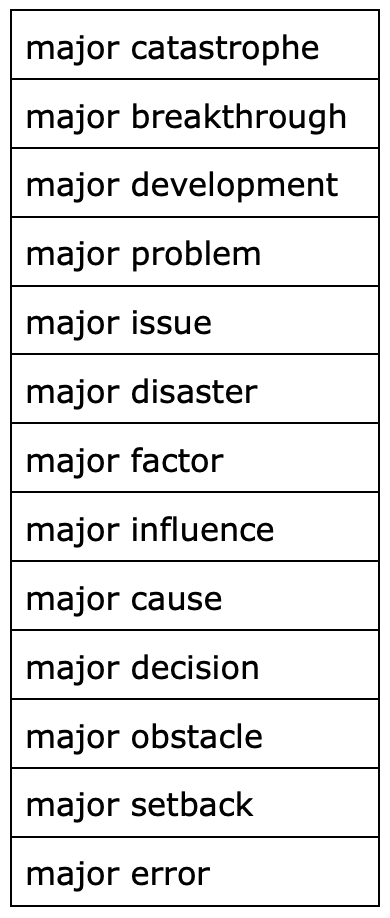
For extra context, you can add some example sentences below each collocation.
2. Prioritise quality over quantity
I’ve always advised my students to prioritise quality over quantity.
The four short texts below are part of a lesson plan on the topic of ‘workaholism’:
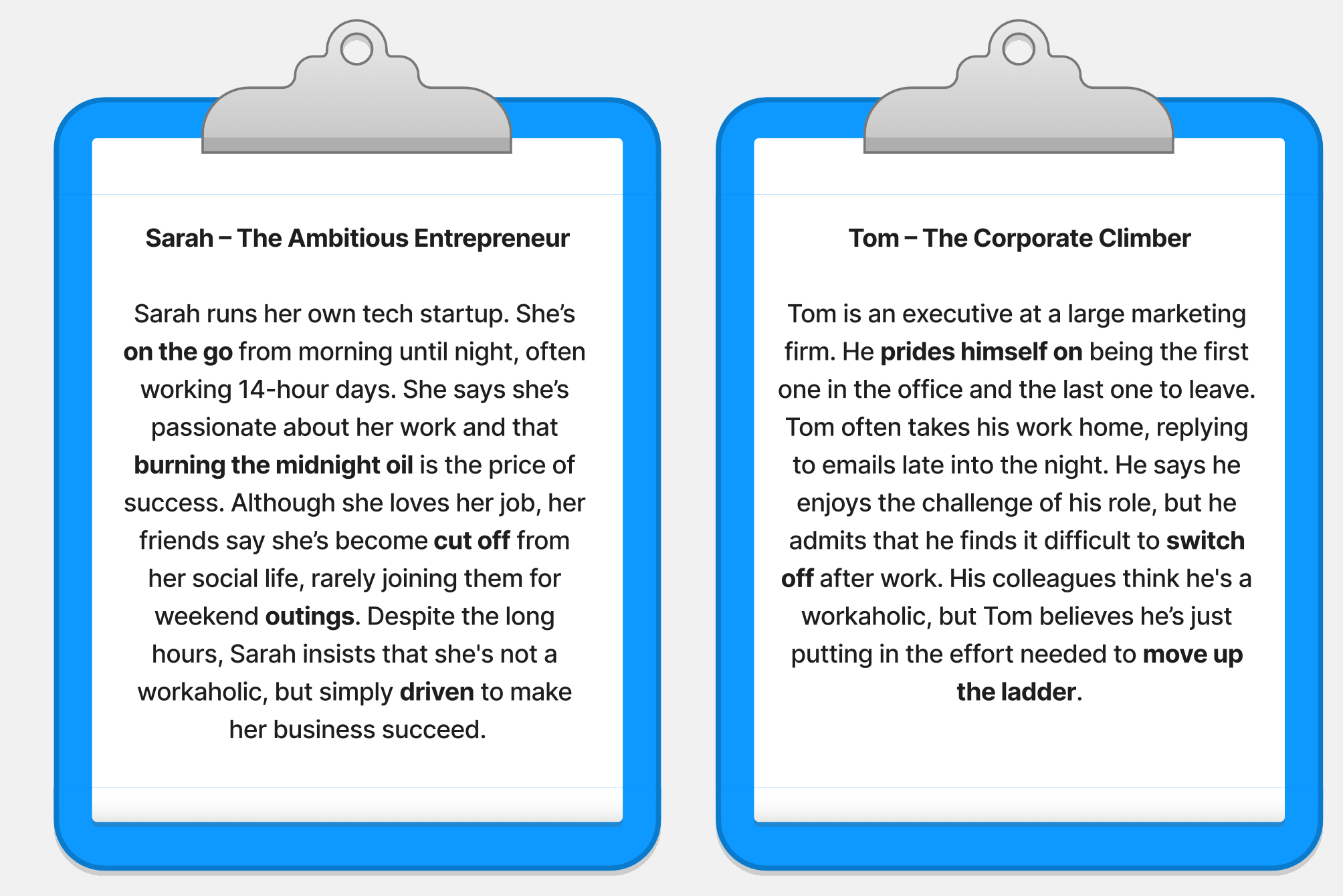
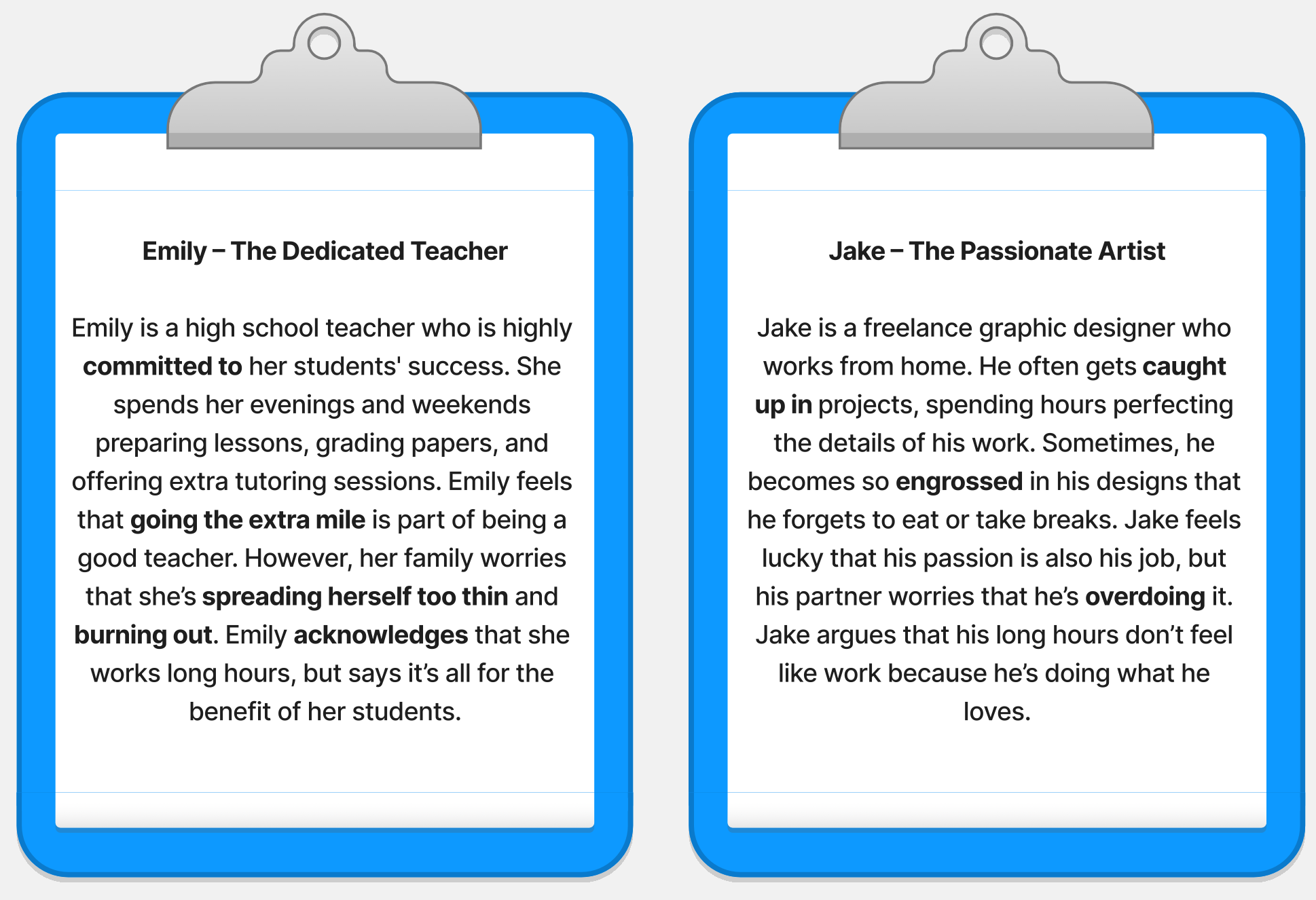
Just because idioms such as ‘burn the midnight oil’, ‘spread oneself too thin’ and ‘go the extra mile’ may be new to you, I believe they fall in the category of ‘handy if I acquire them incidentally, but not an absolute priority of mine’.
Some of the lesson plans I have designed with the aid of Figma in recent times have boasted up to 40 highlighted lexical chunks or words. However, it’s impractical to devote attention to so many formulaic sequences. Even 20 per lesson is too many."In my experience as a teacher, working with a maximum of seven lexical chunks per class is a manageable and productive approach. On the basis of having eight classes a month, that’s 56 lexical chunks a month. It is more than enough.
3. Deep-process new vocabulary and collocations
If you think you have come across a useful lexical chunk in your reading, it’s not enough to add it to a flashcard and expect it to move to your long-term memory and be automatically available when you speak English.
You need to acquire a wide range of lexical chunks in order to progress from an intermediate speaking level to an advanced level. It’s my contention that one of your starting points on your journey to improving your spoken English is the intensive study of chunks containing delexical verbs.
Delexical verbs and advanced delexicalisation
A delexical verb (or delexicalised verb) is a high-frequency verb such as have, take, make, give, go, or do that loses its literal meaning when paired with a noun. Instead, the noun carries the main meaning, while the verb merely acts as a grammatical vehicle (e.g., have a drink, take a bath, make an appointment).
As you begin to make that step up to an advanced or proficient speaking level, I recommend my students to focus on advanced delexicalisation. Advanced delexicalisation revolves around lower-frequency nouns and more complex noun phrases. Hence, more advanced speakers of English are able to use less predictable, more precise and contextually appropriate noun phrases alongside delexical verbs.
Examples:
- have a bearing on
- have an inkling
- take exception to
- do justice to
- make a commitment
- make an impression
- make a distinction
The deep learning of lexical chunks with the aid of a reputable corpus
Let’s imagine that you've come across the collocation ‘make an impression’ in your reading. The definition of ‘make an impression’ is “to have a strong effect on people or a situation, or cause someone to notice and admire you”.
Your next step should be to visit a reputable online corpus, such as the British National Corpus (BNC). For those of you who don’t know, a corpus is a large, structured collection of spoken or written texts that is used for language research.
Anyway, let’s head to the SEARCH function in the BNC and add the collocation ‘make an impression’:
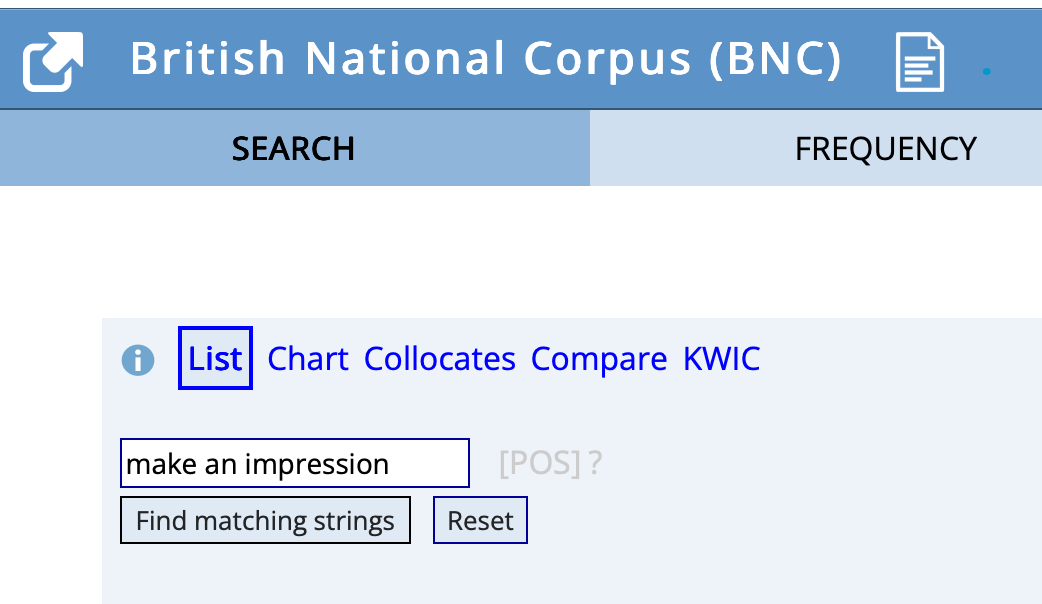
We have a frequency count of 42 in the corpus. Click on ‘MAKE AN IMPRESSION’:

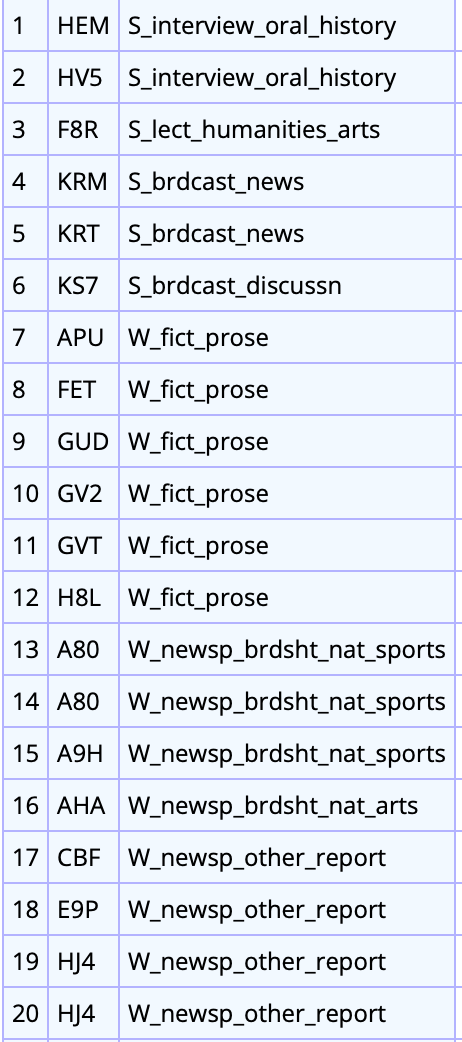
The third column from the left reveals how a text corpus gets its source materials from a wide variety of authentic written and spoken records. These include prose fiction, newspapers and radio interviews:
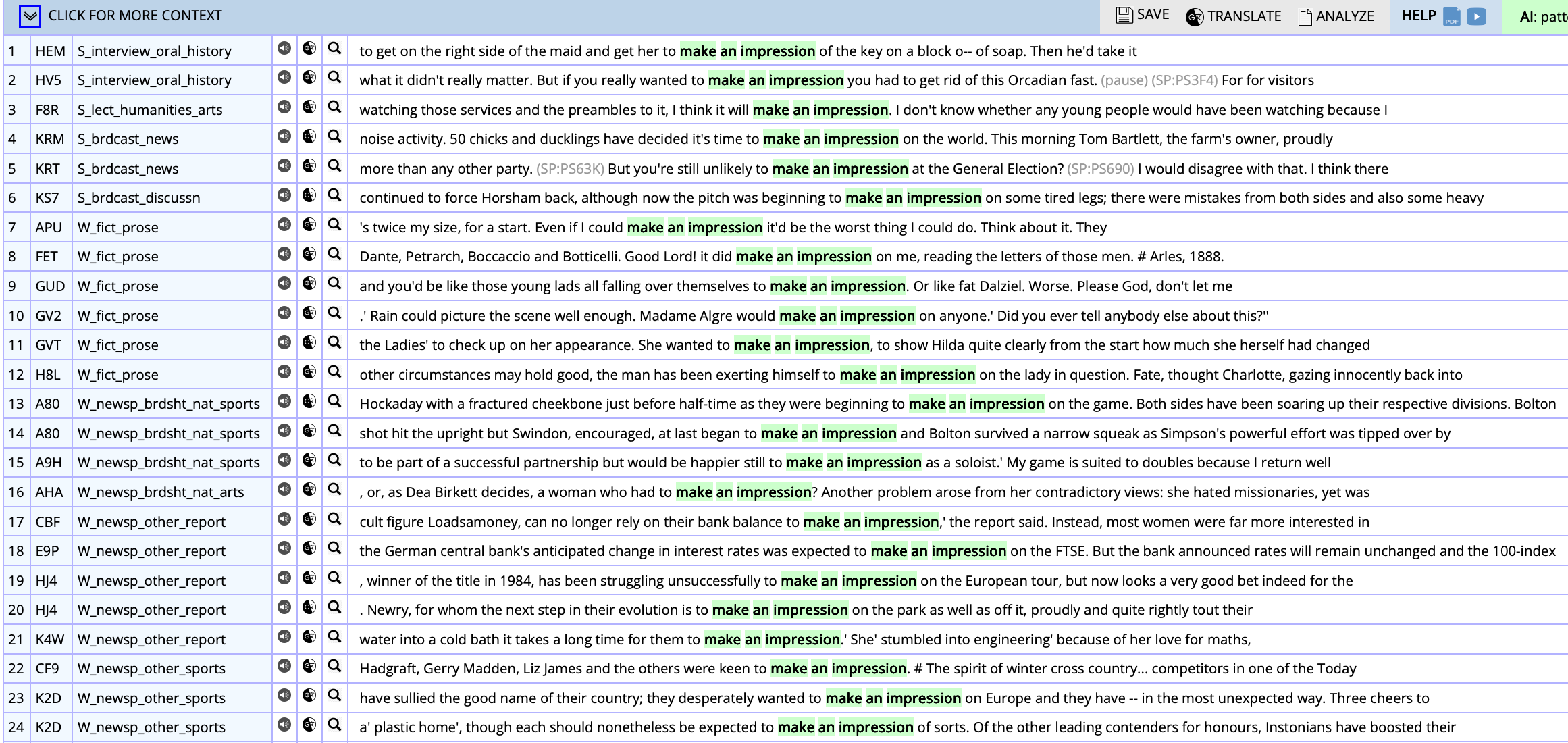
Clicking on ‘W_newsp_other_report’ in 19 brings up the following expanded context:
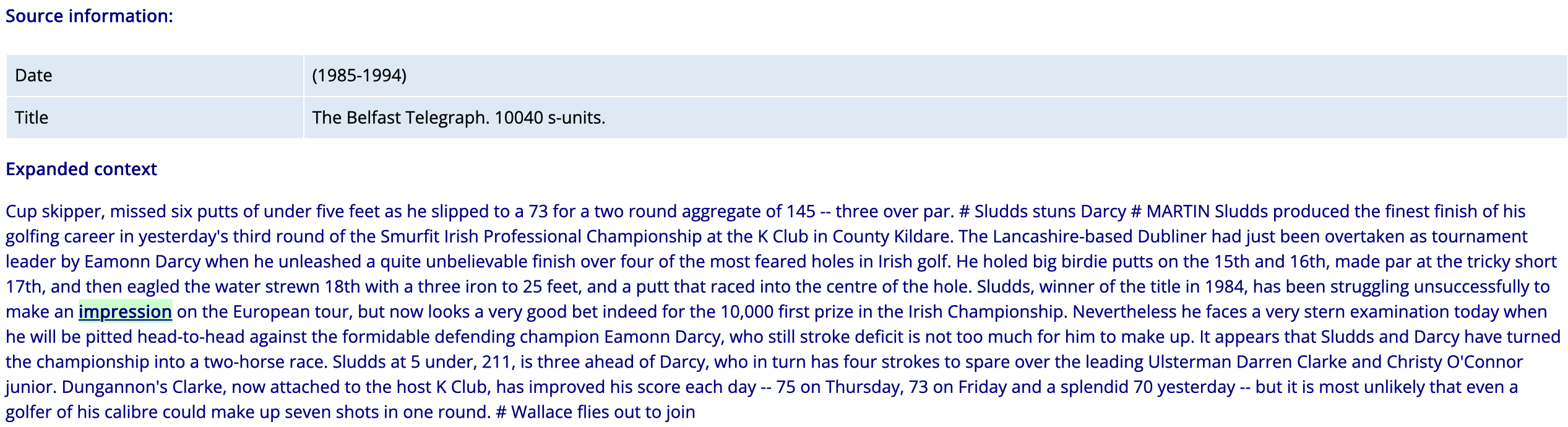
The fact the expanded context is related to golf is irrelevant. You are studying these corpora entries for their linguistic benefits.
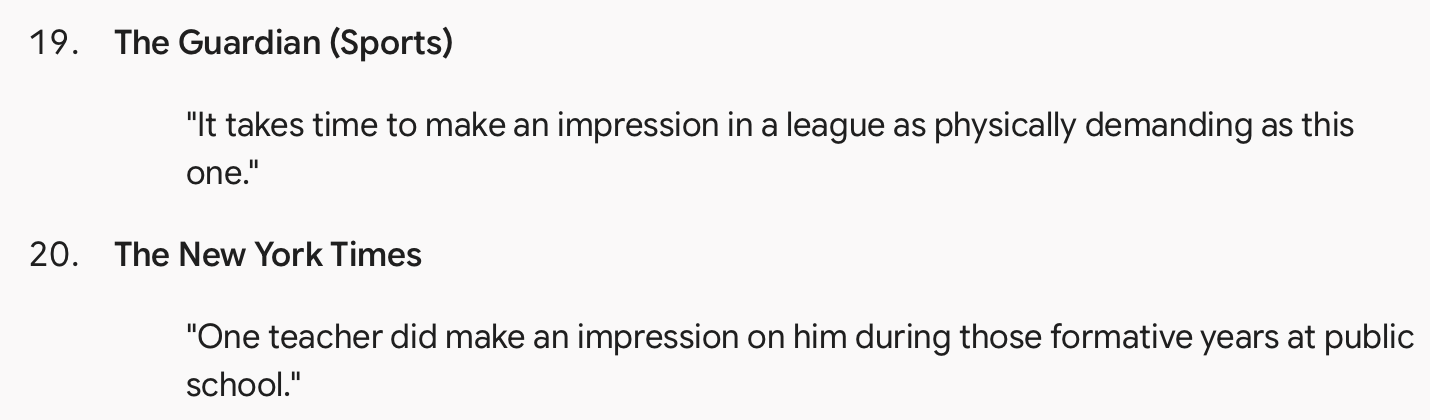
AI assistants may assist with the deep learning of lexical chunks
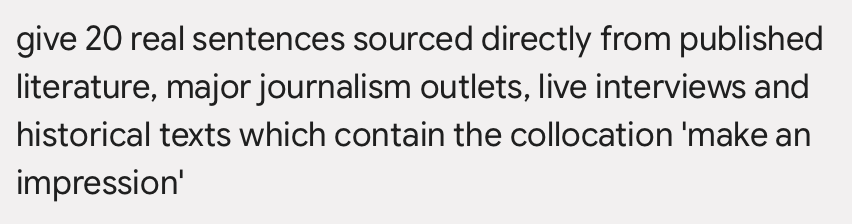
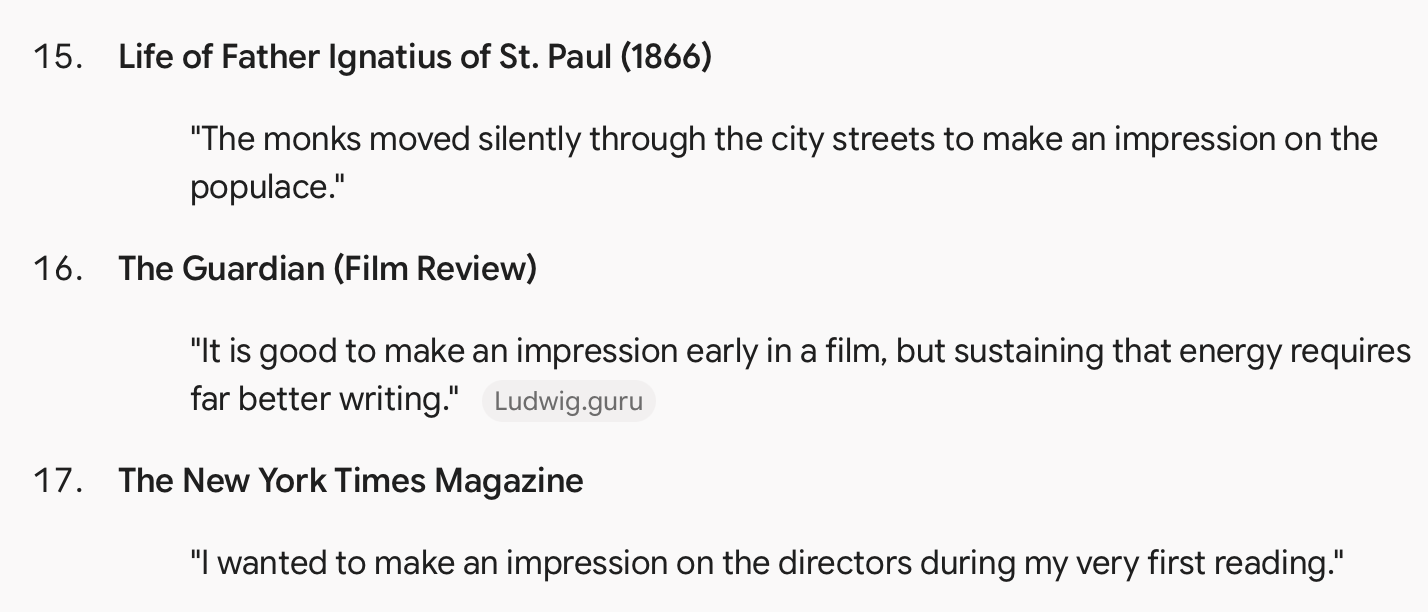
AI assistants such as Google’s Gemini certainly have their uses when it comes to the deep learning of lexical chunks:
4. Learn the grammatical patterns surrounding lexical chunks
As you can begin to read through all the sentences you have sourced from authentic materials, corpora or an AI assistant, I advise you to make a note of the constructions and prepositions that typically surround lexical chunks.
A. make an impression ON [someone/something]
Returning to our target chunk ‘make an impression’ once again. The most common prepositional construction is ‘make an impression ON [someone/something]’. This construction specifies the entity that experiences the cognitive or emotional effect:
Her speech made a deep impression ON the board members
B. make an impression WITH [means/tool/attribute]
If we are purely focusing on having an emotional impact on someone else, it’s also worth noting down the prepositional pattern ‘make an impression WITH’ to specify the action, quality or tool used to produce the effect:
She made a strong impression WITH her articulate presentation
The team made an impression WITH their relentless work ethic
C. Quantifiers for minimal or zero effect
We may use negative or limiting quantifiers with ‘make an impression’ to express that little or no effect was produced:
1. no (zero effect):
The aid coming in has made no impression on the horrific death rates
2. little vs little or no (barely any effect):
The board’s apology made little impression on her
The new policy made little or no impression on daily operations
5. Personalise new language to improve retention
In my experience learning a foreign language (Serbian) to advanced level, one of the most effective strategies I implemented was the Word-Phrase Table. In essence, I exploited the convenience of a Google Doc to record newly-learned Serbian words and lexical chunks, together with some of the typical grammar patterns and prepositions that commonly surround those target words and phrases:
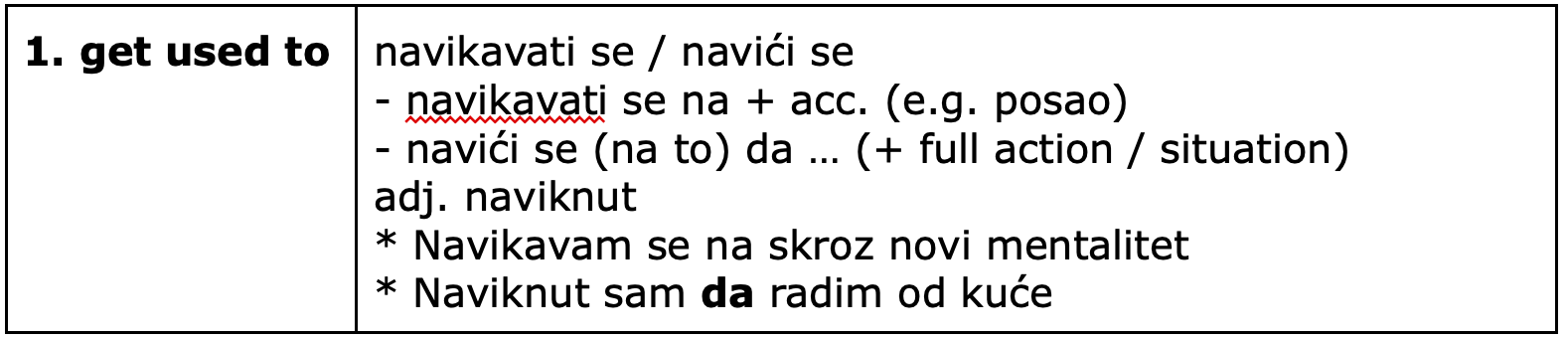
After a dash (-) I would record the most common grammatical patterns and constructions which go with the target lexical chunk. It’s also possible to add other parts of speech, e.g. adj = adjective.
After a star (*), I would add personalised sentences, i.e. statements, scenarios, or associations that directly reflected my own life, opinions, and experiences.
The two personalised sentences in the table above would have been tremendously significant in my life in the second half of 2014 as I moved to Novi Sad, in Serbia, in May that year:
Sentence 1 - * I’m getting used to a completely new mentality
Sentence 2 - * I’m used to working from home
The fact that there is a phenomenon in cognitive psychology known as the ‘Self-Reference Effect’ suggests that the personalisation of lexical chunks is among the most valuable strategies to improve spoken English. In cognitive psychology, the Self-Reference Effect describes how the memory retention of individuals improves if information relates personally to them. Indeed, personalising lexical chunks ensures that there is plenty of mental imagery and emotional context which can only facilitate the acquisition process.
6. Use high-quality repetition and retrieval practice
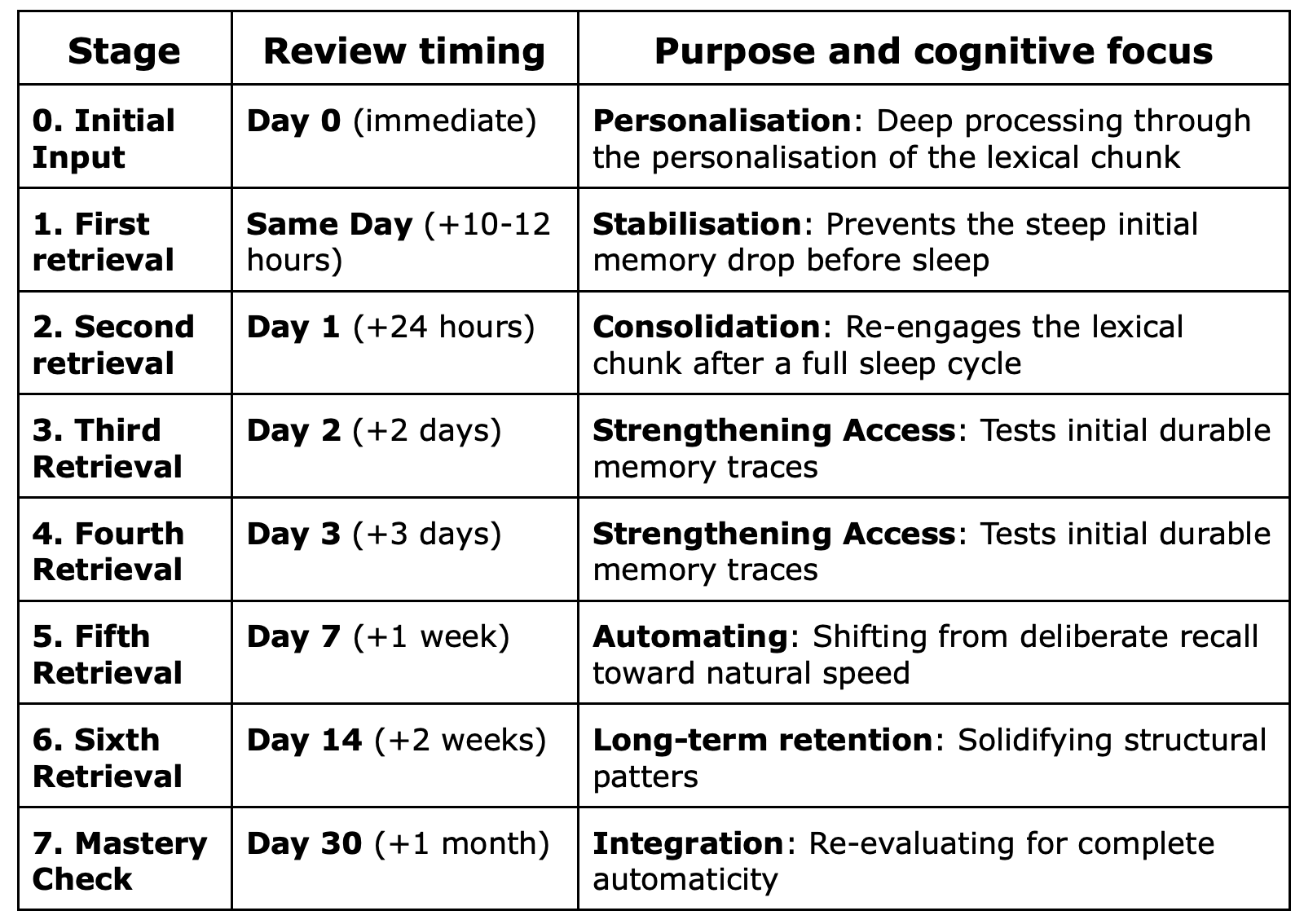
As you begin to create more flashcards or add entries to your Word-Phrase Table, you need to engage in high-quality repetition to keep lexical chunks and personalised sentences top-of-mind so you can retrieve them automatically when speaking.
I personally recommend the following spaced repetition schedule to ensure initial deep processing and regular re-evaluation for complete automaticity:
There is also the question of whether you should read the chunks, extra grammatical information and personalised sentences aloud, in silence or by whispering.
In cognitive psychology, the 'production effect' demonstrates that saying or mouthing a word creates a stronger memory trace than reading it silently. Producing language aloud, even at a whisper, encourages learners to move beyond passive recognition and engage in active retrieval. By articulating words and phrases, learners involve additional cognitive and motor processes that may strengthen memory encoding and make familiar language more readily accessible.
I am a strong proponent of whispering material. When I was learning Serbian all those years ago, I realised from the get-go that whispering left a much stronger memory trace. However, there is insufficient evidence to suggest that whispering itself offers a memory advantage over normal spoken production.
The interconnected series of strategies to improve spoken English I have put forward in this post have one main goal - to process lexical chunks as single units. I believe that whispering lexical chunks, such as “at the end of the day” and “take something for granted” forces you to naturally group words into meaningful breath groups whereby you apply rhythm, stress patterns, the schwa sound and connected speech. This is particularly the case for the multi-word unit ”at the end of the day” which contains several function words (e.g. articles and prepositions) with vowel sounds that are reduced to schwa.
Part 3 – Putting the strategies into practice
The set of six interconnected strategies in part 2 does come with suggestions to put the strategies into practice. However, here is a more complete practical implementation guide to show you exactly how to integrate the strategies into your daily learning routine.
1. A practical daily routine for improving spoken English
You don't have to spend hours studying vocabulary. Consistency is more vital. You should dedicate a relatively short period each day to acquiring, processing, retrieving and using new multi-word combinations. I'd personally recommend a 20-minute routine.
Your daily 20-minute fluency routine
a. Review previously acquired language
5 minutes
Revisit expressions from previous sessions. Cover the definitions or example sentences and try to recall the expressions from memory. Say them aloud and construct new sentences.
b. Acquire new lexical chunks
5 minutes
Select five to seven useful expressions from authentic sources, such as podcasts, articles, TED talk transcripts, interviews or conversations. Record them in context rather than simply writing down individual words.
c. Personalise the expressions
5 minutes
Construct sentences that relate to your own life experiences, opinions and circumstances. Attempt to incorporate different grammatical structures and collocations.
d. Practise spontaneous retrieval
5 minutes
Choose a topic and speak about it without reading from your notes. The main aim of this exercise is to incorporate the expressions you've studied. Record yourself occasionally and identify which expressions you can retrieve naturally.
Notes:
The objective of this daily fluency routine isn't to memorise five expressions every day and then forget them. It's to gradually build an extensive repertoire of readily accessible language that can be retrieved and adapted during spontaneous conversation.
Freely repeat the routine five or six days a week if seven days is too demanding for you.
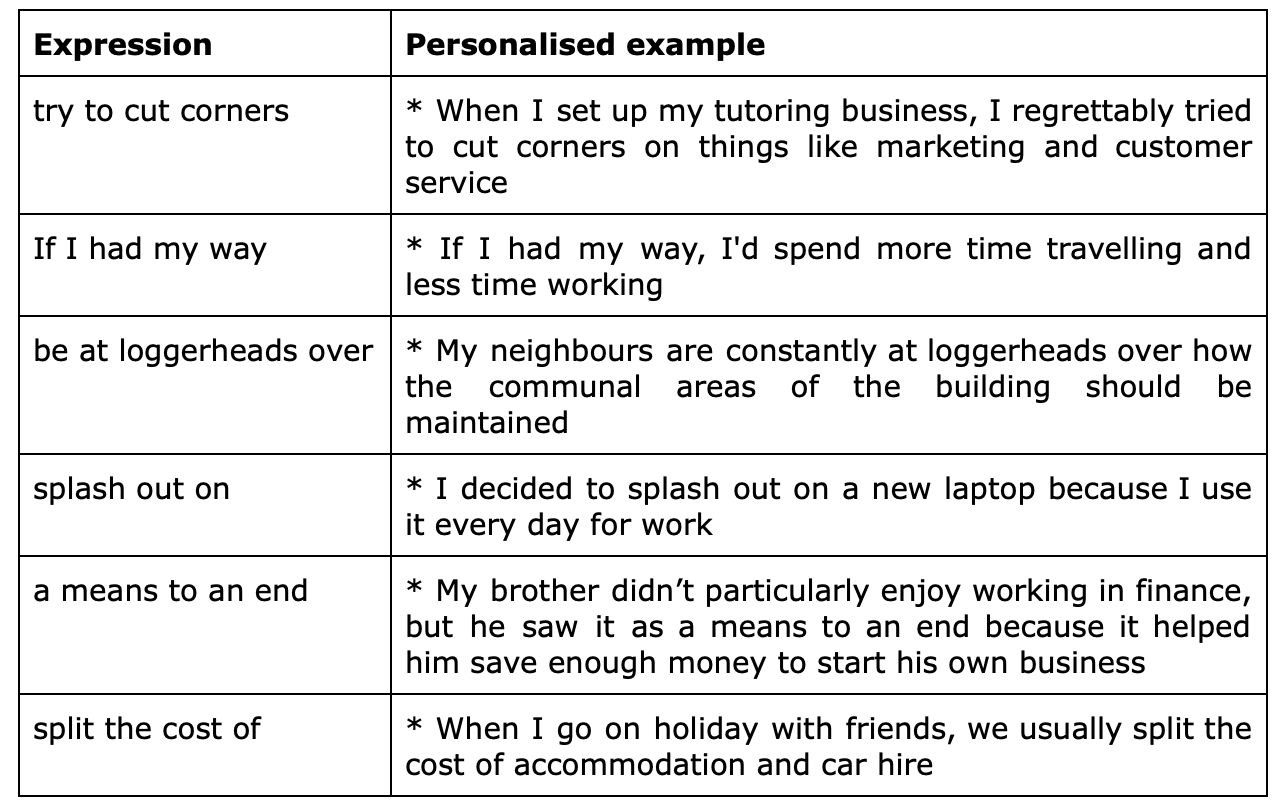
2. How to Build and Maintain a Word-Phrase Table
As an extension to strategy 5 in part 2 above, allow me to show you how to maintain a personalised record of useful lexical chunks, collocations, grammatical patterns and conversational expressions in a Word-Phrase Table.
(a) Pick out five or six expressions from an authentic source:
Article about cutting costs when travelling
(b) Example Word-Phrase Table
How to maintain your Word-Phrase Table:
- Record complete expressions rather than isolated vocabulary items.
- Include authentic examples and personalised sentences.
- Highlight grammatical patterns and typical collocations.
- Group expressions by topic or communicative function.
- Regularly revisit older entries and test your ability to retrieve them.
Don't feel that you have to treat the Word-Phrase Table as a vocabulary collection that grows indefinitely. As circumstances may change in your personal life or work life, freely remove expressions that are irrelevant, redundant or unlikely to be useful.
3. How to measure improvements in speaking fluency
Final Thoughts
When it comes to developing spoken English skills, the importance of the automatic retrieval of multi-word combinations cannot be overestimated. To put things into perspective, a study by Erman and Warren (2000), which aimed to determine the average proportion of multi-word composites (‘prefabs’) in various text types, revealed a density of multi-word combinations in spoken discourse of 58.6%. Of course, their research does not establish that exactly 58.6% of every conversation consists of chunks. Other studies I have found (Foster, 2001; Biber et al., 1999) report lexical chunk densities of around 30–45%.
Selivan (2018, p.4) neatly sums up the essence of fluency in connection with the knowledge of chunks:
… it is much quicker to process a few larger units (chunks) than a lot of smaller ones (words).
Selivan provides the example of the chunk I haven’t seen you for ages. Fluent speakers recall this chunk as a whole unit, rather than going through a series of lexical and grammatical choices every time they bump into an old friend in order to assemble the phrase word-by-word. Fluency essentially means the “fast processing” of chunks of language (Selivan, 2018, p.4). Moreover, according to Selivan (ibid.):
Freeing up processing energy allows more time for speakers to plan what to say next.
Ultimately, improving spoken English is not simply a question of learning more vocabulary or mastering increasingly complex grammatical structures. It is about developing the ability to retrieve familiar combinations of words quickly, accurately and appropriately. The more effectively learners notice, process, personalise and retrieve these combinations, the less they need to rely on conscious sentence construction and the more naturally they can communicate.
Ready to break through from the intermediate plateau?
Ready to take your spoken English to the next level? With personalised coaching, I'll help you develop greater fluency, expand your active vocabulary, and use advanced language more naturally and confidently in real-life conversations.
Bibliography
Biber, D., Johansson, S., Leech, G., Conrad, S. and Finegan, E. (1999). Longman Grammar of Spoken and Written English. Harlow: Longman.
Boers, F., and Lindstromberg, S. (2009). Optimising a Lexical Approach to Instructed Second Language Acquisition, Basingstoke (Hampshire, UK): Palgrave Macmillan
Davis, P., and Krzyszewska, H. (2012). The Company Words Keep: Lexical chunks in language teaching, Stuttgart: Delta
DeKeyser, R. M. (1997). Beyond explicit rule learning: Automatizing second language morphosyntax. Studies in Second Language Acquisition, 19(2), 195–221
Erman, В. & Warren, В. (2000) 'Тhе idiom principle and the ореп choice principle', Text, 20 (1), рр.29-62.
Foster, P. (2001). Rules and routines: A consideration of their role in the task-based language production of native and non-native speakers. In Bygate.M, Skehan, P., and Swain, M. (eds), Researching Pedagogic Tasks. Harlow: Longman.
Lewis, M., (1993). The Lexical Approach: The State of ELT and a Way Forward, London: Commercial Colour Press
Lewis, M. (1997). Pedagogical implications of the lexical approach. In Coady.J., and Huckin, T., (eds), Second Language Vocabulary Acquisition. Cambridge: Cambridge University Press
Lindstromberg, S., and Boers., F. (2008). Teaching chunks of language: from noticing to remembering, Cambridge, UK: Helbling Languages
Nattinger, J.R., and DeCarrico, J.S. (1992). Lexical Phrases and Language Teaching, Oxford: Oxford University Press
Selivan, L. (2018). Lexical Grammar: Activities for teaching chunks and exploring patterns, Cambridge: Cambridge University Press
Segalowitz, N. (2010). Cognitive Bases of Second Language Fluency, Routledge: New York
Timmis, I. (2015). Corpus Linguistics for ELT: Research and Practice, Abingdon: Routledge
Ullman, M. T. (2001). The declarative/procedural model of lexicon and grammar. Journal of Psycholinguistic Research, 30, 37–69
Willis, D. (2003). Rules, Patterns and Words: Grammar and Lexis in English Language Teaching, Cambridge: Cambridge University Press
Wray, A. (2002). Formulaic Language and the Lexicon, Cambridge: Cambridge University Press